Pionex fee rebate with code FEEOTTER: 50% (15% automatic + 35% extra from Fee Otter), 2.5x a typical 20% code. Fees, grid bot maths and the 14-day rule.
Sign up on Pionex with Fee Otter's code FEEOTTER and bind your UID, and your fee rebate is 50% (15% automatic from the exchange + 35% extra from Fee Otter) on spot and futures alike, 2.5 times a typical 20% referral code (checked October 2026). On 1,000 USDT of monthly futures fees, a typical 20% code returns 200 USDT while FEEOTTER returns 500 USDT, or 3,600 USDT more a year.
Pionex is known for its free built-in trading bots: grid, DCA and other bots carry no subscription fee and pay only normal trading fees. A bot can fill dozens of orders a day, so the fee base is large: double the rebate rate and you get double the money back. Below are the fees, the rebate rate, volume scenarios and a grid-bot example.
After the rebate, the futures taker cost is 0.05% × (1 − 50%) = 0.025%; with a typical 20% code it is 0.05% × (1 − 20%) = 0.04%. The 0.02% futures maker fee is halved, to an effective 0.01%.
How is the Pionex rebate calculated?
Rebate = the fees you actually paid × your rebate rate. The Pionex rebate comes in two parts: 15% is returned automatically by Pionex, and the other 35% is settled daily by Fee Otter, with spot and futures counted separately:
Futures: 50% (15% automatic from the exchange + 35% extra from Fee Otter).
Spot: also 50%, split the same way.
Trades that do not count: under the Pionex affiliate programme rules, stock-token spot and MEME trades generate no referral commission, so those fees fall outside the rebate.
On the same futures fees, our code returns 2.5 times what a typical 20% code does. On 500 USDT of monthly futures fees, a typical code returns 100 USDT and ours returns 250 USDT. A referral code cannot be changed once bound, so the code you pick decides what comes back on every trade after that.
Rebate rates: one rate per exchange
Fee Otter has one rate per exchange. For Pionex it is 50% (15% automatic from the exchange + 35% extra from Fee Otter); see how fee rebates are settled. Live rates:
Rebate rate by exchange
Exchange
Auto-rebate
Extra rebate
Total
Pionex
15%
35%
50%
Binance
20%
20%
40%
OKX
20%
20%
Bybit
—
40%
40%
Gate
20%
50%
70%
Bitget
20%
30%
50%
MEXC
20%
40%
60%
BingX
45%
0%
45%
KuCoin
60%
0%
60%
Bitfinex
6%
0%
6%
WEEX
60%
10%
70%
XT.COM
60%
10%
70%
HTX
30%
20%
50%
CoinW
60%
0%
60%
Ourbit
50%
20%
70%
Every rate here is fee paid straight back to you. It excludes VIP fee tiers and platform-token discounts such as BNB or GT; those stack on top and only save you more.
If you are already a VIP on an exchange and want to rebind or sign up on another exchange, contact support: we can help you apply for special trading benefits or a higher rebate rate.
How much comes back? Five volume scenarios
Using Pionex perpetual rates (maker 0.02%, taker 0.05%) and assuming 70% taker and 30% maker, the blended rate is 0.041%:
Monthly futures volume
Monthly fees
Typical 20% code
Fee Otter (50%)
100,000 USDT
41 USDT
8.2
20.5
500,000 USDT
205 USDT
41
102.5
2,000,000 USDT
820 USDT
164
410
5,000,000 USDT
2,050 USDT
410
1,025
10,000,000 USDT
4,100 USDT
820
2,050
At 5,000,000 USDT of monthly futures volume, a typical 20% code returns 4,920 USDT a year while ours returns 12,300 USDT, 7,380 USDT more.
Grid bot example: the bot is free, the fees are not
Pionex's built-in grid, DCA and other bots charge no subscription, but every order they place pays the normal trading fee (see the official Pionex blog). A grid buys low and sells high over and over inside a range; each completed cycle is two fills, one buy and one sell, so volume adds up fast.
The table below uses a futures grid, assuming a fixed order size per grid, a fixed number of buy-sell cycles per day and a 30-day month. Grids fill mostly as resting limit orders, so it uses the 0.02% maker rate:
Scenario
Monthly volume
Monthly fees
Typical 20% code
Fee Otter (50%)
100 USDT per grid, 20 cycles a day
120,000 USDT
24 USDT
4.8
12
200 USDT per grid, 25 cycles a day
300,000 USDT
60 USDT
12
30
500 USDT per grid, 40 cycles a day
1,200,000 USDT
240 USDT
48
120
The arithmetic: 200 USDT per grid × 2 fills × 25 cycles × 30 days = 300,000 USDT, × 0.02% = 60 USDT. If some fills are taker, fees are higher and so is the rebate. A spot grid pays 0.05%: the same 300,000 USDT of monthly volume costs 150 USDT, and the 50% rebate returns 75 USDT.
Bot users are the most likely to underestimate fees: the bot is free, but it trades around the clock. The large grid above pays about 2,880 USDT in fees a year; a typical 20% code returns 576 USDT and ours returns 1,440 USDT.
A DCA bot buys in instalments at set intervals and fills far less often than a grid, so its fees and rebate are comparatively small; the fee-heavy bots are grids, futures grids above all. If you run several grids at once, add up their rows in the table to get your real monthly fees and rebate.
Compare after the rebate: Pionex's effective futures rate
The rebate rate alone doesn't tell you the cost; compare the effective rate after the rebate. Using the same blended mix (70% taker, 30% maker) and each exchange's rebate rate when bound through Fee Otter:
Exchange
Blended list rate
Rebate rate
Effective rate after rebate
Pionex
0.041%
50%
0.0205%
Bitget
0.048%
50%
0.0240%
Binance
0.041%
40%
0.0246%
Bybit
0.0445%
40%
0.0267%
After the rebate, Pionex's effective futures rate is below Bitget, Binance and Bybit; add the low 0.05% spot rate and free bots, and the overall cost is very competitive for bot users. The full comparison across exchanges is in fees and rebates compared (OKX, a 20% auto-rebate + exclusive rewards, is left out of the table).
How is this different from a typical KOL referral code?
Under the Pionex affiliate programme rules, a referrer decides how much of their commission to pass to invited friends as a fee discount, and may pass on nothing at all. So "I used a referral code" says nothing about how much comes back; that depends on what the referrer chooses to share.
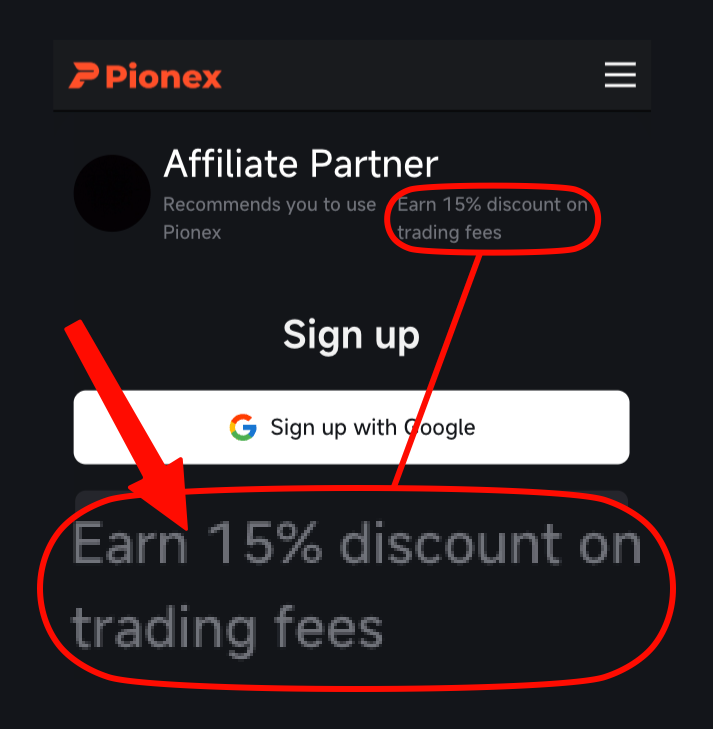
Our code has 15% set on the code itself, so Pionex's sign-up page shows "Earn 15% discount on trading fees"; bound through Fee Otter, you get another 35% on top, 50% in total; the rates are shown publicly on the rebate site and every line item can be checked.
How to open a Pionex account and bind it
Use the button below to open Pionex's signup page, register with an email or phone number (Google and Apple sign-in are also supported) and enter the verification code (valid for 5 minutes).
At the password step, check that the referral field already shows FEEOTTER before submitting; it cannot be changed afterwards.
Log in, turn on two-factor authentication and complete KYC. Pionex LV.1 asks for your country of residence and full legal name; LV.2 requires an ID document and a liveness check. Pionex recommends completing KYC and Google Authenticator before running bots (see the official Pionex signup guide).
Note your Pionex UID and bind it on the Fee Otter rebate site. Binding needs only the UID, with no API key or password.
Start trading, by hand or with bots; the rebate is calculated on fees generated after binding.
This is the actual Pionex signup page opened through our link, with the code already filled in. Plenty of codes that advertise high rebates come without a single screenshot, and people only find out after signing up that no rebate arrives. We put up each exchange's signup page or dashboard so you can check before you register.
When does the rebate arrive, and how is it paid out?
Fees are charged in full at the time of each trade, and the rebate lands in your available balance on the rebate site after settlement, with line items visible. The exchange's daily report is imported, each row is matched to your UID and the rebate is computed, typically posting from T+1 onwards, with no lock-up period. The settlement flow is explained in how fee rebates are settled. Payouts work like this:
On-chain USDT on BNB Smart Chain (BEP20): the only payout method, sent to an address you own; an exchange deposit address works too if you pick the BSC (BEP20) network there and mind that exchange's minimum deposit.
Minimum and fee: 1 USDT minimum per request, a 0.015 USDT network fee borne by you, no cap on requests (one in progress at a time); every payout can be checked on BscScan.
Already have a Pionex account?
Pionex lets you add a referral code later: within 14 days of registering, or only 72 hours (3 days) if you have already created a bot or placed an order. Where to add it: on the web, click your avatar → Account settings → Invitation code → Bind; in the app, Account → Settings → Account → Referrer invitation code (see the official Pionex refill guide).
Work out your own deadline first: if you have already run a bot or placed an order, count 72 hours from registration, not 14 days. A bound referral code cannot be changed or removed, so an account that already has someone else's code, or is past the deadline, cannot switch to Fee Otter itself; instead, close the old account and register again through our link right away, as the Pionex rebind guide explains. For the backfill and rebind rules across exchanges, see exchange rebind rules at a glance.
ⓘ Rates in this article are for futures; spot: Bitget 45%.
What you see every day after binding
Illustration · sample data, not a real user
This is what the Rebate history on the rebate dashboard looks like. Data for the previous day refreshes daily at 16:00 (UTC+8), and every rebate shows the exchange, date and amount.
Available balance
38.66 USDT
Total earned
412.80 USDT
By exchange (this month)
Gate 34.44Binance 5.51Bitget 6.82
Rebate history
Date
Exchange
Amount
10/22
Gate
+6.30 USDT
10/22
Binance
+1.20 USDT
10/22
Bitget
+1.76 USDT
10/21
Gate
+4.83 USDT
10/21
Binance
+0.94 USDT
10/20
Gate
+7.14 USDT
10/20
Bitget
+2.20 USDT
10/20
Binance
+1.43 USDT
The available balance is extra rebate Fee Otter has not yet paid you (denominated in USDT) — an amount we owe you; the automatic rebate from the referral code is paid by the exchange straight to your exchange account.
If you want ready-made grid or DCA bots without writing code or wiring up an API, Pionex is one of the easiest places to start: spot fees of 0.05% are half the major exchanges' spot taker rate, futures fees match the majors, and bots cost nothing extra. The more often you trade, the more the gap in rebate rates is magnified.
If you do not have a Pionex account yet, register through Fee Otter and your rebate is 50% from day one; if your account is less than 14 days old and has no code, add it before the deadline. Code details are in Pionex referral code.
Risks to know before using Pionex
Pionex's built-in bots are convenient, but know these risks before you deposit:
Registration and regulation: Pionex is registered in the British Virgin Islands; CoinGecko lists no regulatory authorisation for its spot business and no proof-of-reserves audit (CoinGecko trust score 8/10).
Bots are not guaranteed profit: grid bots do best in sideways markets. When price trends hard or leaves your range, the bot can stop trading or end up holding a coin that keeps falling, at a loss (Pionex's own explanation). Decide the range and stop-loss before you start, and be extra careful with leveraged bots.
Keep only active trading funds there: an exchange is for money you are actively trading; withdraw idle funds and anything you hold long term.
Use a cold wallet for long-term holdings: move large, long-term assets to a hardware cold wallet (such as a Ledger) and keep them offline.
Futures and high leverage are high risk: leverage magnifies gains and losses alike. Beginners should avoid high leverage and learn the rules with small amounts first.
Frequently asked questions
What is the Pionex fee rebate?
50% when you sign up with our code FEEOTTER and bind through Fee Otter: 15% returned automatically by Pionex plus 35% extra from Fee Otter. Spot and futures are the same.
How much more does Fee Otter pay than a typical Pionex referral code?
Our rebate is 50%; on 1,000 USDT of monthly futures fees, a typical 20% code returns 200 USDT and ours returns 500 USDT, 300 USDT more each month.
Do grid bot trades earn a rebate?
Yes. Bot orders are ordinary spot or futures fills in your account, they pay normal fees, and the rebate is calculated on those fees. Stock-token spot and MEME trades are the exception.
Can I add a Pionex referral code after registering?
Yes, within 14 days of registering, or 72 hours if you have already created a bot or placed an order. Once bound, the code cannot be changed.
Does Pionex VIP conflict with the rebate?
No, they stack. VIP lowers the list rate; the rebate returns part of the fees you paid. Pionex recalculates VIP daily from 30-day rolling volume and average assets, and the VIP1 threshold is 3,000,000 USD of 30-day futures volume or 20 BTC of spot.
Is spot trading on Pionex worth it?
Yes. Pionex spot is 0.05% maker and taker; after the 50% rebate you pay 0.025%, a quarter of the 0.10% spot taker at the major exchanges.
Do I need an API key to bind my UID?
No. Only the UID is needed, with no API key, password or withdrawal permission, and your assets stay in your own Pionex account throughout.
How do I get the rebate paid out?
As on-chain USDT on BNB Smart Chain (BEP20) to an address you own: 1 USDT minimum per request, 0.015 USDT network fee borne by you, no cap on requests (one at a time), verifiable on BscScan.
For information only; not investment advice. Fees are regular-user published rates verified on 2026-09-24, and the grid scenarios are hypothetical. Rebate rates and exchange rules may change; Pionex's official pages and the Fee Otter platform's live figures prevail.


%2C2026-10-05%20%E5%8F%96%E6%A8%A3%3A%0A%20%20%20%20%20%20%20%E5%BA%95%E8%89%B2%20%230E3452%2C%E5%AD%97%E7%AC%A6%20%2303CA9B)%E3%80%82%0A%20%20%20%20%20%20%20%E7%94%A8%20potrace%20%E6%8F%8F%E5%AD%97%E7%AC%A6%E8%BC%AA%E5%BB%93%2C%E6%95%B4%E5%BC%B5%E7%95%AB%E5%B8%83%E7%9B%B4%E6%8E%A5%E6%98%A0%E5%B0%84%E5%88%B0%E9%80%99%E8%A3%A1%E7%9A%84%2032%20%E5%96%AE%E4%BD%8D%20%E2%80%94%E2%80%94%20%E4%B8%8D%E9%87%8D%E6%96%B0%E7%BD%AE%E4%B8%AD%2C%E4%BF%9D%E7%95%99%E5%AE%98%E6%96%B9%E7%9A%84%E7%95%99%E7%99%BD%E6%AF%94%E4%BE%8B%E3%80%82%0A%20%20%20%20%20%20%20%E8%A6%81%E6%94%B9%E8%AB%8B%E9%87%8D%E8%B7%91%E6%8F%8F%E5%9C%96%2C%E4%B8%8D%E8%A6%81%E6%86%91%E5%8D%B0%E8%B1%A1%E8%AA%BF%E3%80%82%20--%3E%0A%20%20%3Crect%20x%3D%221.5%22%20y%3D%221.5%22%20width%3D%2229%22%20height%3D%2229%22%20rx%3D%228%22%20fill%3D%22%230E3452%22%2F%3E%0A%20%20%3Cpath%20fill%3D%22%2303CA9B%22%20d%3D%22M23.02%205.97C22.14%206.02%2021.54%206.07%2021.22%206.1C20.72%206.15%2019.6%206.28%2019.41%206.31C19.31%206.33%2019.1%206.37%2018.94%206.39C18.29%206.5%2017.94%206.57%2017.2%206.73C16.92%206.79%2016%207.03%2015.8%207.09C15.36%207.23%2014.42%207.54%2014.39%207.56C14.38%207.57%2014.3%207.6%2014.23%207.62C13.82%207.76%2012.7%208.28%2012.13%208.6C11.95%208.7%2011.8%208.78%2011.79%208.78C11.7%208.78%2010.42%209.71%209.98%2010.08C9.16%2010.79%208.07%2012.09%207.6%2012.91C7.28%2013.46%207.18%2013.65%207.06%2013.91C6.87%2014.3%206.76%2014.53%206.68%2014.74C6.56%2015.08%206.37%2015.64%206.34%2015.73C6.33%2015.78%206.3%2015.91%206.27%2016C6.06%2016.79%205.93%2017.87%205.94%2018.62L5.95%2019.05L6.69%2019.04C7.78%2019.03%208.57%2018.94%209.73%2018.68C10.18%2018.58%2011.05%2018.33%2011.45%2018.18C11.52%2018.15%2011.7%2018.08%2011.84%2018.03C13.58%2017.38%2015.67%2016.19%2017.55%2014.77C17.8%2014.58%2018.67%2013.89%2018.74%2013.83C18.76%2013.81%2018.94%2013.66%2019.14%2013.48C19.34%2013.31%2019.54%2013.14%2019.58%2013.11C19.61%2013.07%2019.78%2012.92%2019.95%2012.77C20.94%2011.88%2022.24%2010.57%2023.2%209.48C23.68%208.94%2023.69%208.93%2023.86%208.73C23.94%208.63%2024.02%208.54%2024.03%208.53C24.17%208.4%2025.09%207.25%2025.52%206.67C25.67%206.47%2025.81%206.28%2025.83%206.26C25.86%206.23%2025.89%206.19%2025.9%206.16C25.92%206.13%2025.94%206.12%2025.95%206.13C25.98%206.15%2025.3%207.5%2024.99%208.07C24.88%208.28%2024.78%208.45%2024.78%208.46C24.78%208.46%2024.66%208.67%2024.51%208.93C24.24%209.4%2024.17%209.52%2024.07%209.69C24%209.81%2023.72%2010.27%2023.39%2010.8C22.69%2011.91%2021.44%2013.66%2020.74%2014.52C20.25%2015.12%2020.09%2015.31%2019.72%2015.73C19.01%2016.55%2018.19%2017.38%2017.42%2018.08C17.07%2018.39%2016.92%2018.52%2016.5%2018.87C16.37%2018.98%2016.24%2019.09%2016.2%2019.12C15.83%2019.43%2014.7%2020.21%2014.16%2020.54C13.69%2020.82%2012.69%2021.34%2012.41%2021.45C12.33%2021.48%2012.23%2021.52%2012.17%2021.55C12.01%2021.62%2011.45%2021.84%2011.11%2021.95C10.97%2022%2010.05%2022.26%209.84%2022.31C9.23%2022.45%208.97%2022.5%208.56%2022.56C8.43%2022.58%208.25%2022.61%208.16%2022.62C8.06%2022.64%207.79%2022.67%207.56%2022.69C7.32%2022.71%207.12%2022.74%207.12%2022.76C7.12%2022.85%207.58%2023.42%207.97%2023.82C9.2%2025.09%2010.67%2025.8%2012.52%2026.02C16.51%2026.48%2020.99%2024.06%2023.2%2020.25C23.32%2020.05%2023.43%2019.86%2023.46%2019.81C23.51%2019.73%2023.96%2018.81%2024.04%2018.62C24.67%2017.21%2025.19%2015.43%2025.52%2013.67C25.66%2012.9%2025.73%2012.45%2025.81%2011.77C25.99%2010.32%2026.05%209.33%2026.05%207.64C26.05%206.06%2026.04%206.01%2025.97%205.98C25.9%205.95%2023.53%205.94%2023.02%205.97Z%22%2F%3E%0A%3C%2Fsvg%3E%0A)


%2C2026-10-05%20%E5%8F%96%E6%A8%A3%3A%0A%20%20%20%20%20%20%20%E5%BA%95%E8%89%B2%20%23FFFFFF%2C%E5%AD%97%E7%AC%A6%20%235227FF)%E3%80%82%0A%20%20%20%20%20%20%20%E7%94%A8%20potrace%20%E6%8F%8F%E5%AD%97%E7%AC%A6%E8%BC%AA%E5%BB%93%2C%E6%95%B4%E5%BC%B5%E7%95%AB%E5%B8%83%E7%9B%B4%E6%8E%A5%E6%98%A0%E5%B0%84%E5%88%B0%E9%80%99%E8%A3%A1%E7%9A%84%2032%20%E5%96%AE%E4%BD%8D%20%E2%80%94%E2%80%94%20%E4%B8%8D%E9%87%8D%E6%96%B0%E7%BD%AE%E4%B8%AD%2C%E4%BF%9D%E7%95%99%E5%AE%98%E6%96%B9%E7%9A%84%E7%95%99%E7%99%BD%E6%AF%94%E4%BE%8B%E3%80%82%0A%20%20%20%20%20%20%20%E5%AE%98%E6%96%B9%E6%98%AF%E7%99%BD%E5%BA%95%E7%B4%AB%E8%89%B2%E5%AD%97%E7%AC%A6%3B%E7%99%BD%E5%BA%95%E5%8A%A0%E6%B7%A1%E9%82%8A%2C%E5%85%8D%E5%BE%97%E5%9C%A8%E7%99%BD%E8%89%B2%E8%83%8C%E6%99%AF%E4%B8%8A%E6%B6%88%E5%A4%B1%E3%80%82%0A%20%20%20%20%20%20%20%E8%A6%81%E6%94%B9%E8%AB%8B%E9%87%8D%E8%B7%91%E6%8F%8F%E5%9C%96%2C%E4%B8%8D%E8%A6%81%E6%86%91%E5%8D%B0%E8%B1%A1%E8%AA%BF%E3%80%82%20--%3E%0A%20%20%3Crect%20x%3D%221.5%22%20y%3D%221.5%22%20width%3D%2229%22%20height%3D%2229%22%20rx%3D%228%22%20fill%3D%22%23FFFFFF%22%20stroke%3D%22%23E4E4E7%22%2F%3E%0A%20%20%3Cpath%20fill%3D%22%235227FF%22%20d%3D%22M13.31%208.92L13.31%2012.28L9.94%2012.28L6.56%2012.28L6.57%2015.71C6.58%2019.51%206.57%2019.29%206.79%2020.2C7.56%2023.33%2010.21%2025.78%2013.38%2026.31C14.1%2026.43%2014.44%2026.44%2019.24%2026.44L23.91%2026.44L23.91%2023.05L23.91%2019.66L19.2%2019.65L14.48%2019.64L14.28%2019.56C13.89%2019.41%2013.63%2019.16%2013.44%2018.76L13.36%2018.58L13.35%2015.46L13.34%2012.34L18.56%2012.34L23.78%2012.34L23.78%208.95L23.78%205.56L18.55%205.56L13.31%205.56L13.31%208.92Z%22%2F%3E%0A%3C%2Fsvg%3E%0A)

 Telegram · @feeotter