CoinW and MEXC pay the same 60% rebate with our codes, so the cheaper exchange is the one with the lower list fee, and that is MEXC. CoinW futures taker is 0.06%, or 0.024% net after the 60% CoinW refunds automatically when you sign up with code OTTER. MEXC with code mexc-FEEOTTER pays 60% (20% automatic rebate from the exchange + 40% extra rebate): its standard 0.04% taker nets 0.016%, and the 0.02% promotional taker on BTC and ETH nets 0.008% (rates from both exchanges' official public APIs, checked 2026-10-17).
On 1,000 USDT of monthly fees, a typical 20% code returns 200 USDT; CoinW and MEXC each return 600 USDT. The difference is who pays it: CoinW refunds all 60% itself, while 40 of MEXC's 60 points arrive only after you bind your UID on Fee Otter.
The short version
- Both pay three times a typical 20% code: 60% on CoinW and 60% on MEXC.
- CoinW pays it all automatically: the full 60% comes back from CoinW. MEXC refunds 20% on its own and the other 40% comes from Fee Otter once your UID is bound.
- Standard futures: MEXC. Net taker 0.016% vs 0.024% on CoinW, net maker 0.004% vs 0.008%.
- BTC and ETH: MEXC by a wider margin. BTC, ETH and SOL perpetuals on MEXC are currently 0% maker / 0.02% taker, 0.008% net, a third of CoinW's.
- Spot can only be compared on MEXC's side: Fee Otter's CoinW rebate covers futures only; MEXC spot gets 60%.
- Mind MEXC's API rule: MEXC's affiliate FAQ says API trades no longer count toward commission, so MEXC API orders earn no rebate.
Rebate rates: 60% on both
| With Fee Otter's code | CoinW | MEXC |
|---|---|---|
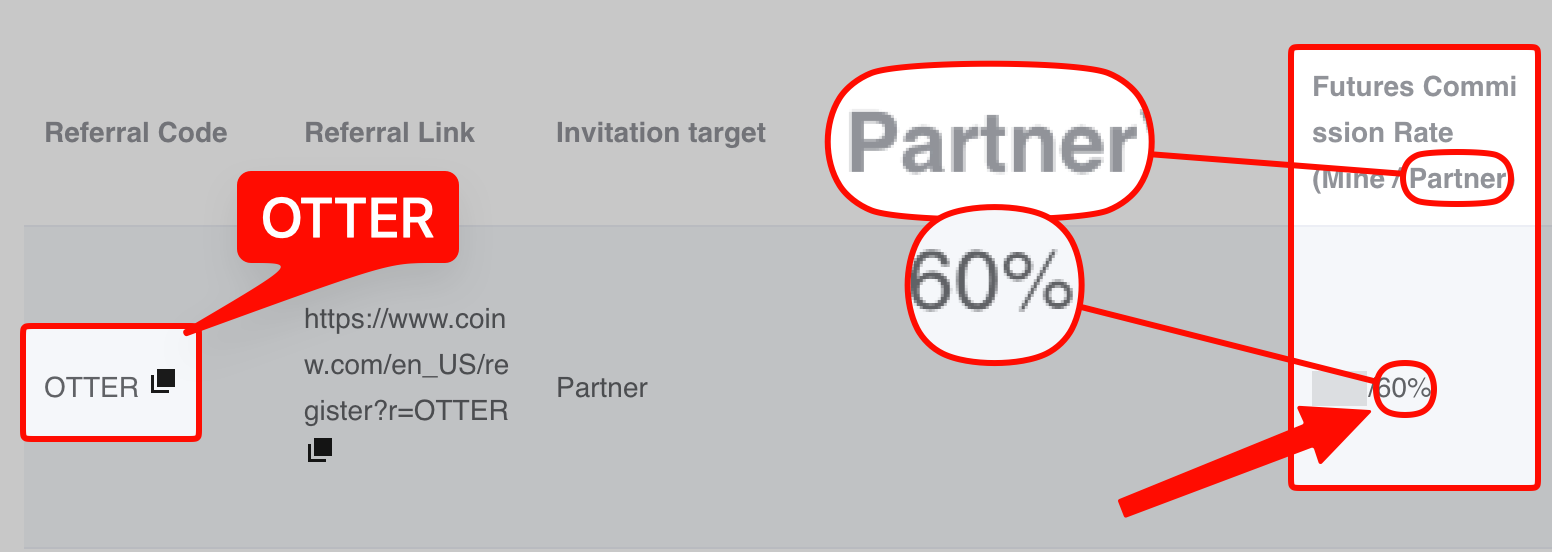
| Referral code | OTTER | mexc-FEEOTTER (prefix included) |
| Layer 1: exchange automatic rebate | 60% | 20% |
| Layer 2: Fee Otter extra rebate | None | 40% (UID binding required) |
| Total | 60% on futures | 60% on futures and spot |
| Against a typical 20% code | 3× | 3× |
Layer 1 goes straight back to your exchange account. MEXC's layer 2 settles daily into your Fee Otter balance and is paid out as USDT on BEP20, minimum 1 USDT per request, with the 0.015 USDT network fee paid by you. The layers are explained in automatic vs extra rebate; CoinW's code is covered in the CoinW referral code guide.
Skip the UID binding and CoinW keeps 60% while MEXC drops to 20%. Forty points of MEXC's 60% depend on binding, so bind your MEXC UID on Fee Otter after you sign up. On CoinW, binding confirms the account sits under our code.
List fees: MEXC is lower on every line
| USDT-M perpetuals (regular user) | CoinW | MEXC |
|---|---|---|
| Standard maker / taker | 0.02% / 0.06% (all 369 contracts) | 0.01% / 0.04% (557 of 1,194 contracts) |
| Promotional rates | None | 0% / 0.02% (489, including BTC, ETH, SOL); 0% / 0% (125) |
| Taker ÷ maker | 3× | 4× |
| BTC perpetual max leverage | 200× | 500× |
Checked 2026-10-17 from both exchanges' official public APIs (CoinW futures, MEXC futures, MEXC spot) · Methodology
- CoinW's futures schedule is uniform: today all 369 perpetuals are 0.02% maker and 0.06% taker. CoinW's public API does not return spot fees, so this article does not compare CoinW spot.
- MEXC sets fees pair by pair. Promotional rates move: on 2026-09-27 we recorded ETH perpetuals at 0% / 0.01%; today they are 0% / 0.02%. MEXC's zero-fee page says some pairs have a quota and an end date, after which the standard rate applies, and that API users, market makers and institutional accounts are not eligible.
- MEXC spot is 0% maker and 0.05% taker on BTC/USDT and ETH/USDT; 1,101 of 1,864 pairs, mostly small caps, are 0.08% taker.
Net fees after the rebate
Formula: net rate = list rate × (1 − rebate rate).
| Scenario | Net maker | Net taker | 70% taker / 30% maker |
|---|---|---|---|
| CoinW (60%) | 0.008% | 0.024% | 0.0192% |
| MEXC standard-rate futures (60%) | 0.004% | 0.016% | 0.0124% |
| MEXC promotional BTC, ETH (60%) | 0% | 0.008% | 0.0056% |
| For reference: CoinW with a typical 20% code | 0.016% | 0.048% | 0.0384% |
Worked through: CoinW taker = 0.06% × (1 − 60%) = 0.024%; MEXC standard taker = 0.04% × (1 − 60%) = 0.016%; MEXC BTC taker = 0.02% × (1 − 60%) = 0.008%. CoinW's list taker is 50% higher than MEXC's, and with the same 60% rebate on both, that gap carries straight through to the net rate.
In money: 500,000 USDT a month, all taker
| Option | Monthly fees | Returned | Net monthly cost |
|---|---|---|---|
| CoinW (60%) | 500,000 × 0.06% = 300 USDT | 180 USDT | 120 USDT |
| MEXC standard-rate futures (60%) | 500,000 × 0.04% = 200 USDT | 120 USDT | 80 USDT |
| MEXC promotional BTC, ETH (60%) | 500,000 × 0.02% = 100 USDT | 60 USDT | 40 USDT |
On standard contracts MEXC costs 40 USDT a month less, 480 USDT a year; on BTC and ETH, 80 USDT a month less. CoinW returns the most money only because its fee base is the largest; compare net monthly cost.
If you are already a VIP on an exchange and want to rebind or sign up on another exchange, contact support. We can help you apply for special trading perks or a higher rebate rate.
One 20× trade
Open 20× on 1,000 USDT of margin for a 20,000 USDT position, with market orders in and out. The CoinW round trip costs 24 USDT, or 9.6 USDT net after 60%, 0.96% of margin. MEXC standard contracts cost 16 USDT, or 6.4 USDT net, 0.64%. MEXC BTC costs 8 USDT, or 3.2 USDT net, 0.32%.
API and bots
Section 1.5 of MEXC's affiliate FAQ says: "All trades made by users via API will no longer count toward commission" (checked 2026-10-17). MEXC API orders get no rebate, neither the exchange's 20% nor Fee Otter's 40%, and the zero-fee page excludes API users. For algorithmic trading on MEXC, count fees at the full rate: 0.04% taker on standard contracts. We did not find a rule on CoinW's public pages about whether API trades count toward commission; go by the rebate ledger. MEXC setup steps are in the MEXC API guide.
Adding a code late and rebinding
| Item | CoinW | MEXC |
|---|---|---|
| Add a code after signup | We are still confirming CoinW's rule; contact support first | Within 30 days, main account, no referrer yet: self-service binding |
| Change a code once bound | Same as above | No |
| Existing accounts | Contact support before switching | Re-register with a new email; one KYC allows up to 2 accounts |
MEXC's conditions are in its self-service referrer linking guide; steps are in the MEXC rebind guide and every exchange's rules in the rebind rules table. Binding on Fee Otter only takes your UID, never an API key or password.
%2C2026-10-05%20%E5%8F%96%E6%A8%A3%3A%0A%20%20%20%20%20%20%20%E5%BA%95%E8%89%B2%20%23FFFFFF%2C%E5%AD%97%E7%AC%A6%20%235227FF)%E3%80%82%0A%20%20%20%20%20%20%20%E7%94%A8%20potrace%20%E6%8F%8F%E5%AD%97%E7%AC%A6%E8%BC%AA%E5%BB%93%2C%E6%95%B4%E5%BC%B5%E7%95%AB%E5%B8%83%E7%9B%B4%E6%8E%A5%E6%98%A0%E5%B0%84%E5%88%B0%E9%80%99%E8%A3%A1%E7%9A%84%2032%20%E5%96%AE%E4%BD%8D%20%E2%80%94%E2%80%94%20%E4%B8%8D%E9%87%8D%E6%96%B0%E7%BD%AE%E4%B8%AD%2C%E4%BF%9D%E7%95%99%E5%AE%98%E6%96%B9%E7%9A%84%E7%95%99%E7%99%BD%E6%AF%94%E4%BE%8B%E3%80%82%0A%20%20%20%20%20%20%20%E5%AE%98%E6%96%B9%E6%98%AF%E7%99%BD%E5%BA%95%E7%B4%AB%E8%89%B2%E5%AD%97%E7%AC%A6%3B%E7%99%BD%E5%BA%95%E5%8A%A0%E6%B7%A1%E9%82%8A%2C%E5%85%8D%E5%BE%97%E5%9C%A8%E7%99%BD%E8%89%B2%E8%83%8C%E6%99%AF%E4%B8%8A%E6%B6%88%E5%A4%B1%E3%80%82%0A%20%20%20%20%20%20%20%E8%A6%81%E6%94%B9%E8%AB%8B%E9%87%8D%E8%B7%91%E6%8F%8F%E5%9C%96%2C%E4%B8%8D%E8%A6%81%E6%86%91%E5%8D%B0%E8%B1%A1%E8%AA%BF%E3%80%82%20--%3E%0A%20%20%3Crect%20x%3D%221.5%22%20y%3D%221.5%22%20width%3D%2229%22%20height%3D%2229%22%20rx%3D%228%22%20fill%3D%22%23FFFFFF%22%20stroke%3D%22%23E4E4E7%22%2F%3E%0A%20%20%3Cpath%20fill%3D%22%235227FF%22%20d%3D%22M13.31%208.92L13.31%2012.28L9.94%2012.28L6.56%2012.28L6.57%2015.71C6.58%2019.51%206.57%2019.29%206.79%2020.2C7.56%2023.33%2010.21%2025.78%2013.38%2026.31C14.1%2026.43%2014.44%2026.44%2019.24%2026.44L23.91%2026.44L23.91%2023.05L23.91%2019.66L19.2%2019.65L14.48%2019.64L14.28%2019.56C13.89%2019.41%2013.63%2019.16%2013.44%2018.76L13.36%2018.58L13.35%2015.46L13.34%2012.34L18.56%2012.34L23.78%2012.34L23.78%208.95L23.78%205.56L18.55%205.56L13.31%205.56L13.31%208.92Z%22%2F%3E%0A%3C%2Fsvg%3E%0A)
 Telegram · @feeotter