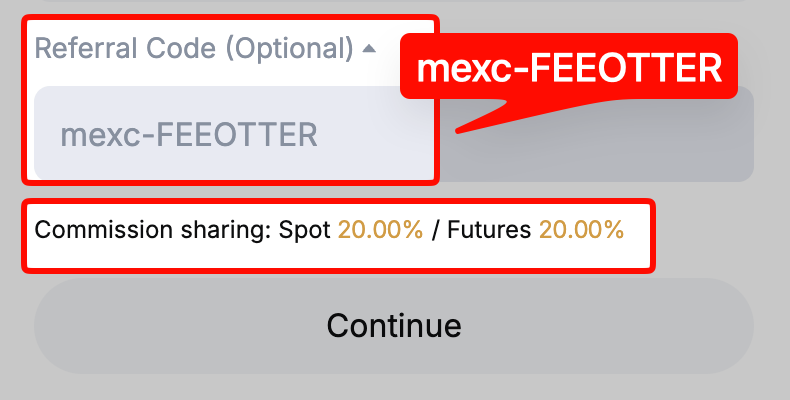
The most important point first: orders placed on MEXC through the API earn no rebate. MEXC's affiliate FAQ says "All trades made by users via API will no longer count toward commission", so whichever referral code you used, API orders from your scripts and bots get neither the exchange's 20% automatic rebate nor Fee Otter's extra rebate. The API itself works as normal: up to 30 keys per account, keys without a bound IP expire after 90 days, futures order placement needs KYC first, and futures order creation is limited to 4 requests per 2 seconds (checked 2026-10-17).
This guide draws on MEXC's official API documentation (mexc.com/api-docs and the official GitHub version), the affiliate FAQ and live data from the public API. It covers creating a key, choosing permissions, IP binding and expiry, spot and futures rate limits, how to test, a minimal script that queries your balance, and, with numbers, what the lack of an API rebate does to your fee costs.
Key points
- No rebate on API orders: MEXC's affiliate FAQ (2026-07-20) says API trades don't count toward commission. If you run code, count the rebate as zero.
- Key limits and expiry: up to 30 API keys per account and up to 10 IPs per key; keys without a bound IP expire automatically after 90 days, and can be renewed for 90 days starting 5 days before expiry.
- Futures API is back: MEXC's futures order API was under maintenance for a long time; the official update log says maintenance ended and trading reopened on 2026-03-31. KYC is required before enabling futures order permissions.
- Rate limits: spot IP-weighted endpoints get 300 weight per 10 seconds and UID-weighted endpoints 500; futures order creation 4 per 2 seconds; keep sending after limits and your IP is banned for 2 minutes up to 3 days.
- Fees: on the check date, BTC_USDT perpetual was 0% maker and 0.02% taker, and BTCUSDT spot 0% maker and 0.05% taker.
No rebate on API orders: the official wording and what it means
Section 1.5 of MEXC's affiliate FAQ says "All trades made by users via API will no longer count toward commission" and "Your Commission will only display commissions generated from non-API trades." Rebates come out of the commission the exchange pays the referrer. API orders generate no commission, so there is no automatic exchange rebate and no Fee Otter extra rebate on them.
The same section adds two more rules: fees offset by bonuses generate no commission, and some pairs are in zero-fee campaigns, with commission based on fees actually paid rather than volume. In short, MEXC rebates only apply to orders placed by hand on which you actually paid a fee.
Here is what that costs. Say a bot does 5 million USDT a month of taker volume on the BTC_USDT perpetual, at the 0.02% taker rate on the check date:
| Situation | Monthly fees | Rebate | Net paid |
|---|---|---|---|
| Same volume, placed by hand, with our code (60%) | 1,000 USDT | 600 USDT | 400 USDT |
| Same volume, placed through the API | 1,000 USDT | 0 | 1,000 USDT |
This is our own illustration using the official rate. If you run API strategies on MEXC, you pay the full fee. If your strategy mostly makes, the BTC_USDT maker rate is already 0%, so the missing rebate matters less. To compare API costs across exchanges, see exchange APIs compared and fee rebates for quant traders.
MEXC's API docs also describe an "API Broker" programme for copy-trading, bot and quant platforms with more than 500 users: users authorise their API key to the broker, the broker sends orders carrying its broker ID, and MEXC shares fees with the broker. That is an arrangement between a platform and MEXC, separate from an ordinary referral rebate.
Before you create a key: the official limits
- Numbers: up to 30 API keys per account and up to 30 sub-accounts per main account. Sub-accounts inherit the main account's fee rates, and sub-accounts created through the API can't log in on the web.
- IP: up to 10 IPs per key. MEXC strongly recommends binding; keys without one are valid for 90 days and then expire.
- Renewal: from 5 days before expiry, go to My API Key → Action → Renew to add 90 days.
- Trading pairs: spot API orders only work on pairs open to the API. On the check date the public endpoint
/api/v3/defaultSymbolslisted 1,789 of 1,864 spot pairs, including BTCUSDT, ETHUSDT and SOLUSDT. You set the pairs a key can trade under My API Key → Trading Pairs → Set. - KYC for futures: the futures docs say the account must complete KYC before futures order permissions can be created or enabled. Accounts without KYC can still create a key but may not be able to switch on order permissions.
Sources: MEXC spot API docs, MEXC futures integration guide and the official GitHub spot docs, checked 2026-10-17.
Which permissions to tick
Each endpoint in the spot docs lists the permission it needs:
| Permission | What it allows | Needed for a strategy? |
|---|---|---|
| SPOT_ACCOUNT_READ / WRITE | Account info, balances, fee rates (read); account settings (write) | Read, yes; write if needed |
| SPOT_DEAL_READ / WRITE | Orders and fills (read); placing and cancelling orders (write) | Write, for spot strategies |
| SPOT_TRANSFER_READ / WRITE | View and make transfers between accounts | Only if you use it |
| SPOT_WITHDRAW_READ / WRITE | Withdrawal history (read); withdrawals (write) | Never tick withdraw write |
| Futures: account read / modify, trade read / order placing | Futures assets and positions; placing and cancelling orders, changing leverage | Order placing, for futures strategies |
Withdrawal is the riskiest permission on any key, so leave it off if your strategy doesn't need it. Then even if the key leaks, nobody can use it to pull your assets out.
Rate limits: spot and futures are counted separately
Spot
- Two units: endpoints that need an API key are limited per account (UID); those that don't are limited per IP. The two are independent.
- Budgets: IP-weighted endpoints share 300 weight per 10 seconds; UID-weighted endpoints share 500 weight per 10 seconds.
POST /api/v3/orderweighs IP 1 and UID 1;GET /api/v3/accountweighs 10 with a limit of 2 per second;GET /api/v3/tradeFeeweighs 20. - Over the limit: you get a 429. Keep sending after a 429 and your IP is banned automatically, from 2 minutes up to 3 days, longer for repeat offenders. 418 and 429 responses carry a Retry-After header in seconds.
- Batch orders: up to 20 orders per batch, 2 batches per second.
- Open orders: up to 500 valid orders not completely filled per account.
- Time window:
recvWindowdefaults to 5,000 ms; MEXC recommends 5 seconds or less, with a maximum of 60 seconds. - WebSocket: up to 100 requests per second and 30 streams per connection; a connection with no valid subscription drops after 30 seconds, and one with no traffic for 60 seconds after subscribing also drops. Reply with a Pong when the server sends a Ping.
Futures
- Domain: since 2026-01-19 the futures API uses
https://api.mexc.com. - Placing orders:
POST /api/v1/private/order/create, 4 requests per 2 seconds, needs the Order Placing permission; leverage must be sent when opening a position. - Signing: headers ApiKey, Request-Time and Signature; the signature is HMAC-SHA256 over access key + timestamp + parameter string. The default allowed time difference is 10 seconds, adjustable with Recv-Window up to 60, and MEXC advises against going above 30.
- Reopening: the futures API update log says "Futures Trading API maintenance ended; trading access reopened" on 2026-03-31. The official GitHub futures docs still marked order endpoints "Under maintenance" on the check date; go by the newer docs on mexc.com.
Testing: MEXC has no public testnet
None of the MEXC spot or futures docs we checked mention a testnet or demo environment. Spot has a test order endpoint, POST /api/v3/order/test, which takes the same parameters as a real order and validates the request without filling it, so you can check signing and parameters. Futures has no equivalent; before going live, start with the minimum order size and low leverage.
Below is a minimal example that queries your spot balances. The signing rule follows the official docs: build all parameters into a query string, HMAC-SHA256 it with your secret key, output lowercase hex in the signature parameter, and send the API key in the X-MEXC-APIKEY header. Read the keys from environment variables rather than hard-coding them:
import hashlib, hmac, os, time, requests
API_KEY = os.environ["MEXC_API_KEY"] # read-only key is enough
API_SECRET = os.environ["MEXC_API_SECRET"]
BASE = "https://api.mexc.com"
params = f"recvWindow=5000×tamp={int(time.time() * 1000)}"
sign = hmac.new(API_SECRET.encode(), params.encode(), hashlib.sha256).hexdigest()
r = requests.get(f"{BASE}/api/v3/account?{params}&signature={sign}",
headers={"X-MEXC-APIKEY": API_KEY})
print(r.status_code, [b for b in r.json().get("balances", []) if float(b["free"]) > 0])Once it works, switch the path to /api/v3/tradeFee?symbol=BTCUSDT to see your actual fee rate on that pair.
Fees: API orders pay the normal rates
MEXC doesn't publish a separate API fee schedule. Data from the public API (/api/v3/exchangeInfo and /api/v1/contract/detail) on the check date:
| Market | Pair | Maker | Taker |
|---|---|---|---|
| Spot | BTCUSDT, ETHUSDT, SOLUSDT | 0% | 0.05% |
| Spot | XRPUSDT | 0% | 0% |
| Perpetual | BTC_USDT, ETH_USDT | 0% | 0.02% |
| Perpetual (spread of 1,194 contracts) | 557 contracts | 0.01% | 0.04% |
| Perpetual (spread of 1,194 contracts) | 489 contracts | 0% | 0.02% |
| Perpetual (spread of 1,194 contracts) | 125 contracts | 0% | 0% |
MEXC changes fees often, so check your own account's rates with /api/v3/tradeFee or the futures fee endpoint before going live. For VIP levels, see MEXC VIP tiers.
Service regions
The prohibited jurisdictions in MEXC's User Agreement (updated 2026-10-13) include North Korea, Cuba, Sudan, Iran, Mainland China, Singapore, Malaysia, the United States, the United Kingdom, Hong Kong, Kazakhstan, the Russian-controlled regions of Ukraine, Canada, and places under comprehensive sanctions or on FATF's call-for-action list; the list may change. When you run a strategy on a cloud server, both the server's location and your own residence matter. The official FAQ suggests Japan or Singapore AWS servers if connections are unstable; Singapore itself is on the prohibited list, so that advice is about server location only and doesn't mean Singapore residents can use MEXC. For licence status by country, see exchange licences compared.
Security and risks
- One key per use: separate keys for your own strategy, third-party bots and accounting tools, so you can delete just the one that goes wrong.
- Bind an IP: if your strategy runs on a fixed-IP server, bind it; that also avoids the 90-day expiry.
- Delete a leaked key at once: MEXC says never share your key or secret, and to delete and recreate a key that leaks.
- Code risk: bugs, disconnects and price gaps can all cause losses, and futures add liquidation risk. Start small, with low leverage.
Never hand an API key to anyone who offers to trade for you and promises profits with no risk, least of all a key with withdrawal rights.
Trading with code and still wanting a rebate
On MEXC, rebates only work for orders placed by hand. Register with our code mexc-FEEOTTER and manual trading fees get a 60% rebate (20% automatic exchange rebate + 40% extra rebate), spot and futures alike. MEXC pays the 20% straight into your account; Fee Otter settles the 40% daily and pays it out on request as USDT on BEP20, minimum 1 USDT per request, with the 0.015 USDT network fee paid by you. The rebate covers trading fees only, not funding or liquidations, and API orders on MEXC never earn a rebate.
If most of your trading goes through the API, look at other exchanges' API and rebate rules: Bybit API setup, Binance API setup and OKX API setup; for grid-style strategies, rebates for grid and arbitrage traders. For MEXC manual-trading rebates, see the MEXC fee rebate guide.
 Telegram · @feeotter