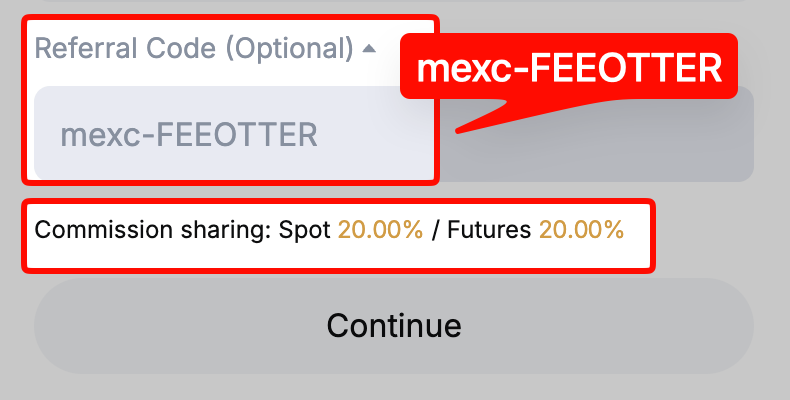
MEXC sets futures fees pair by pair: about 560 contracts charge 0.01% maker / 0.04% taker, about 490 (BTC and ETH among them) 0% / 0.02%, about 125 charge 0% on both sides, and BTC goes up to 500x. A pair with zero fees generates no rebate; on trades that do pay a fee, binding with our code mexc-FEEOTTER gets you a 60% futures rebate, 3 times the common 20% referral code (checked October 2026).
MEXC futures differ from other exchanges in three ways: many pairs charge zero fees, BTC goes up to 500x, and liquidation is triggered by the "fair price" and carried out in stages. All three affect your costs and risk, and they affect rebates too: a pair with zero fees generates no rebate at all. This guide uses MEXC's official futures API (BTC data from a single ?symbol=BTC_USDT query) and Help Center, checked on 2026-10-18.
Futures can wipe out your entire margin in a short time, and 500x only means the liquidation distance is extremely short; it is not a recommendation. Leverage and minimum-order comparisons across exchanges are in futures exchanges for beginners; this guide covers MEXC's own rules only.
Understand MEXC futures fees first: many are zero, and zero means no rebate
MEXC sets futures fees pair by pair. On 2026-10-18 the MEXC futures API listed 1,194 contracts, and their fees fall roughly into the groups below (different requests at the same moment return different cached versions, so the counts shift and are shown as approximations; for any single pair, the fee on the order page prevails):
| Maker / taker | Contracts | Rebate |
|---|---|---|
| 0.01% / 0.04% | about 560 | Maker and taker both earn rebates |
| 0% / 0% | about 125 | No fee, no rebate |
| 0.04% / 0.1% | about 20 | Maker and taker both earn rebates |
| 0% / 0.01%–0.02% | about 490 (incl. BTC_USDT, ETH_USDT, SOL_USDT) | Taker only |
MEXC's Affiliate FAQ states that commission is calculated on fees actually paid, not on volume, so zero-fee campaigns generate no commission; fees offset by bonuses generate no commission; and trades placed via API do not count. MEXC's Affiliate Channel Trading Fee Rate Explanation also states that accounts registered with an affiliate referral code have their fee rate applied under the cooperation agreement between that affiliate and the platform, which may differ from the platform default; the amount actually charged prevails, and MEXC recommends checking the fee shown on the page before trading and contacting your affiliate with questions. For accounts registered with our code, that affiliate is Fee Otter, so you can ask our support directly about your fee rate. Check the fee shown on the order page before trading to know whether that trade earns a rebate.
Before you start: KYC, contract types and position mode
- Identity verification: MEXC states that not completing KYC may affect services such as deposits, withdrawals and trading, with the affected items shown on screen; levels and limits are in our MEXC KYC guide.
- Contract types: of the 1,194 contracts in the API on 2026-10-18, 1,085 settle in USDT, 64 in USDC, 35 in USD1, and 10 are coin-margined (one each for BTC, ETH, SOL, XRP and others). USDT-margined contracts show PnL in stablecoins; coin-margined contracts use the coin as margin and settle in it. Both support cross and isolated margin (official FAQ). BTC coin-margined (BTC_USD) showed 125x maximum and 0% maker / 0.02% taker on the check date.
- One-way vs hedge mode: one-way mode allows one direction per contract, and an opposite order first offsets the existing position; hedge mode holds longs and shorts together. MEXC suggests one-way mode for beginners, and you cannot switch position mode with open orders or positions; cancel and close first (official FAQ).
- Demo trading: MEXC offers futures demo trading synced to live market data, where you can practise orders, leverage and TP/SL without real profit or loss (demo trading guide).
BTC_USDT specifications and risk limits
MEXC futures are sized in contracts; one BTC_USDT contract is 0.0001 BTC, minimum one contract. Key parameters on the check date (contract API): 0% maker, 0.02% taker, 500x maximum, 0.04% liquidation fee, and limit prices within 10% of the index price. There are six risk limit tiers:
| Tier | Max position (contracts) | About BTC | Max leverage | Maintenance margin rate | Initial margin rate |
|---|---|---|---|---|---|
| 1 | 120,000 | 12 | 500x | 0.1% | 0.2% |
| 2 | 310,000 | 31 | 200x | 0.4% | 0.5% |
| 3 | 480,000 | 48 | 100x | 0.5% | 1% |
| 4 | 2,800,000 | 280 | 50x | 1% | 2% |
| 5 | 17,500,000 | 1,750 | 20x | 2% | 5% |
| 6 | 19,000,000 | 1,900 | 10x | 5% | 10% |
MEXC's maintenance margin rate depends only on position size, not on the leverage you pick; leverage decides how large a position you can open (pending opening orders count too). The liquidation FAQ includes a BTCUSDT table with "200x and 525,000 contracts" that MEXC itself labels as illustrative; the live values are under Futures Information → Risk Limits on the trading page (viewing risk limits). In extreme markets MEXC may also adjust maximum leverage, tier limits and maintenance margin rates at short notice.
Margin rate and the liquidation process
MEXC measures risk with a margin rate: (maintenance margin + liquidation fee) ÷ (position margin + unrealized PnL). At 100%, the position is liquidated. Liquidation is triggered by the fair price, not the last traded price, to reduce unnecessary liquidations from abnormal wicks (official liquidation FAQ).
Once triggered, it runs in stages:
- Cancel orders: cross margin cancels all open orders in the account; isolated margin (with auto-add margin on) cancels that contract's orders. It moves on only if the rate is still at or above 100%.
- Long-short self-trade: in cross margin only, if you hold both longs and shorts, the system reduces them against each other.
- Tiered liquidation: if the position sits in a higher risk tier, part of it is closed at the bankruptcy price to drop one tier, and the rate is recalculated with the lower maintenance rate; this repeats down to the lowest tier.
- Full takeover: if the position is in the lowest tier and still at or above 100%, the liquidation engine takes over the rest at the bankruptcy price.
Liquidations are handled by the liquidation engine, not the matching engine, so the bankruptcy price does not appear in trade records or on the chart; the average close price in position history is the takeover (bankruptcy) price. MEXC also offers liquidation alerts: turn them on in futures preferences with a margin-rate threshold, and you are notified at most once every 30 minutes per position.
Worked example: 0.01 BTC, 10x isolated long
The official isolated long liquidation formula is (maintenance margin − position margin + entry price × contracts × contract size) ÷ (contracts × contract size); MEXC's own example leaves out the liquidation fee for simplicity (margin calculation guide). Below we include the 0.04% liquidation fee and use the BTC price at query time, 84,590 USDT:
| Item | Calculation | Result |
|---|---|---|
| Contracts and notional | 100 × 0.0001 × 84,590 | 845.9 USDT |
| Position margin (10x) | 845.9 ÷ 10 | 84.59 USDT |
| Maintenance margin (tier 1, 0.1%) | 845.9 × 0.1% | about 0.85 USDT |
| Liquidation fee (0.04%) | 845.9 × 0.04% | about 0.34 USDT |
| Estimated liquidation price | (0.85 + 0.34 − 84.59 + 845.9) ÷ 0.01 | about 76,249 USDT (about 9.9% lower) |
| Bankruptcy price | (845.9 − 84.59) ÷ 0.01 | 76,131 USDT |
| Taker fees to open and close | 845.9 × 0.02% × 2 | about 0.34 USDT |
With a first-tier maintenance rate of only 0.1%, a 10x isolated BTC_USDT position is liquidated very close to the point where the margin is fully used up. Put the other way, at 100x the margin is just 1% of notional and a move of less than 1% against you liquidates the position.
When a position is liquidated, its margin is usually lost in full, and in fast markets the result can be worse than the estimated liquidation price. Only trade futures with money you can afford to lose entirely.
Cross-margin liquidation prices keep moving
In cross margin, the liquidation price depends on the account's available balance and the value of all positions, so unrealized PnL on other pairs and funding deductions move it; if you hold both longs and shorts on one contract, both sides share one liquidation price. MEXC also notes that in cross margin the leverage you select only sets how much initial margin is used; it does not directly set the liquidation price.
Insurance fund and auto-deleveraging (ADL)
After the liquidation engine takes over at the bankruptcy price, any leftover from a better exit goes to the insurance fund; a shortfall is covered by the insurance fund; and if that is not enough, the position goes to ADL. The ADL ranking formula (official ADL FAQ):
- In profit: ranking = profit percentage × effective leverage; at a loss: ranking = loss percentage ÷ effective leverage.
- Effective leverage = fair value ÷ (fair value − bankruptcy value). Longs and shorts are ranked separately.
- The ADL indicator has five levels (0 to 4 bars): top 25% shows 4 bars, 25%–50% shows 3, and so on; losing positions show 0.
The more profit and effective leverage a position has, the sooner it is used to offset and reduce in an ADL event. MEXC's advice is to control leverage, take profits in stages, set TP/SL and watch the ADL indicator.
Funding: usually every 8 hours, BTC capped at ±0.18%
Funding is exchanged between longs and shorts, and MEXC takes no cut. When positive, longs pay shorts; when negative, shorts pay longs. Funding fee = position value × funding rate, with position value at the fair price. It normally settles every 8 hours at 00:00, 08:00 and 16:00 UTC, but some pairs differ, so check the contract page (funding rate guide).
- BTC_USDT cap and floor: the funding rate API on 2026-10-18 showed an 8-hour cycle, +0.18% cap, −0.18% floor, and a current rate of 0.0026%.
- In money terms: for the 845.9 USDT position above, one payment at the 0.18% cap is about 1.52 USDT, or 1.8% of the 84.59 USDT margin.
- Settlement can lag up to 15 seconds: MEXC says batch processing may delay settlement, so a position opened a few seconds after the settlement time (for example 08:00:05 UTC) may still be included.
- Funding affects the liquidation price: deducted funding reduces margin and moves the liquidation price.
Order types and TP/SL
MEXC futures has six order types: limit, market, chase limit, trigger, trailing stop and post-only. Limit, market and trigger orders support time-in-force settings (such as GTC for limit orders), and trigger orders freeze no position or margin before they trigger (official time-in-force guide). TP/SL can be placed three ways: preset before opening (by trigger price or PnL ratio/amount, as limit or market), on the whole position or part of it (for staged exits), and as "TP reverse / SL reverse", which opens an opposite position of the same size once triggered (TP/SL FAQ). MEXC also warns that TP/SL may fail to execute in extreme markets, and a triggered market order can fill away from the set price.
One unusual feature is the guaranteed stop-loss: MEXC guarantees the fill at your trigger price, removing slippage. It has three limits: it only works in market stop-loss mode, only on selected pairs, and only with the last price as trigger (not fair or index price). It is also a paid feature, charged only when triggered and filled, with rates varying by pair as shown on the trading page (guaranteed stop-loss guide).
Net fee rates after rebate
Bound through Fee Otter with referral code mexc-FEEOTTER, the futures rebate is 60%. Applied to the fee groups above:
| Pair type | Listed maker / taker | Net taker after 60% rebate |
|---|---|---|
| Standard contracts (about 560) | 0.01% / 0.04% | 0.016% |
| BTC_USDT | 0% / 0.02% | 0.008% |
| Zero-fee contracts | 0% / 0% | 0% (no rebate) |
For the 845.9 USDT BTC_USDT position above, opening and closing as taker costs about 0.34 USDT, or about 0.14 USDT net after the 60% rebate; filled entirely as maker, BTC_USDT charges 0%, so there is no fee and no rebate. Rebates are settled daily with every trade traceable, and they do not change margin or liquidation price. Timing and monthly examples are in the MEXC fee rebate guide, the code is in MEXC referral code; MEXC allows binding within 30 days of registration, otherwise see the MEXC rebind guide.
If you're already a VIP on an exchange or trade futures in size and want to rebind or sign up with another exchange, contact Fee Otter support. We work directly with the exchange's official team and can help arrange special trading perks (such as a VIP tier trial) or a higher rebate rate, subject to the exchange's approval. MEXC's own tier system is in MEXC VIP tiers.
 Telegram · @feeotter