Binance referral code: a 40% fee rebate (20% paid by Binance + 20% Fee Otter extra), twice a typical 20% code. Where to enter it and the 30-day backfill.
Register on Binance through Fee Otter's dedicated link (referral code FEEOTTER) and the referral code is already built in, filled automatically, for a 40% fee rebate (20% automatic from Binance + 20% extra from Fee Otter), 2x a common 20% code. If you missed it at sign-up, you can still add it within 30 days as long as you haven't deposited or traded (checked October 2026). Full rates and evidence: referral codes and rebate rates by exchange.
The Binance referral code FEEOTTER is built into the dedicated link. Registering with it earns a fee rebate of 40%: 20% returned automatically by Binance, plus 20% more from Fee Otter. Most referral codes out there pay 20% (some 25%); with your UID bound on Fee Otter, our code pays 40%, twice a typical code. On 1,000 USDT of monthly fees, a typical 20% code returns 200 USDT; ours returns 400 USDT.
This page answers questions about the code itself: where it goes, what it earns, whether it expires, and what to do if you missed it. For the full account-opening walkthrough, see the Binance registration guide.
What is the Binance referral code?
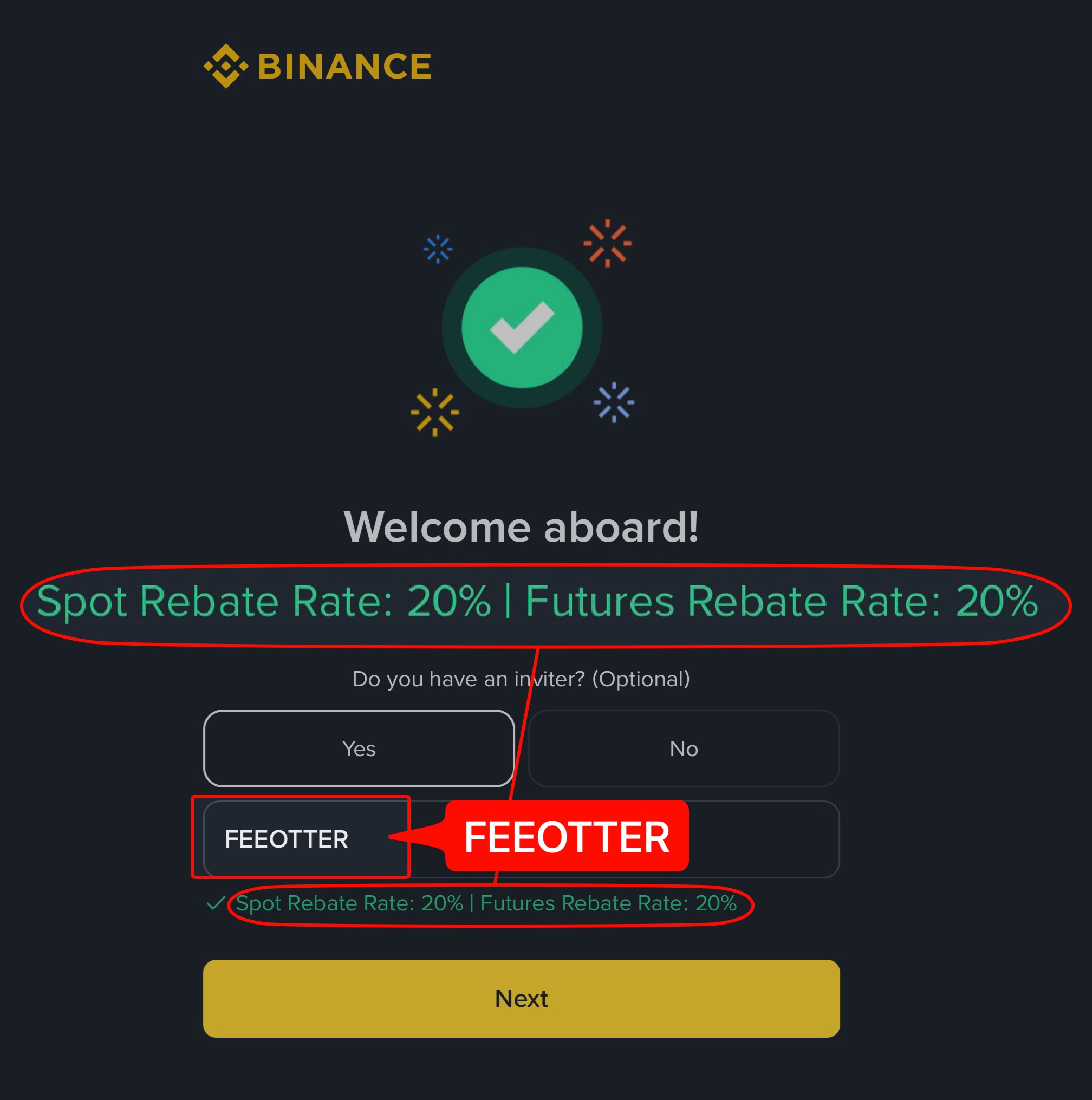
Our Binance referral code is FEEOTTER, built into the dedicated link on the button below, so it fills in automatically and you do not need to type anything.
This is the actual Binance signup page opened through our link, with the code already filled in. Plenty of codes that advertise high rebates come without a single screenshot, and people only find out after signing up that no rebate arrives. We put up each exchange's signup page or dashboard so you can check before you register.
Where do you enter the code?
After the email and password step, Binance shows a collapsed "Referral ID (optional)" field, folded away by default, which is why most people miss it. Expand it, check that the code is already filled in, and submit.
If the code did not stick, you get no rebate. Check it this way:
At sign-up: before you submit, look at the referral code field and make sure it says FEEOTTER. Signing up through our link fills it in for you.
Bind your UID on Fee Otter: enter your Binance UID on the Fee Otter rebate site. After you submit it, we check Binance's referral list, the first time within about 5 minutes. If you are under our code, the status changes to "Verified" and we email you. If it still says "Pending review" after 5 hours, your UID is not on the list: check that you signed up with FEEOTTER, or contact support.
If you trade large volumes and want to confirm before your first trade, contact support and we will check it by hand. If the code did not stick, see the Binance rebinding guide for your options.
How much does it earn?
Binance pays 40% (20% automatic from Binance + 20% Fee Otter extra). Fee Otter has one rate per exchange, with no tiers. Rates across the exchanges:
Rebate rate by exchange
Exchange
Auto-rebate
Extra rebate
Total
Binance
20%
20%
40%
OKX
20%
20%
Bybit
—
40%
40%
Gate
20%
50%
70%
Bitget
20%
30%
50%
MEXC
20%
40%
60%
BingX
45%
0%
45%
Pionex
15%
35%
50%
KuCoin
60%
0%
60%
Bitfinex
6%
0%
6%
WEEX
60%
10%
70%
XT.COM
60%
10%
70%
HTX
30%
20%
50%
CoinW
60%
0%
60%
Ourbit
50%
20%
70%
Every rate here is fee paid straight back to you. It excludes VIP fee tiers and platform-token discounts such as BNB or GT; those stack on top and only save you more.
Submitting without expanding the field. Binance collapses the "Referral ID" field by default, which accounts for about half of the people who miss it. Once submitted it can only be added within 30 days and before any deposit or trade.
Clicking another referral link mid-signup. Open a second coded link before you finish and the later one overwrites the first. Decide which code you want, enter through that link, and do not click other referral links on the way.
Registering in the app and skipping the field. The app places the referral field differently from the web form and it is easier to pass over. If unsure, complete registration on the web and sign in to the app afterwards.
Assuming it can be changed later. It cannot. The relationship is written at account creation; after that the only route is an official rebind.
The 20% column is the automatic rebate alone, which is what most circulating codes deliver. The 40% column is the total once you bind to Fee Otter. The gap between them is what binding somewhere in particular is worth, and it repeats every month. The effective rate calculator converts it to your numbers.
If you're already a VIP at an exchange and want to rebind or sign up at another one, contact support; we can help you apply for special trading perks or a higher rebate rate.
Specific to Binance: TradFi perpetuals have their own fee schedule
Binance places tokenized stocks and commodities (TradFi perpetuals such as TSLA, NVDA and crude oil CL) on a fee schedule separate from ordinary futures, as its own tab on the official fee page. Your actual fee on tokenized stocks can therefore differ from crypto perpetuals, and so does the base the rebate is calculated on.
No. A Binance referral link is written when the account is created and is effectively permanent. It is not a campaign code: there is no expiry and no cap on how many people can use it.
What can change is the percentage, not the code: exchanges can revise affiliate policy. The binding itself does not lapse with time. What can lapse is the kickback: under Binance's official rules, a regular referral code (Referral Pro Tier 0) pays the futures kickback for 12 months only, unless the referrer's rate is 30% or more. Affiliate codes have no such limit, and ours is a Binance affiliate code, so its futures kickback is not capped at 12 months.
The flip side is that binding to the wrong party is hard to undo, so read the next section before you commit.
Already registered without a code?
A Binance referral code can only be added after signup within 30 days and before any deposit or trade (official FAQ). Past that point, Binance is still one of the few exchanges offering an official rebind route: no account closure, no borrowing someone else's identity; you submit a request on the official bind-referral page.
Is a "40% Binance rebate" or "40% off fees" elsewhere the same as our 40%?
No. Search for Binance rebates and you will find plenty of "up to 40%" and "40% off fees" claims, but many of them reach that number by multiplying in the BNB fee discount. A typical write-up says the code gives 20% off spot and 10% off futures, and then adds BNB to call it "up to 40% off".
Broken down: spot is 1 − 0.8 × 0.75 = 40%, futures is 1 − 0.9 × 0.9 = 19%. The BNB part (25% on spot, 10% on futures) is a platform-token fee reduction Binance gives everyone, with or without a referral code; the code itself only gives 20% on spot and 10% on futures.
Where does 40% come from?
Their 40%Code20+BNB 20your own→ back to you20
Fee Otter 40%Code20+Extra20→ back to you40
Binance spot, per 100 USDT of fees. Turn on BNB and Fee Otter saves you 55.
We don’t win you over with inflated math. We rely on transparent, line-by-line records and automatic daily settlement.
Why do different sources offer different rebates?
Same exchange, same code format, yet the rebates vary widely. Three things explain most of the gap:
1. Direct partnership versus a resold sub-affiliate
We hold direct, long-term agreements with each exchange. Many codes circulating online belong to individuals operating as sub-affiliates, and affiliate status is reviewed. If that person fails review or gets downgraded, the rate their users receive is affected directly. You are bound to them, not to the exchange, so their situation becomes yours.
2. Whether they are still around
A common pattern: an individual code promises manual top-ups, pays for a few months, then stops answering. The problem is that a binding is almost impossible to change, so you end up locked into a relationship that no longer functions, while still paying the fees.
3. How much they give back
We pass most of the share to users and rely on the relationship lasting rather than on a one-off cut. Actual percentages are in the rate table above, and the rebate platform (Fee Otter) shows them live.
What you see every day after binding
Illustration · sample data, not a real user
This is what the Rebate history on the rebate dashboard looks like. Data for the previous day refreshes daily at 16:00 (UTC+8), and every rebate shows the exchange, date and amount.
Available balance
38.66 USDT
Total earned
412.80 USDT
By exchange (this month)
Gate 34.44Binance 5.51Bitget 6.82
Rebate history
Date
Exchange
Amount
10/22
Gate
+6.30 USDT
10/22
Binance
+1.20 USDT
10/22
Bitget
+1.76 USDT
10/21
Gate
+4.83 USDT
10/21
Binance
+0.94 USDT
10/20
Gate
+7.14 USDT
10/20
Bitget
+2.20 USDT
10/20
Binance
+1.43 USDT
The available balance is extra rebate Fee Otter has not yet paid you (denominated in USDT) — an amount we owe you; the automatic rebate from the referral code is paid by the exchange straight to your exchange account.
40%: 20% returned automatically by Binance plus 20% more from Fee Otter; see the rate table above. That is twice a typical 20% code and 1.6 times a 25% one.
Can a referral code be added after registering?
Yes, with conditions. Under Binance's official rules, you can add one within 30 days of signup if you have made no deposit or trade and have no referrer; once the relationship exists it cannot be edited. Existing accounts that do not qualify should use the official rebind; see the rebind guide.
Does using a referral code cost more in fees?
No. The code does not change your fee schedule; you pay Binance's published rates either way. It only determines how much of that comes back to you. People who skip the code pay the same fees and get nothing back.
Is there a deadline or a limit on this code?
No. It is not a campaign code: no expiry, no quota, and it is effectively permanent once bound. Ours is an affiliate code, so its futures kickback has no 12-month limit either.
When does the rebate arrive?
Binance charges first and returns later: fees are taken as normal, then rebated. Once your UID is bound, every rebate is recorded on the rebate platform (Fee Otter), where you can view them and request withdrawals.
Can I sign up with a friend's or relative's referral code instead of Fee Otter's code?
You can, but it usually isn’t worth it. Your friend or relative does earn a small reward, but a personal referral code tends to offer you poor terms, and both the fee discount and the trading rebate are time-limited. On Binance, for example, a regular user’s code can share at most 10% with you, and futures kickback lasts only 12 months (official rules). Fee Otter is a professional affiliate partner with a long-term agreement with the exchange, so signing up with our code is the safer choice and keeps your trading rebate going for the long run.
Can I switch to a different referral code after binding?
Binance is one of the few exchanges with an official rebind route, but it still carries conditions (account status, volume). It is not a switch you can flip at will, which is why getting the first binding right costs far less than fixing it later.
Does a rebate affect my VIP level?
No. VIP level is set by your volume and token holdings; a rebate is money returned afterwards and does not enter that calculation. The two stack, and the effective rate calculator shows what you actually pay once a VIP discount and a rebate are combined.
This is the actual Binance signup page opened through our link, with the code already filled in. Plenty of codes that advertise high rebates come without a single screenshot, and people only find out after signing up that no rebate arrives. We put up each exchange's signup page or dashboard so you can check before you register.
Information only, not investment advice. Rebate percentages and exchange policy can change; Binance's official announcements and the live Fee Otter platform are authoritative.



%2C2026-10-05%20%E5%8F%96%E6%A8%A3%3A%0A%20%20%20%20%20%20%20%E5%BA%95%E8%89%B2%20%230E3452%2C%E5%AD%97%E7%AC%A6%20%2303CA9B)%E3%80%82%0A%20%20%20%20%20%20%20%E7%94%A8%20potrace%20%E6%8F%8F%E5%AD%97%E7%AC%A6%E8%BC%AA%E5%BB%93%2C%E6%95%B4%E5%BC%B5%E7%95%AB%E5%B8%83%E7%9B%B4%E6%8E%A5%E6%98%A0%E5%B0%84%E5%88%B0%E9%80%99%E8%A3%A1%E7%9A%84%2032%20%E5%96%AE%E4%BD%8D%20%E2%80%94%E2%80%94%20%E4%B8%8D%E9%87%8D%E6%96%B0%E7%BD%AE%E4%B8%AD%2C%E4%BF%9D%E7%95%99%E5%AE%98%E6%96%B9%E7%9A%84%E7%95%99%E7%99%BD%E6%AF%94%E4%BE%8B%E3%80%82%0A%20%20%20%20%20%20%20%E8%A6%81%E6%94%B9%E8%AB%8B%E9%87%8D%E8%B7%91%E6%8F%8F%E5%9C%96%2C%E4%B8%8D%E8%A6%81%E6%86%91%E5%8D%B0%E8%B1%A1%E8%AA%BF%E3%80%82%20--%3E%0A%20%20%3Crect%20x%3D%221.5%22%20y%3D%221.5%22%20width%3D%2229%22%20height%3D%2229%22%20rx%3D%228%22%20fill%3D%22%230E3452%22%2F%3E%0A%20%20%3Cpath%20fill%3D%22%2303CA9B%22%20d%3D%22M23.02%205.97C22.14%206.02%2021.54%206.07%2021.22%206.1C20.72%206.15%2019.6%206.28%2019.41%206.31C19.31%206.33%2019.1%206.37%2018.94%206.39C18.29%206.5%2017.94%206.57%2017.2%206.73C16.92%206.79%2016%207.03%2015.8%207.09C15.36%207.23%2014.42%207.54%2014.39%207.56C14.38%207.57%2014.3%207.6%2014.23%207.62C13.82%207.76%2012.7%208.28%2012.13%208.6C11.95%208.7%2011.8%208.78%2011.79%208.78C11.7%208.78%2010.42%209.71%209.98%2010.08C9.16%2010.79%208.07%2012.09%207.6%2012.91C7.28%2013.46%207.18%2013.65%207.06%2013.91C6.87%2014.3%206.76%2014.53%206.68%2014.74C6.56%2015.08%206.37%2015.64%206.34%2015.73C6.33%2015.78%206.3%2015.91%206.27%2016C6.06%2016.79%205.93%2017.87%205.94%2018.62L5.95%2019.05L6.69%2019.04C7.78%2019.03%208.57%2018.94%209.73%2018.68C10.18%2018.58%2011.05%2018.33%2011.45%2018.18C11.52%2018.15%2011.7%2018.08%2011.84%2018.03C13.58%2017.38%2015.67%2016.19%2017.55%2014.77C17.8%2014.58%2018.67%2013.89%2018.74%2013.83C18.76%2013.81%2018.94%2013.66%2019.14%2013.48C19.34%2013.31%2019.54%2013.14%2019.58%2013.11C19.61%2013.07%2019.78%2012.92%2019.95%2012.77C20.94%2011.88%2022.24%2010.57%2023.2%209.48C23.68%208.94%2023.69%208.93%2023.86%208.73C23.94%208.63%2024.02%208.54%2024.03%208.53C24.17%208.4%2025.09%207.25%2025.52%206.67C25.67%206.47%2025.81%206.28%2025.83%206.26C25.86%206.23%2025.89%206.19%2025.9%206.16C25.92%206.13%2025.94%206.12%2025.95%206.13C25.98%206.15%2025.3%207.5%2024.99%208.07C24.88%208.28%2024.78%208.45%2024.78%208.46C24.78%208.46%2024.66%208.67%2024.51%208.93C24.24%209.4%2024.17%209.52%2024.07%209.69C24%209.81%2023.72%2010.27%2023.39%2010.8C22.69%2011.91%2021.44%2013.66%2020.74%2014.52C20.25%2015.12%2020.09%2015.31%2019.72%2015.73C19.01%2016.55%2018.19%2017.38%2017.42%2018.08C17.07%2018.39%2016.92%2018.52%2016.5%2018.87C16.37%2018.98%2016.24%2019.09%2016.2%2019.12C15.83%2019.43%2014.7%2020.21%2014.16%2020.54C13.69%2020.82%2012.69%2021.34%2012.41%2021.45C12.33%2021.48%2012.23%2021.52%2012.17%2021.55C12.01%2021.62%2011.45%2021.84%2011.11%2021.95C10.97%2022%2010.05%2022.26%209.84%2022.31C9.23%2022.45%208.97%2022.5%208.56%2022.56C8.43%2022.58%208.25%2022.61%208.16%2022.62C8.06%2022.64%207.79%2022.67%207.56%2022.69C7.32%2022.71%207.12%2022.74%207.12%2022.76C7.12%2022.85%207.58%2023.42%207.97%2023.82C9.2%2025.09%2010.67%2025.8%2012.52%2026.02C16.51%2026.48%2020.99%2024.06%2023.2%2020.25C23.32%2020.05%2023.43%2019.86%2023.46%2019.81C23.51%2019.73%2023.96%2018.81%2024.04%2018.62C24.67%2017.21%2025.19%2015.43%2025.52%2013.67C25.66%2012.9%2025.73%2012.45%2025.81%2011.77C25.99%2010.32%2026.05%209.33%2026.05%207.64C26.05%206.06%2026.04%206.01%2025.97%205.98C25.9%205.95%2023.53%205.94%2023.02%205.97Z%22%2F%3E%0A%3C%2Fsvg%3E%0A)


%2C2026-10-05%20%E5%8F%96%E6%A8%A3%3A%0A%20%20%20%20%20%20%20%E5%BA%95%E8%89%B2%20%23FFFFFF%2C%E5%AD%97%E7%AC%A6%20%235227FF)%E3%80%82%0A%20%20%20%20%20%20%20%E7%94%A8%20potrace%20%E6%8F%8F%E5%AD%97%E7%AC%A6%E8%BC%AA%E5%BB%93%2C%E6%95%B4%E5%BC%B5%E7%95%AB%E5%B8%83%E7%9B%B4%E6%8E%A5%E6%98%A0%E5%B0%84%E5%88%B0%E9%80%99%E8%A3%A1%E7%9A%84%2032%20%E5%96%AE%E4%BD%8D%20%E2%80%94%E2%80%94%20%E4%B8%8D%E9%87%8D%E6%96%B0%E7%BD%AE%E4%B8%AD%2C%E4%BF%9D%E7%95%99%E5%AE%98%E6%96%B9%E7%9A%84%E7%95%99%E7%99%BD%E6%AF%94%E4%BE%8B%E3%80%82%0A%20%20%20%20%20%20%20%E5%AE%98%E6%96%B9%E6%98%AF%E7%99%BD%E5%BA%95%E7%B4%AB%E8%89%B2%E5%AD%97%E7%AC%A6%3B%E7%99%BD%E5%BA%95%E5%8A%A0%E6%B7%A1%E9%82%8A%2C%E5%85%8D%E5%BE%97%E5%9C%A8%E7%99%BD%E8%89%B2%E8%83%8C%E6%99%AF%E4%B8%8A%E6%B6%88%E5%A4%B1%E3%80%82%0A%20%20%20%20%20%20%20%E8%A6%81%E6%94%B9%E8%AB%8B%E9%87%8D%E8%B7%91%E6%8F%8F%E5%9C%96%2C%E4%B8%8D%E8%A6%81%E6%86%91%E5%8D%B0%E8%B1%A1%E8%AA%BF%E3%80%82%20--%3E%0A%20%20%3Crect%20x%3D%221.5%22%20y%3D%221.5%22%20width%3D%2229%22%20height%3D%2229%22%20rx%3D%228%22%20fill%3D%22%23FFFFFF%22%20stroke%3D%22%23E4E4E7%22%2F%3E%0A%20%20%3Cpath%20fill%3D%22%235227FF%22%20d%3D%22M13.31%208.92L13.31%2012.28L9.94%2012.28L6.56%2012.28L6.57%2015.71C6.58%2019.51%206.57%2019.29%206.79%2020.2C7.56%2023.33%2010.21%2025.78%2013.38%2026.31C14.1%2026.43%2014.44%2026.44%2019.24%2026.44L23.91%2026.44L23.91%2023.05L23.91%2019.66L19.2%2019.65L14.48%2019.64L14.28%2019.56C13.89%2019.41%2013.63%2019.16%2013.44%2018.76L13.36%2018.58L13.35%2015.46L13.34%2012.34L18.56%2012.34L23.78%2012.34L23.78%208.95L23.78%205.56L18.55%205.56L13.31%205.56L13.31%208.92Z%22%2F%3E%0A%3C%2Fsvg%3E%0A)
