The “40% off Binance fees” you see online is only half an invite-code discount: the code takes 20% off, and the rest is Binance's 25% BNB fee deduction, which multiplies out to 40%. Sign up with referral code FEEOTTER and the whole 40% comes back to you as rebated fees (20% automatic from Binance + 20% extra from Fee Otter), no BNB required; turn on BNB deduction as well and you save 55% in total (checked October 2026). Here is the difference:
| | The “40%” quoted online | Fee Otter (referral code FEEOTTER) |
|---|
| Where the number comes from | Referral-code discount 20% × BNB fee deduction 25% | Binance returns 20% automatically + Fee Otter pays 20% extra |
| How much of it is the referral code's own discount | Only half (the code gives 20%) | All of it (the whole 40% comes from signing up with referral code FEEOTTER) |
| Do you have to buy the platform token (BNB) to offset fees | Yes, and the BNB you buy is used up trade by trade | No |
| How the money reaches you | Charged less at the moment of the trade | Charged in full, then paid back, recorded line by line and paid out on request |
| What you actually pay per 100 USDT of fees | 60 USDT | 60 USDT |
| If you also switch on the BNB fee deduction | Nothing left to stack; 40% is the ceiling | You pay 45 USDT, a 55% saving |
Half of their 40% only exists if you buy the platform token BNB yourself; all of our 40% is fee money paid back to you. This page takes each segment apart, with every number traceable to Binance's own fee schedule and affiliate terms.
The other half of that 40% comes from BNB
Discounts multiply, they do not add: take 20% off and 0.8 remains, take another 25% off and 0.75 of that remains: 0.8 × 0.75 = 0.6, a 40% saving. So “20% + 25% = 45%” is wrong on its face.
Now look at the second segment. Paying fees with BNB (Binance's own platform token) takes up to 25% off, and Binance offers that reduction to every account (on the official fee schedule, 0.1000% becomes 0.07500% once it is on), so you get it without entering any referral code.
It is not free either:
- You have to buy BNB first. Fees are then paid in BNB, so every trade burns a little of it and you have to top up.
- You carry BNB price risk. Holding a volatile asset to save on fees is a separate investment decision, not a discount.
- You have to switch it on. Enable “Using BNB Deduction” in your fee settings, or you get nothing (official FAQ).
Folding that segment into “what the invite code gets you” credits one code with something Binance hands to everybody. The pattern is everywhere in crypto content:
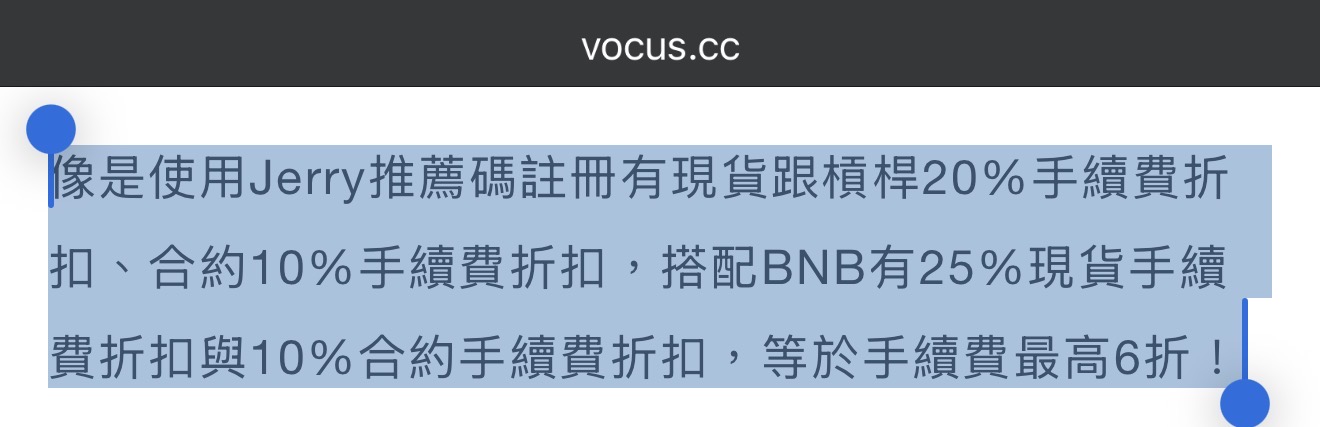
The arithmetic in that screenshot is correct (1 − 0.8 × 0.75 = 40%). The problem is that it presents “what the code gives you” and “what you buy yourself” as one single offer. Change the headline and the same math becomes “40% off fees with this invite code”.
The code itself is capped at 20%
That cap is Binance's own. Its affiliate program guide states that a partner earns up to 50% commission but may pass on a fee rebate of up to 20% to a friend.
The gap between those two numbers is the whole story: for any code to give you more than 20%, the excess cannot be a “discount”; it can only be someone handing back commission they already received. So instead of asking whose code is bigger, ask whether the person receiving that commission keeps it or passes it back to you.
A discount and a rebate are not the same thing
A discount means you are charged less at the moment of the trade; no money moves. A rebate means the full fee is charged and part of it is returned afterwards, which is why it can be seen, counted and paid out. They stack, but multiplying them into a single headline percentage makes readers think that number measures the code.
How our 40% is put together
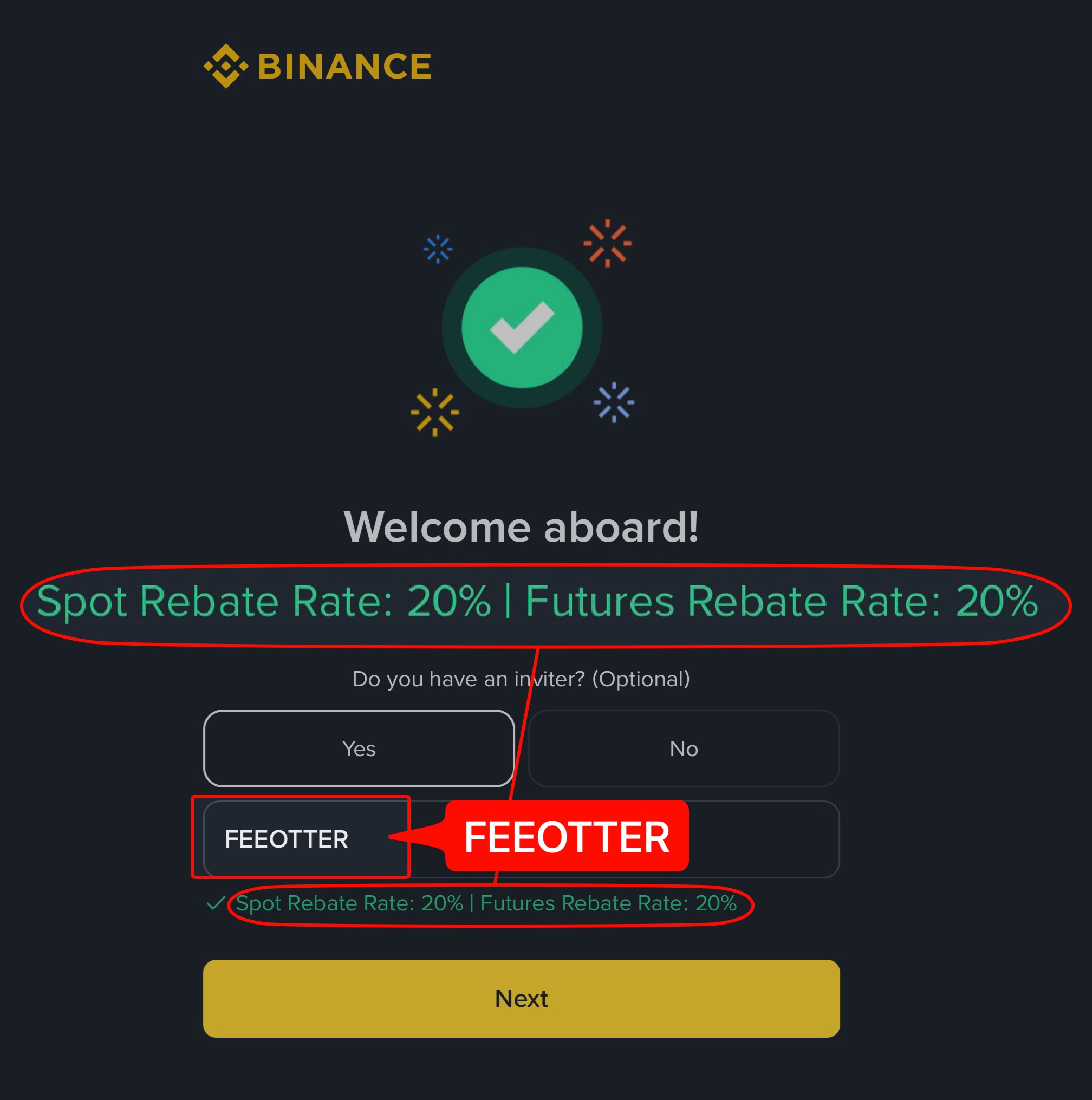
Sign up with referral code FEEOTTER and bind your UID (your exchange account ID), and the Binance rebate is 20% returned automatically by Binance plus another 20% paid by Fee Otter, 40% in total. The code runs through Binance's affiliate program rather than a personal referral code, so the time limits attached to ordinary codes do not apply. All of that 40% is fee money paid back to you: no BNB required, and VIP fee tiers are not baked into it. Turning the BNB deduction on as well is entirely up to you; the two stack.
Per 100 USDT of fees, with the last column scaled to 2,000 USDT of monthly fees (roughly 2,000,000 USDT of monthly volume):
| Setup | What you actually pay per 100 USDT of fees | Share of fees saved | Saved per month (USDT) |
|---|
| No referral code at all | 100 | 0% | 0 |
| An ordinary 20% referral code | 80 | 20% | 400 |
| Ordinary 20% referral code + BNB deduction on | 60 | 40% (the headline number) | 800 |
| Fee Otter (rebate 40%) | 60 | 40% | 800 |
| Fee Otter + BNB deduction on | 45 | 55% | 1,100 |
With the BNB deduction on in both cases, swapping a 20% code for a 40% rebate moves the effective saving from 40% to 55%. So 40% is not a ceiling. It is simply the top of the “20% code + BNB” combination.
If you are already a VIP on an exchange and want to rebind or sign up on another exchange, contact support: we can help you apply for special trading benefits or a higher rebate rate.
The table below shows the live rate for every exchange, read straight from the rebate platform rather than copied into this article:
To convert it to your own volume and VIP tier, use the effective fee rate calculator.
Four questions that decode any “up to XX%” headline
- Discount or rebate? “40% off” means you pay less now; “40% back” means it returns afterwards. They stack, but they should not be merged into one number.
- Does it require a platform token? BNB, GT and BGB reductions are something you fund yourself, not something the code gives you.
- Multiplication or addition? Anything written as “20% + 25% = 45%” has the number wrong.
- Where do you collect it, and can you audit it? An extra rebate should come with line-by-line records and a withdrawal request page, not a “DM me and I'll send it”.
What about the “500 USDT welcome bonus”?
New-user rewards like that are usually task-based vouchers or trial funds: unlocked step by step through deposits, volume or specific tasks, normally with an expiry date, and usually issued as vouchers rather than withdrawable cash. They are not a bad thing, but they happen once, whereas a rebate rate applies to every trade, every month. On 2,000 USDT of monthly fees, the gap between 20% and 40% is 4,800 USDT a year.
Three things you can verify yourself
- Binance's fee schedule: check your own VIP tier and whether the BNB deduction is on, and read your real rate.
- Binance's affiliate program page: the 20% cap on what a partner may rebate to a friend, and the 50% cap on partner commission.
- Your own rebate records: once your UID is bound, every fee and every rebate is listed line by line on the rebate platform (Fee Otter), queryable, with withdrawals on request. A code that quotes a percentage but cannot show you the records is worth nothing, whatever the percentage says.
FAQ
Does a Binance referral code really give 40% off fees?
The arithmetic holds, but only if you buy BNB and switch the deduction on yourself. The code segment is capped at 20% (Binance's own limit), and the other half is the BNB deduction every account gets without any code.
Why isn't 20% + 25% equal to 45%?
Because discounts multiply. Take 20% off and 0.8 remains; take another 25% off and 0.75 of that remains. 0.8 × 0.75 = 0.6, a 40% saving. Any article that adds the two together has the number wrong.
Do I need a referral code to get the BNB discount?
No. Any Binance account that holds BNB and enables “Using BNB Deduction” gets it, with or without a code. The cost is that you have to buy the BNB, and paying fees consumes it.
Can I save more without buying BNB?
Yes, through a rebate instead. Once your UID is bound, Binance returns 20% automatically and Fee Otter pays a further 20%, 40% in total, all of it fee money returned and no platform token required. Add the BNB deduction on top and the effective saving is 55%.
Are those “40%” articles lying?
The numbers themselves are not fabricated; what is missing are the conditions: that you fund the BNB yourself, and that half of it has nothing to do with the referral code. Check which segments make up the percentage and what each one requires.
When does the rebate arrive, and can I check it?
Binance charges the fee first and returns it afterwards. The automatic 20% is returned by Binance into your exchange account; the extra part is settled daily by Fee Otter and recorded line by line on the rebate platform, where it can be reviewed and paid out on request.
This article is informational and not investment advice. Binance fee rates, the BNB deduction and affiliate terms are summarised from official public documentation as of September 2026 and may change; Binance's own announcements and the live figures on the Fee Otter platform take precedence.


%2C2026-10-05%20%E5%8F%96%E6%A8%A3%3A%0A%20%20%20%20%20%20%20%E5%BA%95%E8%89%B2%20%230E3452%2C%E5%AD%97%E7%AC%A6%20%2303CA9B)%E3%80%82%0A%20%20%20%20%20%20%20%E7%94%A8%20potrace%20%E6%8F%8F%E5%AD%97%E7%AC%A6%E8%BC%AA%E5%BB%93%2C%E6%95%B4%E5%BC%B5%E7%95%AB%E5%B8%83%E7%9B%B4%E6%8E%A5%E6%98%A0%E5%B0%84%E5%88%B0%E9%80%99%E8%A3%A1%E7%9A%84%2032%20%E5%96%AE%E4%BD%8D%20%E2%80%94%E2%80%94%20%E4%B8%8D%E9%87%8D%E6%96%B0%E7%BD%AE%E4%B8%AD%2C%E4%BF%9D%E7%95%99%E5%AE%98%E6%96%B9%E7%9A%84%E7%95%99%E7%99%BD%E6%AF%94%E4%BE%8B%E3%80%82%0A%20%20%20%20%20%20%20%E8%A6%81%E6%94%B9%E8%AB%8B%E9%87%8D%E8%B7%91%E6%8F%8F%E5%9C%96%2C%E4%B8%8D%E8%A6%81%E6%86%91%E5%8D%B0%E8%B1%A1%E8%AA%BF%E3%80%82%20--%3E%0A%20%20%3Crect%20x%3D%221.5%22%20y%3D%221.5%22%20width%3D%2229%22%20height%3D%2229%22%20rx%3D%228%22%20fill%3D%22%230E3452%22%2F%3E%0A%20%20%3Cpath%20fill%3D%22%2303CA9B%22%20d%3D%22M23.02%205.97C22.14%206.02%2021.54%206.07%2021.22%206.1C20.72%206.15%2019.6%206.28%2019.41%206.31C19.31%206.33%2019.1%206.37%2018.94%206.39C18.29%206.5%2017.94%206.57%2017.2%206.73C16.92%206.79%2016%207.03%2015.8%207.09C15.36%207.23%2014.42%207.54%2014.39%207.56C14.38%207.57%2014.3%207.6%2014.23%207.62C13.82%207.76%2012.7%208.28%2012.13%208.6C11.95%208.7%2011.8%208.78%2011.79%208.78C11.7%208.78%2010.42%209.71%209.98%2010.08C9.16%2010.79%208.07%2012.09%207.6%2012.91C7.28%2013.46%207.18%2013.65%207.06%2013.91C6.87%2014.3%206.76%2014.53%206.68%2014.74C6.56%2015.08%206.37%2015.64%206.34%2015.73C6.33%2015.78%206.3%2015.91%206.27%2016C6.06%2016.79%205.93%2017.87%205.94%2018.62L5.95%2019.05L6.69%2019.04C7.78%2019.03%208.57%2018.94%209.73%2018.68C10.18%2018.58%2011.05%2018.33%2011.45%2018.18C11.52%2018.15%2011.7%2018.08%2011.84%2018.03C13.58%2017.38%2015.67%2016.19%2017.55%2014.77C17.8%2014.58%2018.67%2013.89%2018.74%2013.83C18.76%2013.81%2018.94%2013.66%2019.14%2013.48C19.34%2013.31%2019.54%2013.14%2019.58%2013.11C19.61%2013.07%2019.78%2012.92%2019.95%2012.77C20.94%2011.88%2022.24%2010.57%2023.2%209.48C23.68%208.94%2023.69%208.93%2023.86%208.73C23.94%208.63%2024.02%208.54%2024.03%208.53C24.17%208.4%2025.09%207.25%2025.52%206.67C25.67%206.47%2025.81%206.28%2025.83%206.26C25.86%206.23%2025.89%206.19%2025.9%206.16C25.92%206.13%2025.94%206.12%2025.95%206.13C25.98%206.15%2025.3%207.5%2024.99%208.07C24.88%208.28%2024.78%208.45%2024.78%208.46C24.78%208.46%2024.66%208.67%2024.51%208.93C24.24%209.4%2024.17%209.52%2024.07%209.69C24%209.81%2023.72%2010.27%2023.39%2010.8C22.69%2011.91%2021.44%2013.66%2020.74%2014.52C20.25%2015.12%2020.09%2015.31%2019.72%2015.73C19.01%2016.55%2018.19%2017.38%2017.42%2018.08C17.07%2018.39%2016.92%2018.52%2016.5%2018.87C16.37%2018.98%2016.24%2019.09%2016.2%2019.12C15.83%2019.43%2014.7%2020.21%2014.16%2020.54C13.69%2020.82%2012.69%2021.34%2012.41%2021.45C12.33%2021.48%2012.23%2021.52%2012.17%2021.55C12.01%2021.62%2011.45%2021.84%2011.11%2021.95C10.97%2022%2010.05%2022.26%209.84%2022.31C9.23%2022.45%208.97%2022.5%208.56%2022.56C8.43%2022.58%208.25%2022.61%208.16%2022.62C8.06%2022.64%207.79%2022.67%207.56%2022.69C7.32%2022.71%207.12%2022.74%207.12%2022.76C7.12%2022.85%207.58%2023.42%207.97%2023.82C9.2%2025.09%2010.67%2025.8%2012.52%2026.02C16.51%2026.48%2020.99%2024.06%2023.2%2020.25C23.32%2020.05%2023.43%2019.86%2023.46%2019.81C23.51%2019.73%2023.96%2018.81%2024.04%2018.62C24.67%2017.21%2025.19%2015.43%2025.52%2013.67C25.66%2012.9%2025.73%2012.45%2025.81%2011.77C25.99%2010.32%2026.05%209.33%2026.05%207.64C26.05%206.06%2026.04%206.01%2025.97%205.98C25.9%205.95%2023.53%205.94%2023.02%205.97Z%22%2F%3E%0A%3C%2Fsvg%3E%0A)


%2C2026-10-05%20%E5%8F%96%E6%A8%A3%3A%0A%20%20%20%20%20%20%20%E5%BA%95%E8%89%B2%20%23FFFFFF%2C%E5%AD%97%E7%AC%A6%20%235227FF)%E3%80%82%0A%20%20%20%20%20%20%20%E7%94%A8%20potrace%20%E6%8F%8F%E5%AD%97%E7%AC%A6%E8%BC%AA%E5%BB%93%2C%E6%95%B4%E5%BC%B5%E7%95%AB%E5%B8%83%E7%9B%B4%E6%8E%A5%E6%98%A0%E5%B0%84%E5%88%B0%E9%80%99%E8%A3%A1%E7%9A%84%2032%20%E5%96%AE%E4%BD%8D%20%E2%80%94%E2%80%94%20%E4%B8%8D%E9%87%8D%E6%96%B0%E7%BD%AE%E4%B8%AD%2C%E4%BF%9D%E7%95%99%E5%AE%98%E6%96%B9%E7%9A%84%E7%95%99%E7%99%BD%E6%AF%94%E4%BE%8B%E3%80%82%0A%20%20%20%20%20%20%20%E5%AE%98%E6%96%B9%E6%98%AF%E7%99%BD%E5%BA%95%E7%B4%AB%E8%89%B2%E5%AD%97%E7%AC%A6%3B%E7%99%BD%E5%BA%95%E5%8A%A0%E6%B7%A1%E9%82%8A%2C%E5%85%8D%E5%BE%97%E5%9C%A8%E7%99%BD%E8%89%B2%E8%83%8C%E6%99%AF%E4%B8%8A%E6%B6%88%E5%A4%B1%E3%80%82%0A%20%20%20%20%20%20%20%E8%A6%81%E6%94%B9%E8%AB%8B%E9%87%8D%E8%B7%91%E6%8F%8F%E5%9C%96%2C%E4%B8%8D%E8%A6%81%E6%86%91%E5%8D%B0%E8%B1%A1%E8%AA%BF%E3%80%82%20--%3E%0A%20%20%3Crect%20x%3D%221.5%22%20y%3D%221.5%22%20width%3D%2229%22%20height%3D%2229%22%20rx%3D%228%22%20fill%3D%22%23FFFFFF%22%20stroke%3D%22%23E4E4E7%22%2F%3E%0A%20%20%3Cpath%20fill%3D%22%235227FF%22%20d%3D%22M13.31%208.92L13.31%2012.28L9.94%2012.28L6.56%2012.28L6.57%2015.71C6.58%2019.51%206.57%2019.29%206.79%2020.2C7.56%2023.33%2010.21%2025.78%2013.38%2026.31C14.1%2026.43%2014.44%2026.44%2019.24%2026.44L23.91%2026.44L23.91%2023.05L23.91%2019.66L19.2%2019.65L14.48%2019.64L14.28%2019.56C13.89%2019.41%2013.63%2019.16%2013.44%2018.76L13.36%2018.58L13.35%2015.46L13.34%2012.34L18.56%2012.34L23.78%2012.34L23.78%208.95L23.78%205.56L18.55%205.56L13.31%205.56L13.31%208.92Z%22%2F%3E%0A%3C%2Fsvg%3E%0A)

 Telegram · @feeotter