Binance trading bots charge no subscription. Every bot order pays the normal spot or futures trading fee: 0.1% on spot at VIP 0, and 0.02% maker / 0.05% taker on USDⓈ-M futures, with 25% off for spot bots and 10% off for futures bots when you pay fees in BNB. The strategies Binance lists today are Spot Grid, Futures Grid, Spot DCA, Futures DCA, the Rebalancing Bot, the Funding Rate Arbitrage bot and the TWAP / VP algo orders (checked 2026-10-22).
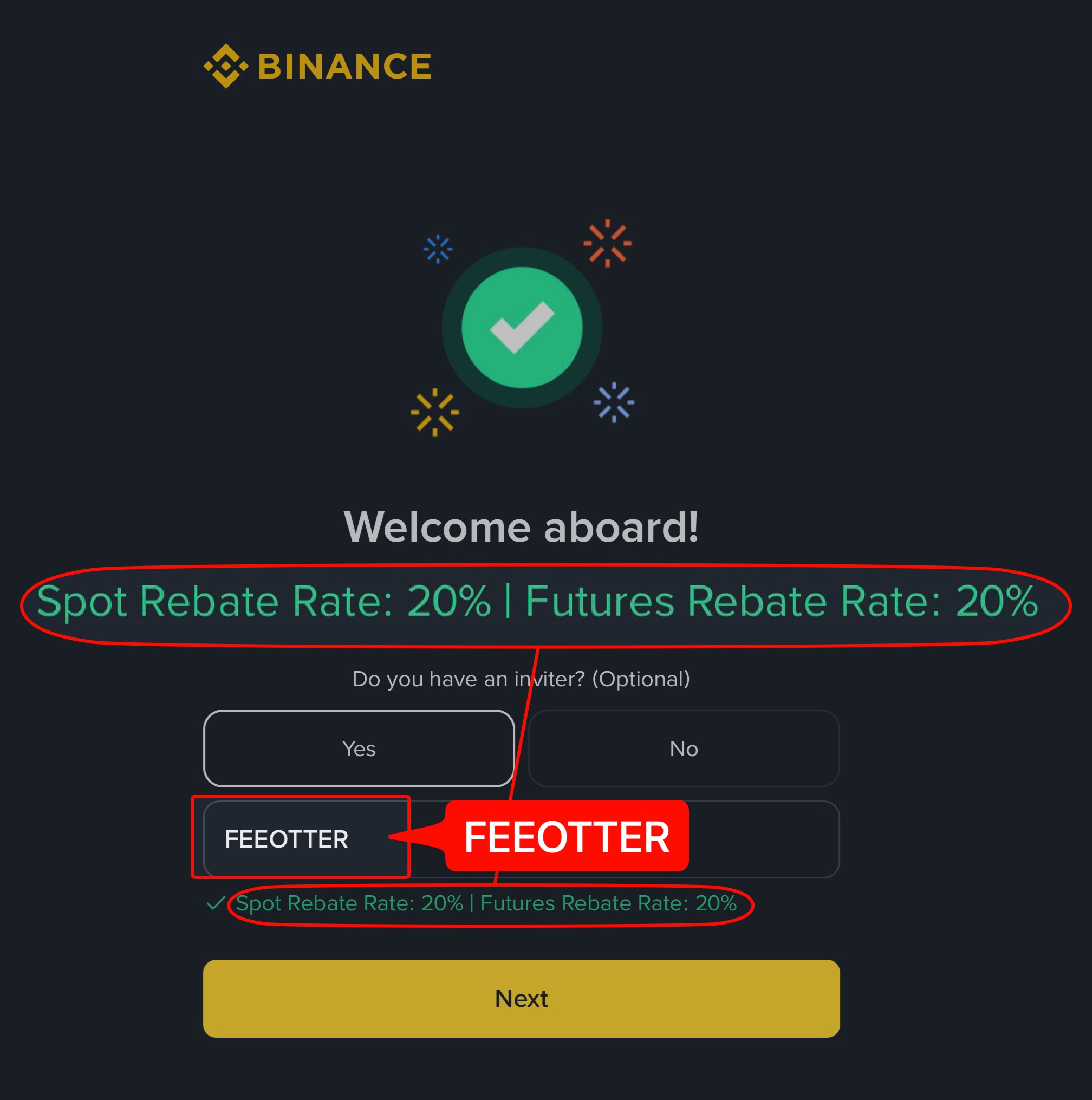
Sign up with the code FEEOTTER for a 40% rebate (20% automatic exchange rebate + 20% Fee Otter extra rebate). Binance's referral terms do not say anything specific about bot orders. The one bot page that does is the arbitrage bot: referral rebates apply to its spot leg, not its futures leg. Bots trade often, so fees pile up faster than with manual trading; register with FEEOTTER before you start a bot, because 40% is twice the common 20% code, and check your rebate records for what actually comes back.
Which trading bots does Binance offer?
| Bot | What it does | Key numbers from Binance |
|---|---|---|
| Spot Grid | Buys lower and sells higher inside a price range | 2 to 500 grids (170 max with Trailing Up); up to 50 at once |
| Futures Grid | Grid on futures, long, short or neutral | Up to 1,000 grids on USDⓈ-M, 169 on COIN-M; up to 99 USDⓈ-M strategies per account |
| Spot DCA | Buys more at set drops, sells everything at the take-profit | Up to 10 per trading pair; 60-second default cooldown between rounds |
| Futures DCA | The futures version of scaling in | Listed in the bot terms and category menu; we did not find its help article this time |
| Rebalancing Bot | Keeps several coins at target weights | 2 to 10 coins; up to 20 strategies; 10 USDT minimum per order |
| Funding Rate Arbitrage bot | Buys spot and shorts the perpetual (or the reverse) to collect funding | 10% of the investment held as a buffer; up to 10 strategies |
| TWAP / VP (futures algo orders) | Splits a large order into small timed fills | TWAP runs 5 minutes to 24 hours; order must exceed 1,000 USDT |
Sources: Binance Trading Bots Terms (updated 2026-01-04), Trading Bots landing page guide, Spot Grid, Futures Grid, Spot DCA, Rebalancing Bot, Funding Rate Arbitrage bot, Futures TWAP, checked 2026-10-22. The category menu also lists Position Snowball, the Bots Marketplace and Auto-Invest, which this guide does not cover.
Before you start: bots run from a separate Trading Bots Account
Under the Trading Bots Account rules (updated 2026-01-08), Spot Grid, Futures Grid, the Rebalancing Bot and Spot DCA all run from this account, kept apart from your Spot and Futures accounts:
- No manual transfers: the funds a bot needs move in automatically when it starts and stay locked while it runs; they return to your Spot (or Futures) account about 30 seconds after it ends.
- The BNB discount still works: 25% off for spot bots and 10% off for USDⓈ-M futures bots. The fee is first charged to the bot account and the discount is refunded afterwards, shown under Fees Return History; you need enough BNB for it to apply.
- Same fee schedule as regular trading: Spot Grid follows spot rates, Futures Grid follows futures rates plus funding.
Spot Grid: setting one up, the parameters and leaving the range
Open the page
on the web, Trade → Trading Bots → Spot Grid; in the app, Trade → Bots → Spot Grid.Pick a setup mode
"AI" generates parameters from technical analysis of the period you choose, and you can copy them into manual mode to edit; "Popular" uses recommended settings; "Manual" lets you choose arithmetic or geometric yourself.Set the range and grid count
enter the lower price, upper price and number of grids (2 minimum, 500 maximum). More grids need more funds.Enter the investment
quote coin only, or both coins; the amount actually needed may differ slightly from what you type.Advanced settings (optional)
trigger price, stop loss (below the lower price), take profit (above the upper price), and "Sell All Base Coins on Stop", which is on by default for new strategies.
- Leaving the range: orders stop executing once price falls below the lower price or rises above the upper price; in Binance's example the strategy is suspended and resumes when price comes back.
- More than 170 grids: the Dynamic Order Mechanism switches on and keeps at most 170 orders near the market price; Trailing Up is unavailable in this mode.
- Cancelling an order ends the grid: cancelling one of the grid's orders on the spot trading page terminates the whole strategy; delisting or a hit take-profit or stop-loss also ends it.
- On stop: open orders are cancelled and profits settle at market price; with "Sell All" off, base coins stay in your Spot account. If holdings are large or liquidity is poor, the system may not sell.
Each grid's profit has to pay two fees, one buy and one sell, before any of it is yours: at VIP 0 spot that is 0.1% each time, so a 0.3% profit per grid leaves about 0.1% after 0.2% in fees; with BNB it is 0.075% each time, leaving about 0.15%. Binance's "grid profit" is already net of fees, while "float profit" is the unrealized gain or loss on the base coin you hold; total profit is the two added together.
Futures Grid: direction, grid count and what ends a grid
- Direction: long and short can open an initial position at creation; neutral opens none and lets the first fill set the direction.
- Leverage: Binance gives no fixed range; the cap follows the symbol's leverage bracket. If the position's notional value exceeds the maximum for its leverage bracket, the grid expires, whether it is in profit or not; if Binance lowers a symbol's maximum leverage, grids above the new limit expire once new orders are placed.
- Margin mode: USDⓈ-M grids can be cross or isolated, with up to 99 strategies per account (50 cross, 49 isolated) and only one active cross grid per symbol; COIN-M grids do not support isolated margin for now.
- Bots Risk Ratio (BRR): margin balance divided by occupied margin; below 1.0 the grid expires. Insufficient margin, liquidation, delisting or delivery also end a grid. Since 2026-06-04 the estimated liquidation price for USDⓈ-M grids assumes every unfilled order on the risky side gets filled.
- Positions on stop: with "Close All Positions on Stop" on, positions close at market; with it off, you close them yourself. Open orders are always cancelled.
- Fee warning: if profit per grid is below the maker fee, the system warns that fees may not be covered.
Binance's total profit formula is net realized profit + unrealized PnL + funding fees. For leverage limits and account rules on Binance futures itself, see the Binance futures guide.
Spot DCA and the Rebalancing Bot
- Spot DCA: "Buy" mode adds as price falls and sells at the take-profit; "Sell" mode works the other way round. Settings include price deviation, base order, DCA order, max DCA count and two multipliers: with a 1,000 USDT DCA order and a size multiplier of 2, three entries are 1,000, 2,000 and 4,000 USDT. A running bot cannot be edited or paused, only ended; on end, base coins from open orders are sold at market, and a manual cancel lets you keep them. Binance warns that dust left after fees can turn a round's profit negative.
- Rebalancing Bot: 2 to 10 coins, triggered by coin ratio change (preset steps from 0.5% to 50%) or by time (30 minutes to 28 days). Orders go in as limit IOC, with market orders only when closing; orders under 10 USDT will not execute. Normal spot fees apply, with 25% off in BNB.
Funding Rate Arbitrage bot: the clearest rebate rule
Positive carry buys spot and shorts the same amount of the perpetual to collect positive funding; reverse carry goes long futures and sells spot. The APR shown is |3-day cumulative funding rate| ÷ 3 × 365, a backward-looking number. 10% of the investment is held as a buffer, so 1,000 USDT in a positive-carry strategy puts 900 USDT into spot.
Binance's page for this bot states: "Referral rebates apply to Spot trading but not arbitrage Futures trading." So the futures leg's fees generate no referral rebate, and anyone running arbitrage should leave those fees out of their rebate math. On risk, Binance says the position is liquidated when uniMMR falls below 105%; a gap between spot and futures prices, or funding turning negative, can wear down margin. For the full cost picture, see funding rate arbitrage: the real cost.
How bot fees are charged
| Type | VIP 0 rate | Paying fees in BNB |
|---|---|---|
| Spot Grid, Spot DCA, Rebalancing | 0.1% maker / 0.1% taker | 0.075% / 0.075% (25% off) |
| USDⓈ-M Futures Grid, Futures DCA | 0.02% maker / 0.05% taker | 10% off |
Sources: Binance spot fee schedule, Binance futures fee FAQ (updated 2026-05-01) and the Trading Bots Account rules, checked 2026-10-22. The Spot DCA and Rebalancing pages both say there are "no additional fees". Binance does not say whether bots have a separate fee tier; for how VIP levels work, see Binance VIP fee tiers.
Do bot orders earn the rebate? What Binance's terms say
We read the Binance Affiliate Program guide (updated 2026-07-15) and the referral program FAQ (updated 2026-08-05), checked 2026-10-22:
- Where commission comes from: the trading fees paid by referred users on spot, margin and futures. Neither document mentions trading bots, grids or API orders.
- No fee, no commission: "no commission will be generated from your referrals' trading with no trading fee". A grid on a zero-fee pair earns no rebate.
- Net fees: commission is calculated on net fees after any market maker rebates.
- Arbitrage bot: as above, Binance says the futures leg is not eligible.
Under Binance's rules a bot order is an ordinary fill charged at spot or futures rates, but no official sentence says outright that Grid or DCA bot orders count toward referral commission, so we will not answer for Binance. Once your bot is running, go by your Fee Otter rebate records and check that the fees from those days have matching rebate entries. Binance says its futures TWAP was launched for API users; API order rules are covered in Binance API trading setup.
Sign up with the code FEEOTTER for a 40% rebate (20% automatic exchange rebate + 20% Fee Otter extra rebate), twice the common 20% code. The extra rebate is paid in on-chain USDT on BEP20, from 1 USDT, with the 0.015 USDT network fee paid by the user. The sign-up link is in Binance referral code; for an existing account, see the Binance rebind guide.


%2C2026-10-05%20%E5%8F%96%E6%A8%A3%3A%0A%20%20%20%20%20%20%20%E5%BA%95%E8%89%B2%20%230E3452%2C%E5%AD%97%E7%AC%A6%20%2303CA9B)%E3%80%82%0A%20%20%20%20%20%20%20%E7%94%A8%20potrace%20%E6%8F%8F%E5%AD%97%E7%AC%A6%E8%BC%AA%E5%BB%93%2C%E6%95%B4%E5%BC%B5%E7%95%AB%E5%B8%83%E7%9B%B4%E6%8E%A5%E6%98%A0%E5%B0%84%E5%88%B0%E9%80%99%E8%A3%A1%E7%9A%84%2032%20%E5%96%AE%E4%BD%8D%20%E2%80%94%E2%80%94%20%E4%B8%8D%E9%87%8D%E6%96%B0%E7%BD%AE%E4%B8%AD%2C%E4%BF%9D%E7%95%99%E5%AE%98%E6%96%B9%E7%9A%84%E7%95%99%E7%99%BD%E6%AF%94%E4%BE%8B%E3%80%82%0A%20%20%20%20%20%20%20%E8%A6%81%E6%94%B9%E8%AB%8B%E9%87%8D%E8%B7%91%E6%8F%8F%E5%9C%96%2C%E4%B8%8D%E8%A6%81%E6%86%91%E5%8D%B0%E8%B1%A1%E8%AA%BF%E3%80%82%20--%3E%0A%20%20%3Crect%20x%3D%221.5%22%20y%3D%221.5%22%20width%3D%2229%22%20height%3D%2229%22%20rx%3D%228%22%20fill%3D%22%230E3452%22%2F%3E%0A%20%20%3Cpath%20fill%3D%22%2303CA9B%22%20d%3D%22M23.02%205.97C22.14%206.02%2021.54%206.07%2021.22%206.1C20.72%206.15%2019.6%206.28%2019.41%206.31C19.31%206.33%2019.1%206.37%2018.94%206.39C18.29%206.5%2017.94%206.57%2017.2%206.73C16.92%206.79%2016%207.03%2015.8%207.09C15.36%207.23%2014.42%207.54%2014.39%207.56C14.38%207.57%2014.3%207.6%2014.23%207.62C13.82%207.76%2012.7%208.28%2012.13%208.6C11.95%208.7%2011.8%208.78%2011.79%208.78C11.7%208.78%2010.42%209.71%209.98%2010.08C9.16%2010.79%208.07%2012.09%207.6%2012.91C7.28%2013.46%207.18%2013.65%207.06%2013.91C6.87%2014.3%206.76%2014.53%206.68%2014.74C6.56%2015.08%206.37%2015.64%206.34%2015.73C6.33%2015.78%206.3%2015.91%206.27%2016C6.06%2016.79%205.93%2017.87%205.94%2018.62L5.95%2019.05L6.69%2019.04C7.78%2019.03%208.57%2018.94%209.73%2018.68C10.18%2018.58%2011.05%2018.33%2011.45%2018.18C11.52%2018.15%2011.7%2018.08%2011.84%2018.03C13.58%2017.38%2015.67%2016.19%2017.55%2014.77C17.8%2014.58%2018.67%2013.89%2018.74%2013.83C18.76%2013.81%2018.94%2013.66%2019.14%2013.48C19.34%2013.31%2019.54%2013.14%2019.58%2013.11C19.61%2013.07%2019.78%2012.92%2019.95%2012.77C20.94%2011.88%2022.24%2010.57%2023.2%209.48C23.68%208.94%2023.69%208.93%2023.86%208.73C23.94%208.63%2024.02%208.54%2024.03%208.53C24.17%208.4%2025.09%207.25%2025.52%206.67C25.67%206.47%2025.81%206.28%2025.83%206.26C25.86%206.23%2025.89%206.19%2025.9%206.16C25.92%206.13%2025.94%206.12%2025.95%206.13C25.98%206.15%2025.3%207.5%2024.99%208.07C24.88%208.28%2024.78%208.45%2024.78%208.46C24.78%208.46%2024.66%208.67%2024.51%208.93C24.24%209.4%2024.17%209.52%2024.07%209.69C24%209.81%2023.72%2010.27%2023.39%2010.8C22.69%2011.91%2021.44%2013.66%2020.74%2014.52C20.25%2015.12%2020.09%2015.31%2019.72%2015.73C19.01%2016.55%2018.19%2017.38%2017.42%2018.08C17.07%2018.39%2016.92%2018.52%2016.5%2018.87C16.37%2018.98%2016.24%2019.09%2016.2%2019.12C15.83%2019.43%2014.7%2020.21%2014.16%2020.54C13.69%2020.82%2012.69%2021.34%2012.41%2021.45C12.33%2021.48%2012.23%2021.52%2012.17%2021.55C12.01%2021.62%2011.45%2021.84%2011.11%2021.95C10.97%2022%2010.05%2022.26%209.84%2022.31C9.23%2022.45%208.97%2022.5%208.56%2022.56C8.43%2022.58%208.25%2022.61%208.16%2022.62C8.06%2022.64%207.79%2022.67%207.56%2022.69C7.32%2022.71%207.12%2022.74%207.12%2022.76C7.12%2022.85%207.58%2023.42%207.97%2023.82C9.2%2025.09%2010.67%2025.8%2012.52%2026.02C16.51%2026.48%2020.99%2024.06%2023.2%2020.25C23.32%2020.05%2023.43%2019.86%2023.46%2019.81C23.51%2019.73%2023.96%2018.81%2024.04%2018.62C24.67%2017.21%2025.19%2015.43%2025.52%2013.67C25.66%2012.9%2025.73%2012.45%2025.81%2011.77C25.99%2010.32%2026.05%209.33%2026.05%207.64C26.05%206.06%2026.04%206.01%2025.97%205.98C25.9%205.95%2023.53%205.94%2023.02%205.97Z%22%2F%3E%0A%3C%2Fsvg%3E%0A)


%2C2026-10-05%20%E5%8F%96%E6%A8%A3%3A%0A%20%20%20%20%20%20%20%E5%BA%95%E8%89%B2%20%23FFFFFF%2C%E5%AD%97%E7%AC%A6%20%235227FF)%E3%80%82%0A%20%20%20%20%20%20%20%E7%94%A8%20potrace%20%E6%8F%8F%E5%AD%97%E7%AC%A6%E8%BC%AA%E5%BB%93%2C%E6%95%B4%E5%BC%B5%E7%95%AB%E5%B8%83%E7%9B%B4%E6%8E%A5%E6%98%A0%E5%B0%84%E5%88%B0%E9%80%99%E8%A3%A1%E7%9A%84%2032%20%E5%96%AE%E4%BD%8D%20%E2%80%94%E2%80%94%20%E4%B8%8D%E9%87%8D%E6%96%B0%E7%BD%AE%E4%B8%AD%2C%E4%BF%9D%E7%95%99%E5%AE%98%E6%96%B9%E7%9A%84%E7%95%99%E7%99%BD%E6%AF%94%E4%BE%8B%E3%80%82%0A%20%20%20%20%20%20%20%E5%AE%98%E6%96%B9%E6%98%AF%E7%99%BD%E5%BA%95%E7%B4%AB%E8%89%B2%E5%AD%97%E7%AC%A6%3B%E7%99%BD%E5%BA%95%E5%8A%A0%E6%B7%A1%E9%82%8A%2C%E5%85%8D%E5%BE%97%E5%9C%A8%E7%99%BD%E8%89%B2%E8%83%8C%E6%99%AF%E4%B8%8A%E6%B6%88%E5%A4%B1%E3%80%82%0A%20%20%20%20%20%20%20%E8%A6%81%E6%94%B9%E8%AB%8B%E9%87%8D%E8%B7%91%E6%8F%8F%E5%9C%96%2C%E4%B8%8D%E8%A6%81%E6%86%91%E5%8D%B0%E8%B1%A1%E8%AA%BF%E3%80%82%20--%3E%0A%20%20%3Crect%20x%3D%221.5%22%20y%3D%221.5%22%20width%3D%2229%22%20height%3D%2229%22%20rx%3D%228%22%20fill%3D%22%23FFFFFF%22%20stroke%3D%22%23E4E4E7%22%2F%3E%0A%20%20%3Cpath%20fill%3D%22%235227FF%22%20d%3D%22M13.31%208.92L13.31%2012.28L9.94%2012.28L6.56%2012.28L6.57%2015.71C6.58%2019.51%206.57%2019.29%206.79%2020.2C7.56%2023.33%2010.21%2025.78%2013.38%2026.31C14.1%2026.43%2014.44%2026.44%2019.24%2026.44L23.91%2026.44L23.91%2023.05L23.91%2019.66L19.2%2019.65L14.48%2019.64L14.28%2019.56C13.89%2019.41%2013.63%2019.16%2013.44%2018.76L13.36%2018.58L13.35%2015.46L13.34%2012.34L18.56%2012.34L23.78%2012.34L23.78%208.95L23.78%205.56L18.55%205.56L13.31%205.56L13.31%208.92Z%22%2F%3E%0A%3C%2Fsvg%3E%0A)