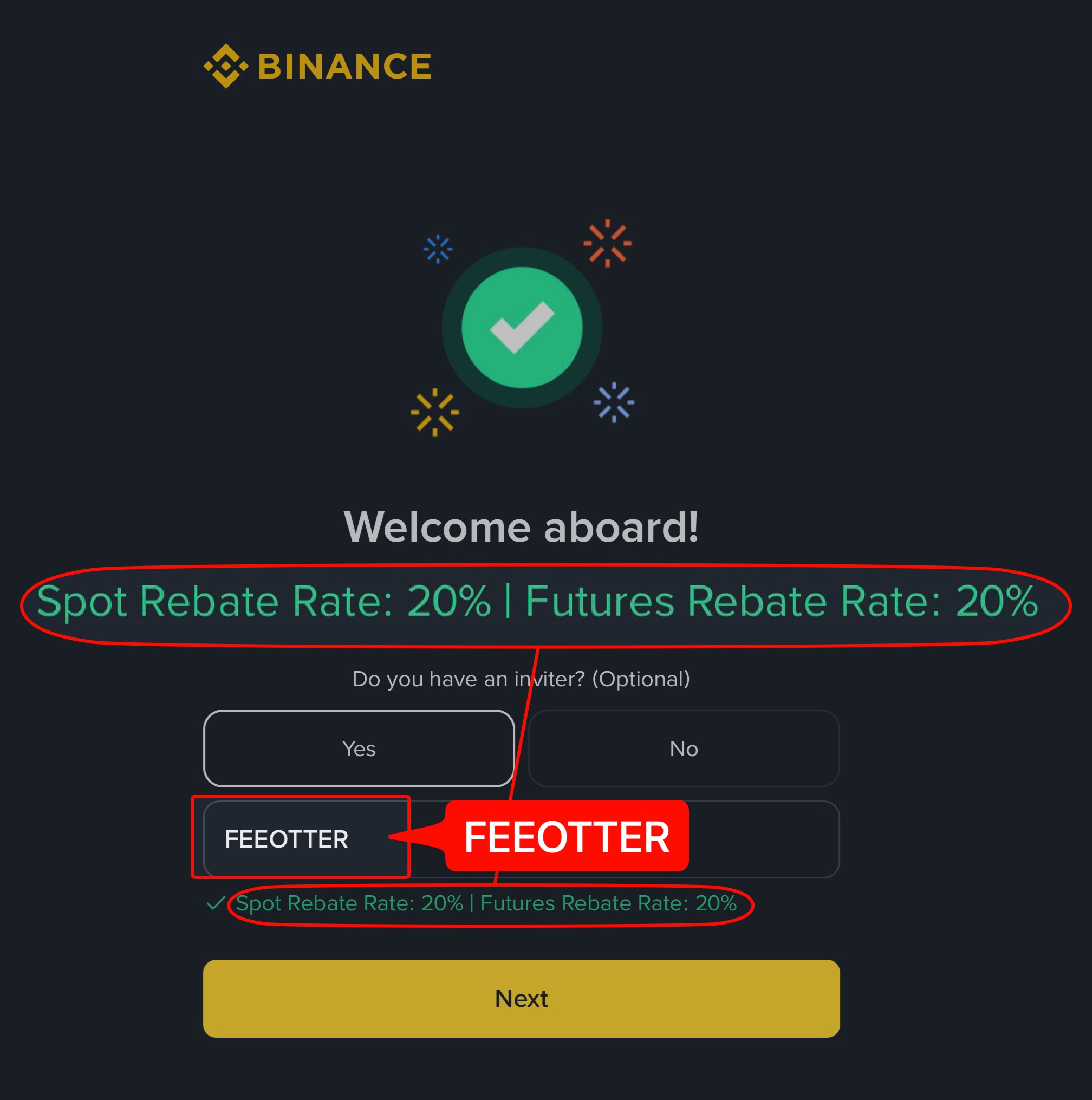
Binance Futures requires identity verification before you can trade, and a new futures account is capped at 20x leverage for its first 30 days. BTCUSDT allows up to 150x on notional up to 300,000 USDT with a 0.4% maintenance margin rate, a liquidation costs an extra 1.25% of notional, and funding settles every 8 hours. Bind with referral code FEEOTTER (Fee Otter's dedicated link) before you open the account and you get 40% of your futures fees back (20% returned automatically by Binance + 20% extra from Fee Otter), so VIP 0 maker drops to 0.012% and taker to 0.03% (checked 2026-10-22).
Binance Futures looks like any other derivatives screen, but a handful of Binance-specific rules decide whether you get liquidated and what each trade really costs: new futures accounts are capped at 20x for their first 30 days, BTCUSDT maintenance margin is charged in notional brackets, liquidations carry a separate "liquidation clearance fee", and funding switches from every 8 hours to every hour once it hits its cap. This guide walks through the USDⓈ-M BTCUSDT perpetual using Binance's help center and official futures API: account opening, margin modes, leverage brackets, the liquidation-price formula, the insurance fund and ADL, funding rules and order types. It ends with a worked 0.01 BTC example. Figures are as of 2026-09-28; Binance can change them at any time, so check the official pages before trading.
A side-by-side comparison of beginner rules across exchanges (max leverage, minimum order, demo trading) is in our futures beginner exchange comparison; this article covers Binance only. Before you open futures, bind with referral code FEEOTTER so every futures fee earns a 40% rebate, twice a typical 20% referral code.
Summary
- Opening requirements: pick a trading-experience level when you open the futures account (Beginner defaults to 2x, Experienced 5x, Advance 20x) and accept the service agreement and risk acknowledgment. Identity verification is required before trading, and also before you can adjust leverage.
- New-account leverage cap: since 2025-12-07, futures accounts cannot use more than 20x during their first 30 days; the limit is lifted gradually afterwards.
- BTCUSDT brackets: up to 300,000 USDT notional allows 150x with a 0.4% maintenance margin rate; 300,000 to 800,000 allows 100x at 0.5%. Larger positions get lower leverage and higher maintenance margin.
- Liquidation clearance fee: a liquidated BTCUSDT position is charged 1.25% of notional (1.5% on the coin-margined BTCUSD). For small positions, liquidation means losing practically the whole margin.
- Funding: BTCUSDT currently settles every 8 hours (00:00, 08:00, 16:00 UTC) with a ±0.3% cap; if a settlement hits the cap, the next cycles switch to hourly.
- Fees and rebate: VIP 0 maker 0.02%, taker 0.05%; after the 40% rebate, 0.012% and 0.03%, and about 0.0108% and 0.027% if you also pay fees in BNB (10% off). Funding and the liquidation clearance fee are not rebated.
Opening a Binance futures account: steps and three limits
Binance's help article "How to Open a Binance Futures Account?" describes the flow: click [Futures] on the homepage → log in → [Open Account] → in the pop-up choose your trading experience, optionally enter a futures referral code, accept the Binance Futures Service Agreement & Risk Acknowledgment → [Open Now]. You can trade once the account is funded. That help article does not mention a futures quiz; if the app shows extra questions for your region, follow the app.
The experience level sets your default leverage:
| Experience chosen | Default leverage | Custom leverage at opening |
|---|---|---|
| Beginner | 2x | No |
| Experienced | 5x | No |
| Advance | 20x | Yes |
Source: How to Open a Binance Futures Account?
Three further limits apply, all listed in Binance's Leverage and Margin of USDⓈ-M Futures:
- 20x max for the first 30 days: from 2025-12-07, leverage above 20x is unavailable to futures accounts within 30 days of opening, applied retroactively. New accounts with no positions must keep every new position at 20x or below; the cap is lifted gradually after 30 days.
- 5x max on sub-accounts: from 2025-08-12, futures accounts created by regular users' sub-accounts cannot use more than 5x.
- KYC before adjusting leverage: Binance states that adjusting leverage requires completed identity verification, and data can take up to 48 hours to sync after KYC is approved. If a leverage change fails right after verification, the sync is the usual reason.
How KYC levels differ between exchanges is covered in our exchange KYC comparison.
USDⓈ-M vs COIN-M: start with USDⓈ-M
Binance futures come in USDⓈ-M and COIN-M. The difference is what you post as margin and what profit and loss settle in. For the BTC perpetual, the official futures API shows:
| Item | USDⓈ-M BTCUSDT perpetual | COIN-M BTCUSD perpetual |
|---|---|---|
| Margin / settlement asset | USDT | BTC |
| Order unit | BTC quantity, minimum 0.001 BTC | Contracts, 1 contract = 100 USD |
| Minimum notional | 50 USDT | n/a |
| Liquidation clearance fee rate | 1.25% | 1.5% |
Source: Binance USDⓈ-M and COIN-M futures official API (exchangeInfo), checked 2026-09-28.
USDⓈ-M is far easier for a beginner: margin, PnL and fees are all in USDT, so you always know what you made or lost. With COIN-M your margin is BTC, so when BTC falls your collateral shrinks too. Binance's ADL article also notes that all coin-margined contracts using the same collateral asset share one insurance fund, which is smaller, so COIN-M contracts are more likely to be hit by auto-deleveraging than USDⓈ-M. The rest of this guide uses USDⓈ-M BTCUSDT.
Binance also offers Multi-Assets Mode (several assets used together as margin) and Portfolio Margin accounts, which follow different rules; for example, the liquidation article says automated negative-balance clearance does not apply when Multi-Assets Mode is on. Beginners can stay in the default single-asset mode.
Cross vs isolated: two Binance-specific differences
Cross margin uses your whole futures wallet to support all positions; isolated margin limits each position to the margin you assign it, so a liquidation costs at most that margin. The general concept is in the comparison article; here are the Binance rules:
- You cannot lower leverage on an open isolated position: Binance's FAQ says cross positions can be adjusted up or down with [Adjust Leverage], but isolated positions cannot have their leverage reduced. To cut risk you add margin or reduce the position.
- Hedge mode liquidation prices: in Hedge Mode with cross margin, long and short positions on the same symbol share one liquidation price; if both are isolated, each has its own, depending on its margin.
- Hedge mode bracket limits are shared: long and short notional are added in absolute value against the same bracket limit.
Beginners are better off starting with isolated margin and deciding the leverage before opening, because an isolated position's leverage cannot be lowered afterwards.
BTCUSDT leverage and maintenance margin brackets
Binance calculates maintenance margin in brackets: the larger the notional, the lower the maximum leverage and the higher the maintenance margin rate. The official formula is:
Maintenance Margin = Notional × Maintenance Margin Rate − Maintenance Amount
The first BTCUSDT brackets:
| Bracket | Notional (USDT) | Max leverage | Maintenance margin rate | Maintenance amount (USDT) |
|---|---|---|---|---|
| 1 | 0–300,000 | 150x | 0.40% | 0 |
| 2 | 300,000–800,000 | 100x | 0.50% | 300 |
| 3 | 800,000–3,000,000 | 75x | 0.65% | 1,500 |
| 4 | 3,000,000–12,000,000 | 50x | 1.00% | 12,000 |
| 5 | 12,000,000–70,000,000 | 25x | 2.00% | 132,000 |
| 6 | 70,000,000–100,000,000 | 20x | 2.50% | 482,000 |
| 7 | 100,000,000–230,000,000 | 10x | 5.00% | 2,982,000 |
Source: the official public data behind Binance's Leverage & Margin page, checked 2026-09-28. There are 12 brackets; the last (1.2 to 1.8 billion) allows only 1x. New accounts are additionally capped at 20x for 30 days.
Two things to note. First, maintenance margin depends only on notional, not on the leverage you pick: a 10,000 USDT position needs 40 USDT of maintenance margin at 5x or at 20x; what changes is how much initial margin you put up, which is your distance to liquidation. Second, Binance may adjust a bracket's maintenance margin rate by less than 0.5% without an announcement.
How the liquidation price works: mark price, clearance fee, insurance fund
Liquidation uses the mark price
Binance Futures uses a Last Price and a Mark Price. The Last Price is the latest trade and is used for realized PnL; the liquidation price and unrealized PnL are based on the Mark Price, which combines funding data with a basket of spot-exchange prices. In the app you can switch the chart between them in [Classic] mode. The trigger condition is:
Collateral (initial collateral + realized PnL + unrealized PnL) < Maintenance Margin → liquidation
Margin Ratio = Maintenance Margin ÷ Margin Balance; liquidation happens at 100%, and Binance recommends keeping it below 80%.
The isolated-margin formula
Binance's "How to Calculate Liquidation Price of USDⓈ-M Futures Contracts" gives a general cross-margin formula; for isolated margin the other contracts' maintenance margin and unrealized PnL are set to zero. For a one-way long it simplifies to:
Liquidation price ≈ (entry price × size − isolated margin − maintenance amount) ÷ (size − size × MMR)
This is an approximation: fees and funding payments change the isolated margin, and in fast markets the mark price can jump past the liquidation price in a second, so the actual price can be worse. Binance also offers a futures calculator, and the order panel shows an estimated liquidation price.
What happens during liquidation
According to Binance Futures Liquidation Protocols, everyone is subject to the same "Smart Liquidation":
- On liquidation, all open orders are cancelled (cross), or all open orders in the same token (isolated).
- The system first sends one large Immediate-or-Cancel order to offload the position. If the remaining collateral, after realized losses and the clearance fee, is back above maintenance margin, liquidation stops; the position is not necessarily closed in full.
- Any unfilled part becomes a "bankrupt position" taken over by the Futures Insurance Fund at the bankruptcy price; the fund keeps any loss or profit.
- Only if the insurance fund cannot absorb the loss does auto-deleveraging (ADL) start.
When a position is liquidated, Binance deducts a liquidation clearance fee from the assets supporting it, shown as "Liquidation Clearance" in your history and calculated as notional × fee rate; for BTCUSDT the rate is 1.25%. Binance also warns: because maintenance margin is based on position size, a small position's effective maintenance margin can be lower than the clearance fee rate, so small positions are more likely to become fully bankrupt when liquidated. BTCUSDT's first bracket MMR is only 0.4%, below the 1.25% fee, so a typical retail position rarely has any margin left after liquidation.
Binance's liquidation protocols state that in volatile markets the Futures Insurance Fund may take over liquidated positions directly at the bankruptcy price, which may be less favourable than the liquidation price and cause greater losses, and that margin-call and liquidation notifications are only risk warnings whose timely delivery is not guaranteed. (Binance Futures Liquidation Protocols)
ADL: profitable traders can be deleveraged too
ADL is the last step of liquidation: when the insurance fund cannot take a bankrupt position, the system closes opposing positions that are the most profitable and most leveraged at the bankruptcy price, by ranking. The ranking is PnL percentage × effective leverage when in profit, and PnL percentage ÷ effective leverage when at a loss; every position shows an ADL indicator. No trading fee is charged to the deleveraged trader, who can reopen immediately. Taking partial profits and lowering leverage moves you down the queue. Source: What Is Auto-Deleveraging (ADL).
Funding: every 8 hours for BTCUSDT, hourly when capped
Funding is paid directly between longs and shorts; Binance takes no fee. Amount = position notional (mark price × size) × funding rate. When the rate is positive longs pay shorts; when negative, shorts pay longs. You only pay or receive if you hold a position at the funding time.
| Item | BTCUSDT (checked 2026-09-28) |
|---|---|
| Interval | 8 hours: 00:00, 08:00, 16:00 UTC |
| Cap / floor | +0.3% / −0.3% |
| Interest component | 0.01% per interval (0.03% per day) |
| Timing deviation | About 15 seconds; opening at 08:00:05 may still be charged |
Sources: Binance official futures API (fundingInfo) and Introduction to Binance Futures Funding Rates.
Rules beginners often miss:
- Where the rate comes from: the official formula is "Funding Rate = Average Premium Index + clamp(interest rate − premium index, ±0.05%)". The premium index is sampled every 5 seconds, with later samples weighted more. Actual settlements vary: the last five BTCUSDT settlements before our check ranged from −0.0005% to 0.0049%.
- Where the cap comes from: for BTCUSDT and a few other major contracts the cap is ±0.75 × the maintenance margin rate at maximum leverage: 0.75 × 0.4% = 0.3%, matching the API. Most other USDⓈ-M perpetuals are capped at ±2%.
- Hourly after hitting the cap: since 2025-05-02, if the previous settlement reached the cap or floor, funding switches to hourly. Since 2026-01-02, an hourly contract reverts to every 4 hours on the 17th cycle after 16 consecutive cycles at or below 0.025% in absolute value. These changes are not announced; check the real-time funding page.
- Short balance eats margin: funding is taken from available balance first, then from position margin, which moves your liquidation price closer.
On long holds, funding can cost more than trading fees: at 10,000 USDT notional and 0.01% per interval, that is 3 USDT a day; in an extreme market at 0.3% and hourly settlement, it is 30 USDT an hour.
Order types: Binance Futures supports 11
Binance's Types of Order on Binance Futures lists 11: Limit, Market, Stop-Limit, Stop Market, Trailing Stop, Post Only, Limit TP/SL (strategy order), Reverse, Scaled, Conditional and TWAP. The ones a beginner should know:
| Type | What it does | Beginner use |
|---|---|---|
| Limit | Fills at your price or better; not guaranteed to fill | Resting on the book usually pays the maker rate |
| Market | Fills immediately at the best price; may slip | Fast entry or exit; pays the taker rate |
| Post Only | Cancelled if it would fill immediately | Guarantees the maker rate |
| TP/SL | Tick [TP/SL] when opening; trigger on Last Price or Mark Price | Set a stop loss as you open |
| Reduce Only | Can only reduce an existing position, never open the opposite side | Stops a closing order from opening a new position; the API docs say it cannot be sent in Hedge Mode |
A stop loss is not a guarantee. Choosing the trigger price involves a trade-off: liquidation uses the mark price, so a stop triggered on the last price may not fire before liquidation in an extreme move. The official API docs also describe a price-protection option for stop-market and take-profit-market orders: if the gap between mark price and last price exceeds a threshold at trigger time, the order will not trigger.
BTCUSDT order rules (official API): market orders up to 120 BTC, limit orders up to 1,000 BTC, up to 200 open orders per symbol, tick size 0.1 USDT.
A worked example: 0.01 BTC, 10x, isolated long
Suppose a new account (within 30 days, so max 20x) opens a 0.01 BTC long on BTCUSDT at 85,000 USDT with 10x isolated margin. Using the official formula and the brackets and fees as of 2026-09-28, excluding funding:
| Item | Calculation | Result |
|---|---|---|
| Notional | 85,000 × 0.01 | 850 USDT (above the 50 USDT minimum) |
| Initial margin | 850 ÷ 10 | 85 USDT |
| Maintenance margin | 850 × 0.4% − 0 | 3.4 USDT (bracket 1) |
| Estimated liquidation price | (850 − 85) ÷ (0.01 − 0.01 × 0.4%) | About 76,807 USDT (a drop of about 9.6%) |
| Clearance fee if liquidated | 0.01 × 76,807 × 1.25% | About 9.6 USDT, more than the margin left, so in practice all 85 USDT is lost |
| Open + close fees (taker 0.05%) | 850 × 0.05% × 2 | 0.85 USDT |
| Open + close fees (maker 0.02%) | 850 × 0.02% × 2 | 0.34 USDT |
At 5x the estimated liquidation price would be about 68,273 USDT (a drop of about 19.7%); at 20x, about 81,074 USDT (about 4.6%). Going from 10x to 20x means a pullback of under 5% liquidates you.
The fee line is the one you can shrink with a rebate. Binance's VIP0 futures rates are 0.02% maker and 0.05% taker; after binding through Fee Otter:
| Binding | Rebate | Net taker | Net maker | Example taker round trip |
|---|---|---|---|---|
| Through Fee Otter | 40% | 0.03% | 0.012% | 0.51 USDT |
| + fees paid in BNB | 40% | 0.027% | 0.0108% | 0.46 USDT |
Per trade the gap looks tiny, but fees are charged on notional on every single trade. The full method is in perpetual fees after rebate, and the maker/taker difference in maker vs taker fees explained.
What it adds up to in a month: fees after rebate
A few cents per trade turns into real money over a month. Say you do 20 round trips a month at 10,000 USDT notional each, so 400,000 USDT of monthly volume. At VIP 0 rates as of 2026-10-22:
| Scenario | Monthly fees | Rebate back | Net paid | Effective rate |
|---|---|---|---|---|
| All market orders, no rebate | 200 USDT | 0 | 200 USDT | 0.05% |
| Market orders, fees paid in BNB | 180 USDT | 0 | 180 USDT | 0.045% |
| Market orders, Fee Otter 40% rebate | 200 USDT | 80 USDT (40 automatic + 40 extra) | 120 USDT | 0.03% |
| Market orders, BNB + 40% rebate | 180 USDT | 72 USDT (36 automatic + 36 extra) | 108 USDT | 0.027% |
| All maker orders, BNB + 40% rebate | 72 USDT | 28.8 USDT | 43.2 USDT | 0.0108% |
Checked 2026-10-22. Futures list rates maker 0.02%, taker 0.05% (verified 2026-09-28); the 10% BNB discount is from Binance Futures Fee Structure: BNB has to be in your USD-M futures account, and if it runs short the fee is taken in USDT with no discount. The rebate is calculated on the discounted fee actually charged; Binance does not state the order of the two.
On every round trip, the price has to move 0.06% just to cover taker fees after the rebate, versus 0.1% at list rates. With BTC at 85,000 USDT as above, that is a move of about 51 USDT before you break even, rather than 85 USDT. For short-term traders who trade often, that gap shows up directly in the win rate. For the cheapest way to stack BNB and the rebate, see Binance fee calculator: BNB discount × 40% rebate.