WEEX USDT-margined perpetuals charge 0.02% maker and 0.08% taker at VIP0, calculated on position value regardless of leverage. BTCUSDT goes up to 400x, funding settles every 8 hours (08:00, 16:00 and 00:00 UTC+8), and once your margin ratio falls to the maintenance margin rate plus the closing fee rate, WEEX reduces the position first and liquidates after (checked October 2026).
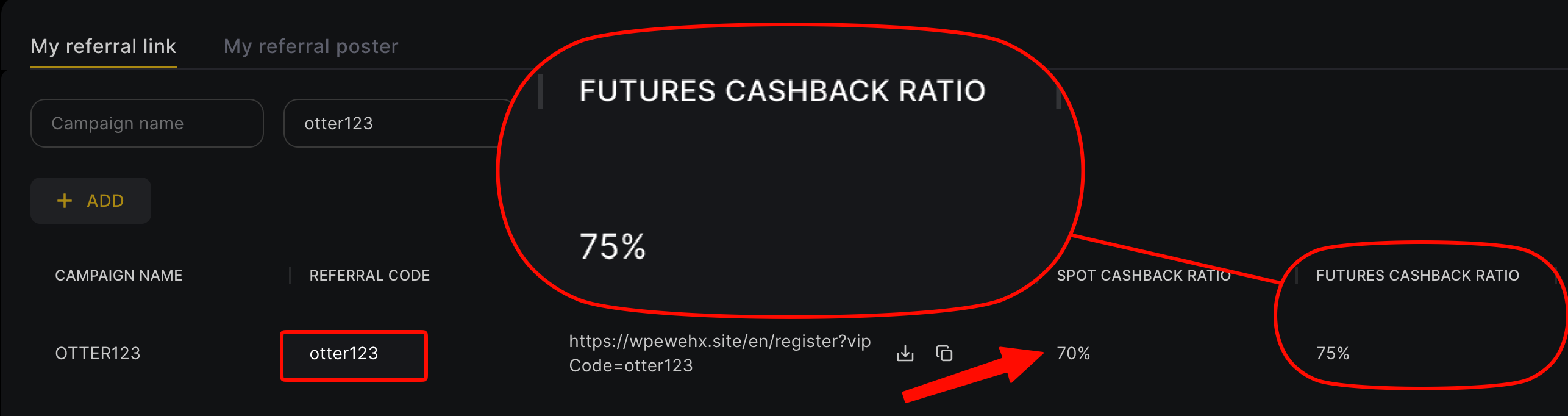
This guide draws on the WEEX help center's futures articles and its public futures API: how fees are worked out, leverage and tiered margin, cross vs isolated margin, the four liquidation steps, mark price, funding and auto-deleveraging (ADL), and a single-trade example of what you pay with and without a rebate. The 0.08% WEEX taker fee is higher than at most exchanges, and so is the rebate: sign up with our referral code otter123 and bind through Fee Otter for a 70% futures rebate, 3.5 times a common 20% code, which brings the effective taker fee to 0.024%.
Key points
- Fees: charged only when opening, closing or reducing; unfilled or cancelled orders are free. Based on position value, not leverage.
- Leverage: up to 400x on BTCUSDT and ETHUSDT, 300x on SOL and XRP; most contracts allow 20x to 100x, and larger positions get less.
- Liquidation: orders are cancelled, two-way positions offset, the position cut two tiers at a time, and only then liquidated at the bankruptcy price.
- Funding: paid between longs and shorts, not to WEEX; every 8 hours on BTCUSDT and every 4 hours on many other contracts.
- Rebate: once bound, a 0.08% taker fee nets out at 0.024% and a 0.02% maker fee at 0.006%.
How futures fees are calculated
From the official spot and futures fee calculation article:
Futures fee = entry price × contract face value × quantity × maker or taker rate
- Fees apply only when an open, close or reduce order fills; unfilled or cancelled orders cost nothing.
- The fee comes out of position margin and is based on position value, not leverage: the same position size costs the same at 10x or 100x.
- Market orders are always taker, and a limit order that fills immediately is also taker. To guarantee maker, choose "Maker Only". IOC and FOK orders are taker.
The public WEEX futures API (2026-10-07) lists 1,033 perpetual contracts: 902 at 0.02% maker / 0.08% taker, 73 at 0.03% maker, 38 at 0.05% maker and 19 at 0.08% maker, with taker almost always 0.08%. VIP levels bring the taker fee on major contracts like BTC down to between 0.04% and 0.075%; see WEEX VIP levels.
Leverage and tiered margin
WEEX raised maximum leverage on BTC and ETH futures to 400x on 21 February 2025 at 18:00 (UTC+8) (announcement). The public API currently shows 400x for BTCUSDT and ETHUSDT and 300x for SOLUSDT and XRPUSDT. Across all 1,033 contracts, 364 top out at 20x, 242 at 50x and 174 at 100x.
Maximum leverage only applies to the smallest positions. WEEX uses tiered maintenance margin rates: the bigger the position, the higher the maintenance margin rate and the lower the leverage you can use. Available leverage also adjusts live to your open positions, pending orders and new order size (tiered leverage). In the app, the "…" menu on the futures page shows your current tier and maintenance margin rate, plus a calculator for PnL, exit price and liquidation price.
Cross or isolated?
| Mode | Margin used | WEEX's example (1,000 USDT account, 1,000 USDT position at 10x) |
|---|---|---|
| Isolated | Each position has its own allocated margin | Margin is 100 USDT; liquidation loses at most 100 USDT and the rest is untouched |
| Cross | The whole futures balance is shared collateral | All 1,000 USDT backs the position, and a sharp move against you could wipe it out |
Isolated lets you add or remove margin per position; cross absorbs more volatility but lets one loss drain the whole account. Beginners are better off with isolated margin and low leverage, so the worst case is known up front.
How liquidation works: four steps
From the official liquidation process:
Margin ratio = (position margin + unrealized PnL) ÷ position value
Position value = face value × quantity × mark price. When the margin ratio falls to or below the maintenance margin rate plus the closing fee rate, the risk engine takes over and works through:
- Cancel orders: for isolated, only orders for that pair and direction; for cross, all orders, isolated ones included.
- Offset two-way positions: long and short holdings on the same contract cancel each other out first (isolated positions excluded).
- Deleverage: a position in a higher tier is cut two tiers at a time, stopping once the margin ratio meets the new tier.
- Liquidate: if that is still not enough, what remains goes to the liquidation engine at the bankruptcy price (where the margin ratio hits zero).
The loss from a liquidation is capped at that position's margin. Once the process starts, other actions are blocked until it ends, and the liquidation price does not appear in your records or on the chart. Any equity left after liquidation goes to the risk reserve fund, and a negative balance is covered by it.
Mark price: why it triggers liquidation
Liquidation and TP/SL triggers use the mark price, not the last traded price:
Mark price = spot index price + moving average of the basis. The index is a weighted average from major exchanges, which keeps a brief wick on one market from triggering liquidations. The mark price only triggers; a stop order then fills at the best available bid or ask, so fast markets can slip.
How funding is charged
From the official funding fee article:
- Funding passes between longs and shorts; WEEX does not charge it. A positive rate means longs pay shorts; a negative rate means shorts pay longs.
- Funding fee = funding rate × position value, also independent of leverage. You only pay or receive it if you hold a position at settlement, and it comes out of position margin.
- Settlement times vary by pair. The public API shows 544 contracts settling every 8 hours, 485 every 4 hours and a few every hour.
- BTCUSDT settles every 8 hours at 00:00, 08:00 and 16:00 UTC, which is 08:00, 16:00 and 00:00 UTC+8.
For reference, over the 100 BTCUSDT settlements from 2026-09-04 to 2026-10-07 the rate ranged from −0.0037% to +0.01%, averaging about 0.0043%. On a 10,000 USDT position, 0.01% is 1 USDT per settlement. A rate that stays on one side for a long time means most traders are positioned the same way.
Auto-deleveraging (ADL)
If a liquidated position cannot be closed in the market and the mark price reaches the bankruptcy price, the system automatically reduces opposing positions (ADL). The queue ranks by profit and effective leverage: for a profitable position, rank = profit percentage × effective leverage, so the most profitable, most leveraged positions go first. Isolated longs and shorts are ranked separately; cross uses the net position.
One trade, with and without a rebate
Take 1,000 USDT of margin at 10x on BTCUSDT, a 10,000 USDT position, opened and closed once:
| Scenario | Round-trip fee | Net with a common 20% code | Net with Fee Otter 70% |
|---|---|---|---|
| Market orders both ways (taker 0.08%) | 16 USDT | 12.8 USDT | 4.8 USDT |
| Limit fills both ways (maker 0.02%) | 4 USDT | 3.2 USDT | 1.2 USDT |
Open the same position at 50x and the fee is still 16 USDT, because fees follow position value. A hundred such market round trips a month means 1,120 USDT less in fees with the 70% rebate. If you are already a VIP on an exchange and want to rebind or sign up on another one, contact support and we can help you apply for special trading benefits or a higher rebate rate.
Before your first futures trade
- Start with isolated margin, 5x to 10x at most, and a stop loss. At 400x, a move of about 0.25% against you nearly wipes out the margin.
- Use limit orders (Maker Only) when you can: a maker round trip costs a quarter of a taker one.
- Check the next funding time and rate before holding overnight.
- WEEX also has a separate "Futures Pro" account, which is where copy trading runs; see WEEX copy trading.
No WEEX account yet? Sign up with referral code otter123 and submit your UID on the Fee Otter rebate platform; steps are in how to register on WEEX. Existing users can follow the WEEX rebind guide. Payouts are explained in how rebates are settled.
 Telegram · @feeotter