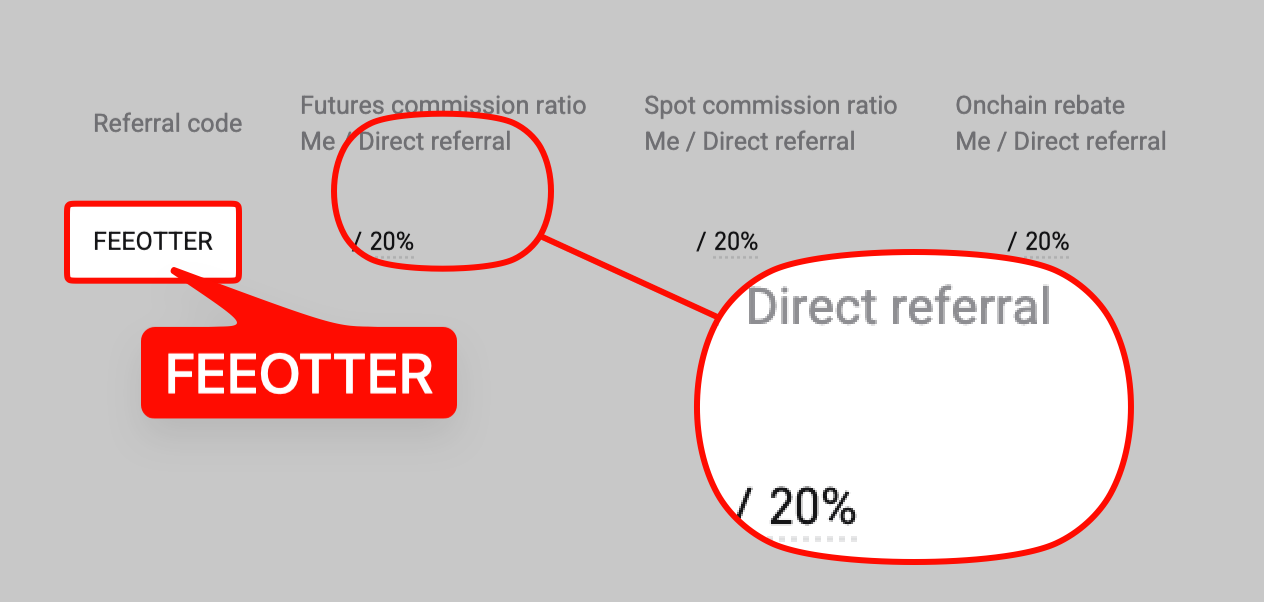
Bitget's BTCUSDT perpetual goes up to 150x, but only in the first tier, for positions up to 200,000 USDT. VIP0 fees are 0.02% maker and 0.06% taker, funding settles every 8 hours within a ±0.3% cap, and because maintenance margin includes a fee rate, liquidation hits before your margin reaches zero. Bind with Fee Otter's code FEEOTTER for a 50% futures fee rebate (checked October 2026).
This guide covers one thing: when you open a BTCUSDT perpetual on Bitget, how the exchange actually calculates your margin, when you get liquidated, how much funding you pay every 8 hours and what each order costs in fees. Every specification comes from Bitget's official API and Help Center, checked on 2026-09-28. Leverage, minimum order and demo-trading comparisons across exchanges are already in our futures exchanges for beginners guide, so here we go deeper into Bitget's own rules only. Bind Bitget with referral code FEEOTTER through Fee Otter and you get a 50% futures fee rebate, 2.5 times the common 20% referral code; the full net-fee calculation is further down.
The short version: futures can wipe out your entire margin in a short time. Bitget's maximum leverage is only available in the smallest position tier, and liquidation happens before your margin reaches zero because the maintenance margin also includes a fee rate.
Before you trade Bitget futures: KYC, account type and contract types
- Identity verification: Bitget's Help Center states that since 2024-01-01, core services such as deposits and trading require identity verification (KYC). The process and limits are in our Bitget KYC guide.
- Classic account vs Unified Trading Account (UTA): in a classic account, USDT-M futures only accept USDT as margin, with separate spot and futures accounts. UTA merges spot, margin and futures into one account and lets several coins count as margin at their collateral ratio. Liquidation also differs: a classic account is liquidated when the mark price hits the liquidation price, while UTA has no fixed liquidation price and starts partial liquidation when the margin rate reaches 100% or more (official comparison). All formulas below assume a classic account.
- Contract types: Bitget's public API on 2026-09-28 listed 805 USDT-M contracts and 49 USDC-M contracts (the BTC USDC perpetual goes up to 125x). Coin-M needs care: Bitget announced that nine classic-account coin-margined perpetuals, including BTCUSD and ETHUSD, were delisted at 15:00 (UTC+8) on 2026-09-17, and users who still want coin-margined futures should upgrade to UTA (delisting notice). The same day, the API list of classic coin-margined contracts was empty.
Opening a position is simple: Futures → USDT-M → search BTCUSDT → choose margin mode → set leverage → choose order type → enter size → Open long or Open short (official USDT-M guide). The numbers below are what take time to understand.
BTCUSDT perpetual specifications (official API, 2026-09-28)
| Item | Value |
|---|---|
| Minimum order | 0.0001 BTC and at least 5 USDT notional |
| Leverage | 1x to 150x (first tier only) |
| VIP 0 fees | Maker 0.02% / taker 0.06% |
| Funding interval | 8 hours |
| Funding rate cap / floor | +0.3% / −0.3% |
| Limit price band | 5% either side of mark price (API buy/sellLimitPriceRatio) |
| Liquidation fee rate (official worst-case price formula) | 0.06% |
Sources: contract API, funding rate API, liquidation and shortfall article. The order-types article says the limit ratio is "2% by default and may be adjusted"; the BTCUSDT API showed 5% on the check date, so go by the order page.
Leverage and position tiers: the bigger the position, the lower the leverage
Bitget splits each pair's position value into tiers. Higher tiers get lower maximum leverage and a higher maintenance margin rate (MMR). These are the full BTCUSDT tiers on the check date (position tier API):
| Tier | Position value (USDT) | Max leverage | Maintenance margin rate |
|---|---|---|---|
| 1 | 0 to 200K | 150x | 0.40% |
| 2 | 200K to 1M | 100x | 0.50% |
| 3 | 1M to 5M | 75x | 0.70% |
| 4 | 5M to 15M | 50x | 1.00% |
| 5 | 15M to 50M | 25x | 2.00% |
| 6 | 50M to 100M | 20x | 3.00% |
| 7 | 100M to 150M | 10x | 6.00% |
| 8 | 150M to 300M | 5x | 12.00% |
| 9 | 300M to 500M | 4x | 15.00% |
| 10 | 500M to 700M | 3x | 20.00% |
| 11 | 700M to 900M | 2x | 30.00% |
| 12 | 900M to 1.2B | 1x | 60.00% |
Two common misunderstandings:
- The Help Center example table is out of date: the position tier article (2025-12-16) uses a BTCUSDT example with a 150,000 USDT first tier at 125x, and mentions that accounts may be placed in "Special Level 1–3" (tier limits 1.5x to 3x larger). Check the Position Tiers panel on the trading page or the API; the table above is the check-date data.
- Maintenance margin is not just the MMR: Bitget announced that from 2025-11-10, new classic-account positions use a tiered calculation, and each slice uses "MMR + taker fee rate". Official example: BTC mark price 110,000, 3 BTC held (330,000 USDT), maintenance margin = 200,000 × (0.40% + 0.06%) + 130,000 × (0.50% + 0.06%) = 1,648 USDT (official notice).
For a small account, the effective first-tier maintenance rate is 0.40% + 0.06% = 0.46%, which is why liquidation comes before your margin hits zero.
Cross, isolated and position mode
Isolated margin only uses the margin assigned to that position, so a liquidation costs at most that margin. Cross margin shares the available balance of the futures account, which makes liquidation less likely, but when it happens it hits the whole account. Bitget states two things: margin mode can only be switched before opening a position, and cross margin is not necessarily better for beginners, who are encouraged to start with isolated margin (cross vs isolated).
Position mode is one-way or hedge. In a classic account's cross mode, long and short leverage on the same pair must match; UTA's isolated mode lets you set different leverage for each side (official comparison table). One-way mode is enough for beginners; you do not need longs and shorts at the same time.
How the liquidation price works: a BTCUSDT isolated example
Bitget's published isolated estimated liquidation price formula is:
Liquidation price = [position margin + pre-calculated offset − position size × average entry price × direction] ÷ [position size × (MMR + taker fee rate − direction)], where direction is 1 for long and −1 for short (estimated liquidation price). The first-tier offset is 0.
Say you go long 0.01 BTC at 84,500 USDT with 10x isolated:
| Item | Calculation | Result |
|---|---|---|
| Position notional | 0.01 × 84,500 | 845 USDT |
| Position margin | 845 ÷ 10 | 84.5 USDT |
| Estimated liquidation price | (845 − 84.5) ÷ [0.01 × (1 − 0.004 − 0.0006)] | about 76,401 USDT (about 9.6% lower) |
| Bankruptcy price | (845 − 84.5) ÷ 0.01 | 76,050 USDT |
| Taker fees to open and close | 845 × 0.06% × 2 | about 1.01 USDT |
The liquidation price (76,401) sits a little above the bankruptcy price (76,050, where the margin is exactly used up); the gap is the maintenance margin. The displayed liquidation price also moves with the mark price, position tier and any margin you add, so check the order page before trading. Cross-margin liquidation prices bring in the whole account balance and the unrealized PnL of other positions; the official formula is longer and not repeated here.
When a position is liquidated, its margin is usually lost in full. In fast markets the actual fill can be worse than the liquidation price, and the higher the leverage, the closer the liquidation price is to your entry.
After liquidation: the insurance fund and auto-deleveraging (ADL)
A liquidated position is taken over at the bankruptcy price. If the final fill is better than the bankruptcy price, the leftover margin goes to the insurance fund; if it is worse, the insurance fund covers the shortfall. Bitget stresses that the insurance fund is not insurance against individual trading losses (insurance fund). Major pairs such as BTC and ETH have their own isolated fund, and ADL starts only when that pair's fund is used up; small and mid-volume pairs share a pooled fund, and ADL starts when the pool's equity falls 50% from its peak within 12 hours.
When ADL starts, the system stops sending liquidation orders to the market and matches them directly against the profitable opposite positions at the top of the ADL ranking, which are then partly or fully closed. The ranking uses "position ROI × margin rate" (divided for losing positions), so bigger profits and higher leverage rank higher; the ADL indicator on the trading page has five lights, and all five lit means you are at the front of the queue (ADL article). A profitable high-leverage position can be forcibly reduced in extreme markets, a risk that winning traders need to understand too.
Funding rate: how often and how much
Funding is paid between longs and shorts, not to Bitget. When the rate is positive, longs pay shorts; when negative, shorts pay longs. You only pay or receive if you hold a position at the settlement time. BTCUSDT settles every 8 hours at 00:00, 08:00 and 16:00 (UTC+8) (funding rate article).
- Cap and floor: the official formula sets the maximum funding rate at 0.75 × the first-tier maintenance margin rate. BTCUSDT's MMR is 0.4%, so the cap is 0.3%, matching the API's +0.3% / −0.3%.
- Not every pair is 8 hours: of 805 USDT-M contracts on 2026-09-28, 426 settled every 8 hours, 378 every 4 hours and 1 every hour, and Bitget regularly announces interval and cap changes for individual pairs.
- In money terms: funding fee = position notional × funding rate. For the 845 USDT position above at the 0.004% rate seen on the check date, one payment is about 0.034 USDT; at the 0.3% cap it would be 2.535 USDT, 3% of the 84.5 USDT margin.
Bitget also notes that if the paying side is liquidated or has insufficient isolated margin, the receiving side may not get the full funding amount.
Order types and take-profit / stop-loss
Bitget futures offers nine order types: market, limit, trigger, post-only, trailing stop, scaled, iceberg, TWAP and advanced limit (with GTC, FOK or IOC) (order types article). The ones beginners use most:
- Post-only: guaranteed to rest as a maker and pay the lower 0.02% maker fee; a price that would fill immediately is cancelled automatically.
- Market: fills immediately, but within the price-limit rule; any unfilled remainder keeps matching at the latest market price.
- Trigger: sends a limit or market order only when the trigger price is hit, and does not reserve assets before then.
- TP/SL: triggers can be set by price, ROI, percentage change or PnL amount; setting them is free, and normal trading fees apply when they fill. Closing the position manually cancels its TP/SL orders (TP/SL guide).
Setting a stop-loss when you open the position is the most direct way to avoid liquidation, and the stop must sit before the liquidation price.
Fees and rebates: what the same trade really costs
Futures fees are charged on position notional, not on margin. Opening and closing the 845 USDT position above as taker costs about 1.01 USDT, or 1.2% of the 84.5 USDT margin. Bind with code FEEOTTER through Fee Otter and 50% of the futures fee comes back:
| Futures rebate | Net taker rate | Net maker rate | Net cost, open + close above |
|---|---|---|---|
| 50% | 0.03% | 0.01% | about 0.51 USDT |
Fee rates are from the Bitget fee page (VIP 0, checked 2026-09-24). Rebates are settled daily with every trade traceable, and they do not change your margin or liquidation price. Monthly examples are in the Bitget fee rebate guide, the code is in Bitget referral code, and existing accounts should read the Bitget rebind guide.
If you are already a VIP on an exchange and want to switch your binding or sign up on another exchange, contact support. We work directly with the exchange's official team and can help you apply for special trading benefits or a higher rebate rate (subject to the exchange's approval). Bitget's own VIP thresholds are in Bitget VIP tiers.
 Telegram · @feeotter