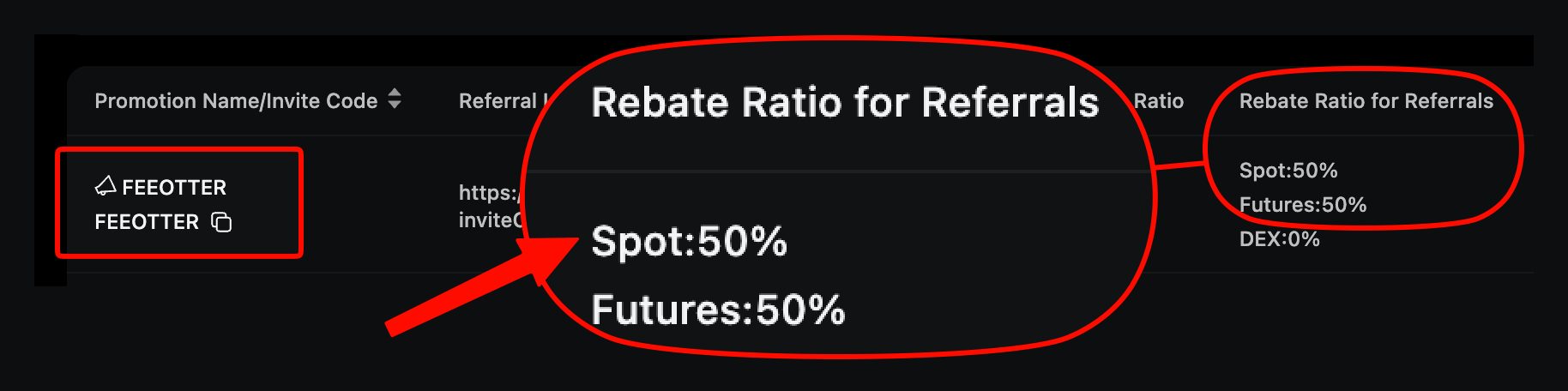
Every Ourbit futures contract is a USDT-margined perpetual, and on 2026-10-07 the official contract API showed all 751 of them at 0.02% maker and 0.04% taker, with BTC_USDT going up to 500x. Sign up with Fee Otter's referral code FEEOTTER and bind your UID for a 70% futures rebate, which brings the taker fee you actually pay down to 0.012% and maker to 0.006% (checked October 2026).
This guide uses the Ourbit contract API (futures.ourbit.com) and the help center: fees, settings to check before you open a position, BTC_USDT risk tiers, the liquidation rule with a worked example, funding rates, and what you pay after the rebate. Futures can wipe out your whole margin quickly. 500x only means the liquidation price is extremely close; it is not a suggestion. For leverage and minimum order size across exchanges, see the futures beginner exchange comparison; this page covers Ourbit only.
Ourbit futures fees: one rate for every contract
Some exchanges, MEXC for example, set futures fees pair by pair. Ourbit uses a single rate for everything. The Ourbit contract specification API on 2026-10-07 returned 0.02% maker and 0.04% taker for all 751 contracts. That matches the 3 September 2024 announcement, which cut spot maker and taker fees to 0% and left futures fees unchanged.
An older help center page, the futures Common Q&As (2024-03-22), still says 0.01% maker and 0.05% taker for regular users, which differs from what the API returns now. Go by the fee shown on the order page.
Before you start: transfers, position mode and margin mode
- Move USDT to your futures account first: click [Transfer] on the assets page to move funds from spot to futures. Transfers are free (Futures Trading Tutorial (Website)).
- Hedge mode is the default: you can hold a long and a short on the same pair at once. Ourbit suggests setting position mode, margin mode and leverage before placing an order.
- Cross and isolated margin: cross uses your entire available balance as margin, and liquidation is triggered if equity falls below the maintenance margin. Isolated calculates each position separately, and you add margin by hand.
- Simple and advanced leverage: simple mode uses one leverage for longs and shorts; advanced mode lets longs and shorts use different leverage and margin modes.
- Identity verification: you can trade futures without KYC and withdraw up to 30 BTC every 24 hours. Levels and limits are in the Ourbit KYC guide.
Leverage caps: up to 500x on BTC, ETH and SOL
Maximum leverage across the 751 contracts in the same API snapshot:
| Max leverage | Contracts | Examples |
|---|---|---|
| 500x | 10 | BTC, ETH, SOL, plus gold, silver and EUR, GBP, JPY and CHF forex contracts |
| 300x | 14 | DOGE, XRP, LINK, SUI, ADA and others |
| 150x to 200x | 57 | BNB, AVAX, LTC, AAVE, 1000PEPE and others |
| 75x to 125x | 193 | HYPE, PAXG, FARTCOIN, PENGU and others |
| 50x or less | 477 | All remaining contracts |
Caps change. Ourbit regularly announces leverage changes for individual pairs (example), so check the limit on the trading page before opening.
BTC_USDT specs and risk tiers
BTC_USDT trades in contracts of 0.0001 BTC, minimum 1 contract. There are 6 risk tiers; the bigger the position, the lower the maximum leverage and the higher the maintenance margin rate:
| Tier | Max leverage | Initial margin rate | Maintenance margin rate |
|---|---|---|---|
| 1 | 500x | 0.2% | 0.1% |
| 2 | 200x | 0.5% | 0.4% |
| 3 | 100x | 1% | 0.5% |
| 4 | 50x | 2% | 1% |
| 5 | 20x | 5% | 2% |
| 6 | 10x | 10% | 5% |
Figures are from the contract specification API on 2026-10-07; ETH_USDT uses the same six tiers (1 contract = 0.01 ETH). The position size covered by each tier is shown on the trading page under Contract Info → Risk Limit.
When liquidation happens
According to the Ourbit futures Common Q&As, liquidation is triggered when:
Position margin + unrealised PnL ≤ maintenance margin
Unrealised PnL is calculated with the fair price (mark price), not the last traded price, which reduces liquidations caused by brief wicks. Isolated liquidation price formulas:
- Long: (maintenance margin − position margin + entry price × quantity × contract size) ÷ (quantity × contract size)
- Short: (entry price × quantity × contract size − maintenance margin + position margin) ÷ (quantity × contract size)
In cross margin, liquidation depends on total account equity, so PnL on other positions moves your liquidation price too. Isolated positions can use Auto Margin Addition: when liquidation is close, the system cancels open orders and then adds margin equal to the maintenance requirement from your available balance, pushing the liquidation price further away. It only works in isolated mode.
Worked example: 0.01 BTC long, 10x isolated
BTC at 84,000 USDT (about 83,960 when checked), the long formula above, and tier 1's 0.1% maintenance margin rate:
| Item | Calculation | Result |
|---|---|---|
| Contracts and notional | 100 × 0.0001 × 84,000 | 840 USDT |
| Position margin (10x) | 840 ÷ 10 | 84 USDT |
| Maintenance margin (0.1%) | 840 × 0.1% | 0.84 USDT |
| Estimated liquidation price | (0.84 − 84 + 840) ÷ 0.01 | 75,684 USDT (about 9.9% lower) |
| Taker fees to open and close | 840 × 0.04% × 2 | 0.672 USDT |
The official formula leaves out the closing fee, so the real liquidation price sits a little closer. At 100x your margin is 1% of notional and a move of under 1% liquidates you; at 500x the initial margin is 0.2% and maintenance 0.1%, so a move of about 0.1% gets you there.
When a position is liquidated you usually lose all of its margin, and in fast markets the result can be worse than the estimate. Only trade futures with money you can afford to lose entirely.
Funding rates: most contracts settle every 4 hours
Funding moves between longs and shorts; Ourbit takes no cut. When the rate is positive longs pay shorts, and when it is negative shorts pay longs. Funding fee = position value × funding rate, with position value at the fair price, and you only pay or receive it if you hold a position at the settlement time (Funding Rate Mechanism).
- Intervals differ by contract: the help center says the default is every 8 hours at 00:00, 08:00 and 16:00 UTC (08:00, 16:00 and 00:00 UTC+8). But the funding rate API on 2026-10-07 showed 452 of 751 contracts settling every 4 hours, 296 every 8 hours, 2 every hour and 1 every 24 hours. Check the countdown on the contract page before you trade.
- BTC_USDT: every 8 hours, capped at ±0.2%. On the day we checked, the next settlement was 16:00 UTC, consistent with the help center. Most other contracts are capped at ±2%.
- In numbers: the 840 USDT position above would pay 1.68 USDT per settlement at the 0.2% cap, 2% of its 84 USDT margin.
An older Ourbit beginner article from 2024 gives the times as 00:00, 08:00 and 16:00 UTC+8, which does not match the funding rate page or the API. Go by the contract page.
Order types and TP/SL
From Types of Order on Ourbit Futures:
- Limit: GTC (stays until filled or cancelled), IOC (fills what it can immediately, cancels the rest) or FOK (cancelled unless it fills in full).
- Market: fills at the best available price; execution is guaranteed, price is not.
- Trigger limit and stop market: when the trigger price is reached, the system places your preset limit or market order.
- Trailing stop: moves the trigger price with the market, by a fixed gap or a percentage from the high or low.
- Post only: never fills immediately, so you are always the maker. It is the safest way to pay the 0.02% maker fee.
- TP/SL: preset exit conditions that close the position at market when hit.
What you pay after the rebate
Sign up through Fee Otter with referral code FEEOTTER and the futures rebate is 70%: Ourbit returns 50% automatically, and Fee Otter adds 20% once you bind your UID.
| Type | Listed fee | After 70% rebate |
|---|---|---|
| Maker | 0.02% | 0.006% |
| Taker | 0.04% | 0.012% |
For the 840 USDT position above, opening and closing as taker costs 0.672 USDT, or about 0.20 USDT after a 70% rebate. A common 20% code returns 0.13 USDT; ours returns 0.47 USDT. The rebate does not change your margin or liquidation price. Monthly estimates are in the Ourbit fee rebate guide and the code is in Ourbit referral code. Ourbit does not allow adding a code after sign-up; existing users should read the Ourbit rebind guide.
If you are already a VIP on an exchange and want to rebind or sign up elsewhere, contact our support; we can help apply for special trading benefits or a higher rebate rate.
 Telegram · @feeotter