MEXC has dropped its old VIP tier table: the official VIP page now redirects to Alpha Trader, where the lowest level, A1, needs 10 million USDT of 30-day standard-fee volume (or 30 million of 0-fee volume) plus an M-Score of at least 800. MEXC publishes no per-tier fee schedule; the benefits come as periodic 0-fee quotas (checked September 2026).
MEXC has replaced its old VIP program with two schemes that run side by side: Alpha Trader ranks you A1 to A7 by trading volume, while the VVIP M-Score looks at assets and overall account performance, and you need an M-Score of at least 800 before you can formally become an Alpha Trader. Also, the requirements table has "spot/futures maker and taker" columns, but they show the logged-in user's own rates; no per-tier fee schedule is published. Alpha trading benefits come as "exclusive 0-fee quotas" issued periodically. This guide covers the A1 to A7 thresholds, how volume is counted, the M-Score requirement, upgrade and downgrade timing, what to do if you're VIP elsewhere, MX deduction, and how all of this works together with a rebate.
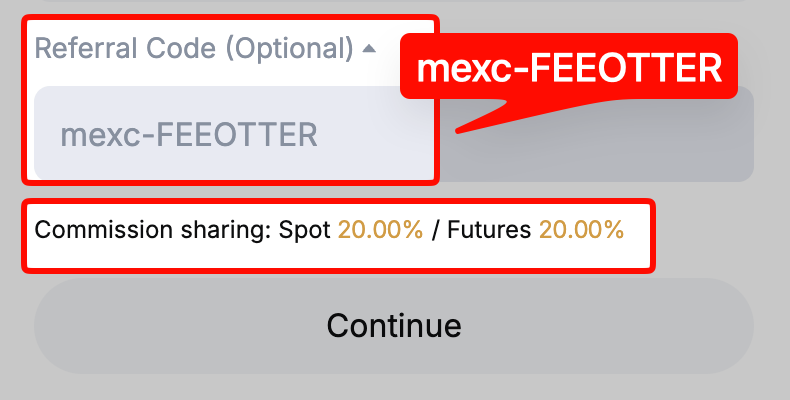
The lowest Alpha Trader level needs 10 million USDT of monthly volume; a rebate needs nothing. Bind MEXC through Fee Otter (invite code mexc-FEEOTTER) and you get 60% back (20% auto-rebate from MEXC + 40% extra from Fee Otter), 3 times a common 20% code.
The short version
- The old VIP program is gone: the VIP page redirects to Alpha Trader, and MEXC says the new program is "powered by both Alpha Trader and the VVIP M-Score".
- A1 threshold: 10 million USDT of 30-day standard-fee volume, or 30 million USDT of 0-fee volume, whichever you reach; A6 and A7 count standard-fee volume only.
- An extra eligibility bar: you must hold VVIP Elite status (M-Score ≥ 800); market makers, institutional accounts, accounts with risk flags or regional restrictions are not eligible.
- No public per-tier fees: benefits are 0-fee quotas, Earn products, MEXC Card and dedicated support, and for now they are activated by contacting support or your manager.
- Regular fees are already low: spot maker 0%, taker 0.05% on BTC and ETH (0.08% on most smaller pairs); the largest group of USDT perpetuals is 0.01% maker and 0.04% taker, about 125 contracts are zero-fee, and BTC_USDT and ETH_USDT are currently 0% / 0.02%.
For almost every trader, MEXC has no "level up, pay a bit less" ladder to climb; the lever you do control is which rebate rate you bind to.
Alpha Trader A1 to A7 requirements
The table comes from the MEXC Alpha Trader page and the official public configuration it loads, checked on 2026-09-28. Meeting either column is enough; the two volumes are not added together, and the higher level applies.
| Level | Standard-fee volume (USDT) | 0-fee volume (USDT) |
|---|---|---|
| A1 | ≥ 10M | ≥ 30M |
| A2 | ≥ 20M | ≥ 50M |
| A3 | ≥ 50M | ≥ 60M |
| A4 | ≥ 100M | ≥ 120M |
| A5 | ≥ 200M | ≥ 300M |
| A6 | ≥ 500M | Not applicable |
| A7 | ≥ 1B | Not applicable |
MEXC: "0-fee trading volume applies to levels A1 to A5 only. It does not count toward A6 or A7." Thresholds as of 2026-09-28; the official page prevails.
Compared with other exchanges' VIP tables, this one stands out in two ways: it ignores assets and platform-token holdings entirely (assets feed the M-Score instead), and 0-fee volume gets its own column. MEXC runs a large number of 0-fee pairs, so that volume is measured against higher thresholds.
How volume is counted: MEXC words it two ways
- What counts: the rules say spot, futures, API, 0-fee and sub-account volume all count; the FAQ adds that "0-fee and fee-paying trading volume are tracked and calculated separately", so each column is measured on its own and whichever reaches a threshold first sets your level.
- Which period: the table header says "30-Day" volume, but the level card says levels "are assessed based on the cumulative trading volume for each calendar month", and the Experience Card mission says volume "resets at the start of the next month". Both wordings appear, so go by the this-month and last-month volume shown in your account.
- Risk exclusions: users with any platform risk-control tag are not eligible, and MEXC reserves the right to revoke status and rewards for wash trading, malicious arbitrage or market manipulation.
The bar beyond volume: M-Score ≥ 800
The Alpha Trader FAQ calls Alpha Trader "the highest level within the MEXC VVIP M-Score framework". To join formally you first need VVIP Elite status (M-Score ≥ 800), then the volume for the level you want; the upgrade is then automatic. MEXC describes the split like this:
- Alpha Trader: levels based on trading performance.
- VVIP: levels based on assets and overall account performance.
The Alpha Trader page does not publish how the M-Score is calculated; once logged in you can see your own score on the level card. High-volume users whose M-Score is below 800 "may still be eligible" for a 1-month VVIP Elite Experience Card or a temporary Alpha Trader experience, subject to account review and compliance checks at MEXC's discretion.
Ineligible account types listed by MEXC: regional restrictions, risk flags, market maker accounts, institutional accounts, and accounts that violate the platform's compliance policies.
When do upgrades and downgrades happen?
- Upgrades: take effect the next day once you hit a threshold; the FAQ says levels update dynamically every day.
- Downgrades: a full review runs at 16:00 (UTC) on the 1st of each month and accounts below the threshold are moved down; the level card words it as adjusted "before 15:59 UTC on the 1st of each month".
- No retroactive effect: MEXC says rule changes take effect in phases and do not affect historically verified levels.
VIP elsewhere? Let us talk to MEXC
MEXC also has a status-match program: users whose volume or assets on other major exchanges meet Alpha Trader requirements can get an upgraded (+1 level) Alpha Trader experience; whether you keep the level afterwards depends on your actual MEXC volume and M-Score. If you're already a VIP on another exchange or trade in size, contact Fee Otter support: we work directly with MEXC's official team to request a VIP tier trial or other perks for you. The tier and duration you actually get are up to MEXC.
What Alpha Trader gives you, and the missing fee table
Benefits listed by MEXC:
- Trading privileges: exclusive 0-fee quotas issued periodically.
- MEXC Earn: premium Earn products and advanced yield strategies.
- MEXC Card: priority access.
- Priority support: dedicated support and personalized rewards; bespoke merchandise on first contact with your manager.
The FAQ says the program currently works on a contact-to-activate basis: you contact online support (bottom right of the MEXC homepage) or your Alpha manager on Telegram to activate benefits and claim rewards, and benefits vary with level and overall account performance.
So when you look up MEXC VIP fees, the numbers that matter are the regular user rates (MEXC's official public APIs, checked 2026-10-18):
- Spot: 0% maker; 0.05% taker on BTC and ETH, 0.08% on most smaller pairs (about 1,100 of 1,864).
- Futures: about 560 of 1,194 contracts are 0.01% maker and 0.04% taker, the most common rate; about 490 are 0% / 0.02%, and about 125 charge 0% on both sides.
- BTC_USDT and ETH_USDT perpetuals: currently 0% maker, 0.02% taker (2026-10-18).
MEXC sets futures fees pair by pair, so 0%, 0.02% and 0.04% all exist side by side and your real cost depends on which contract you trade. Check the rate on the trading pair page before you trade; MEXC also notes that maker and taker rates may vary with platform events or user region.
MX deduction: spot and futures, rate shown per account
MX deduction rules from the MEXC fee page:
- Spot: once enabled, MX is used first to pay spot fees at a discount; the discount stops when MX runs out.
- Futures: once enabled, you must transfer MX to your futures wallet before it is used for futures fees; disabling it moves all MX in the futures account back to spot.
- Some pairs are excluded; see the fee schedule.
- Shown by eligibility: MEXC says the feature is displayed based on your account's eligibility; if you do not see it on the fee page, it is not yet available for your account.
- Not combinable with the MX holding discount: the discount for holding MX in your spot account cannot be used together with MX deduction, and the holding discount takes priority.
The fee page fills in the discount rate per account, so this guide does not quote a fixed number; use what your logged-in fee page shows. Alpha Trader thresholds do not look at MX holdings either.
How Alpha Trader and rebates work together
A rebate is calculated on the fee you actually pay. On MEXC that has a direct consequence: a zero-fee trade has no fee, so it earns no rebate, and the same goes for trades inside an Alpha 0-fee quota. Only trades that carry a fee generate a rebate:
Effective rate = pair fee × (1 − rebate ratio)
| Scenario (futures taker) | Listed | Common 20% code | Fee Otter 60% |
|---|---|---|---|
| Zero-fee pair | 0% | 0% | 0% |
| 0.02% taker (e.g. BTC_USDT) | 0.02% | 0.016% | 0.008% |
| Standard 0.04% | 0.04% | 0.032% | 0.016% |
| Spot taker 0.05% (BTC, ETH) | 0.05% | 0.04% | 0.02% |
In money: 10 million USDT of taker trades in a month on 0.02% futures pairs, exactly the A1 standard-fee threshold, costs 2,000 USDT in fees. At Fee Otter's 60% you get 1,200 USDT back and pay 800 USDT, about 0.008%; a common 20% code returns 400. If the same 10 million were all on zero-fee pairs, fees and rebates would both be 0, and you would need 30 million to reach A1.
In short, Alpha Trader does not directly change what a regular trader pays; on MEXC the two things that really cut costs are picking low-fee pairs and binding a high rebate rate. These are estimates from official listed rates; your trade history and rebate statement are what count. For how payouts work, see how rebates are settled. If you're already a VIP on an exchange and want to rebind or sign up at another one, contact support: we can help you apply for special trading perks or a higher rebate rate.
MEXC's two-layer rebate, sign-up and binding steps, and rebate amounts at different volumes are in the MEXC fee rebate guide; VIP thresholds at other exchanges are compared in crypto exchange VIP fees compared. The MEXC invite code is mexc-FEEOTTER. After you register, bind your UID on the Fee Otter rebate platform. Existing account? See the MEXC rebind guide.
 Telegram · @feeotter