A regular Gate account is VIP 0: spot maker and taker are both 0.1%, or 0.09% with GT fee deduction switched on, and the USDT-margined perpetual taker fee is 0.05%. The futures taker fee first drops at VIP 3, to 0.048%; VIP 5 is 0.045% and VIP 10 is 0.03%. You can reach a level through 30-day trading volume, GT holdings or total account assets, and futures volume only counts at 40% (compiled from Gate's official announcements, checked 2026-10-17).
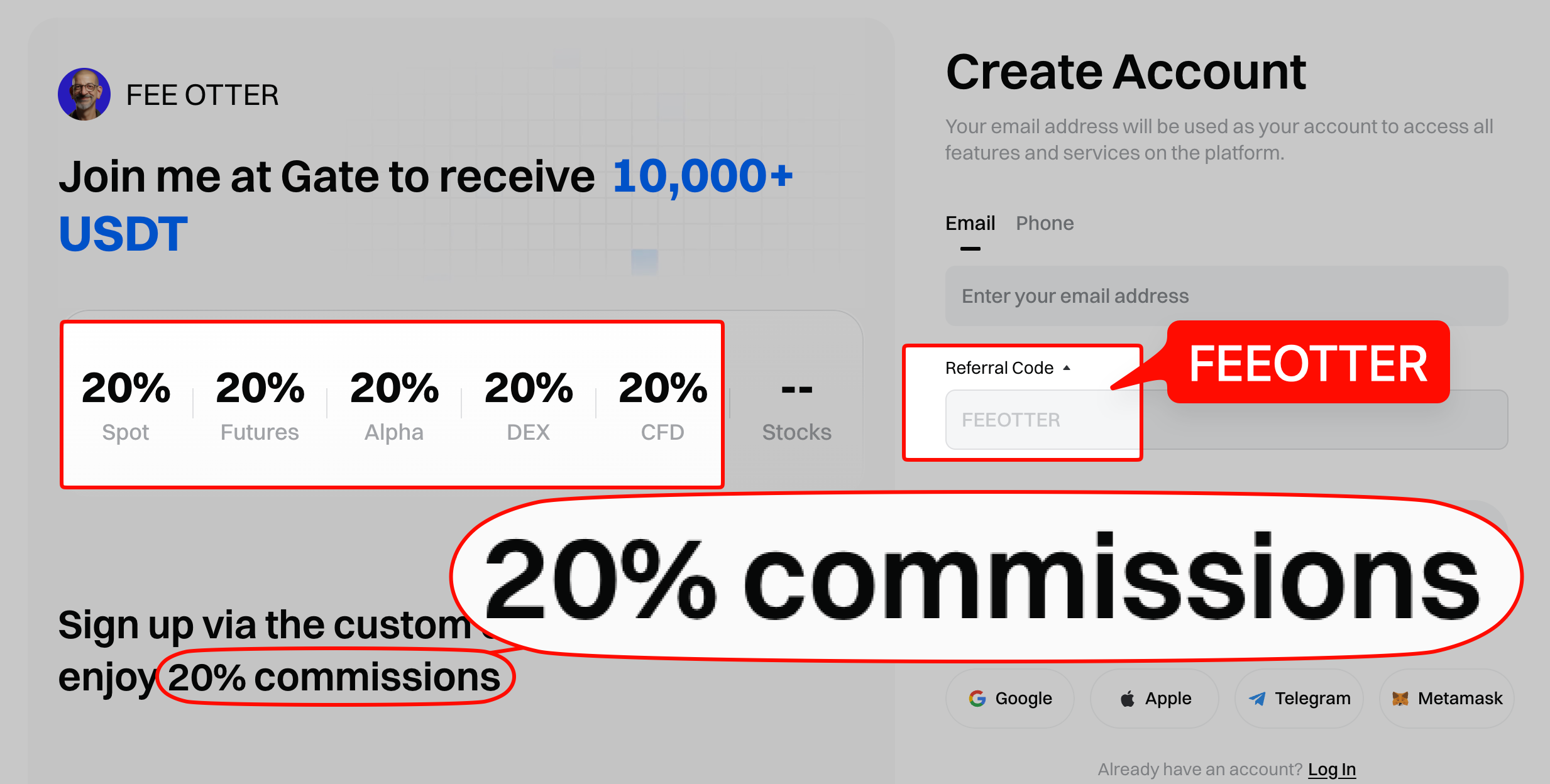
This guide covers the spot and futures VIP fee tables from Gate's announcements, how the three upgrade routes are calculated, the downgrade rules, how to apply for a direct upgrade if you are already VIP elsewhere, and what you actually pay once a rebate sits on top of a VIP rate. VIP costs you volume or token holdings, while a rebate applies to every trade once you bind: sign up with our code FEEOTTER and bind through Fee Otter for a 70% Gate futures rebate (20% automatic exchange rebate + 50% extra rebate), 3.5 times a common 20% code.
Key points
- VIP 0 rates: spot 0.1%/0.1% (0.09% with GT deduction), futures maker 0.02% and taker 0.05%.
- The first levels barely move: spot VIP 1 is 0.099%, and futures taker stays at 0.05% from VIP 0 to VIP 2.
- Futures volume counts at 40%: 30-day volume = spot volume + futures volume × 40% + options volume × 5%. USDC/USDT volume does not count.
- GT holdings also work: since December 2024, VIP 1 needs 50 GT and VIP 5 needs 2,000 GT.
- VIP elsewhere? Upload proof of your VIP status on another exchange; if approved, Gate gives you VIP+2.
Gate spot fees, VIP 0 to VIP 16
The table shows the adjusted rates from Gate's spot and futures fee structure upgrade announcement (published 2026-03-25, effective 2026-04-09), checked 2026-10-17. VIP 0 to VIP 9 did not change; from VIP 10 up, maker fees went from 0% to between 0.008% and 0.04%.
| Level | VIP fee maker/taker | GT deduction maker/taker |
|---|---|---|
| VIP 0 | 0.100%/0.100% | 0.090%/0.090% |
| VIP 1 | 0.099%/0.099% | 0.089%/0.089% |
| VIP 2 | 0.098%/0.098% | 0.088%/0.088% |
| VIP 3 | 0.097%/0.097% | 0.087%/0.087% |
| VIP 4 | 0.095%/0.096% | 0.086%/0.086% |
| VIP 5 | 0.090%/0.095% | 0.081%/0.085% |
| VIP 6 | 0.085%/0.090% | 0.076%/0.081% |
| VIP 7 | 0.080%/0.085% | 0.070%/0.076% |
| VIP 8 | 0.075%/0.080% | 0.060%/0.072% |
| VIP 9 | 0.070%/0.075% | 0.050%/0.068% |
| VIP 10 | 0.040%/0.058% | 0.040%/0.058% |
| VIP 11 | 0.030%/0.045% | 0.030%/0.045% |
| VIP 12 | 0.020%/0.037% | 0.020%/0.037% |
| VIP 13 | 0.010%/0.030% | 0.010%/0.030% |
| VIP 14 | 0.008%/0.023% | 0.008%/0.023% |
| VIP 15 | 0%/0.020% | 0%/0.020% |
| VIP 16 | 0%/0.0175% | 0%/0.0175% |
The same announcement sets USDC/USDT at 0% maker and 0% taker, and says volume on that pair does not count toward VIP levels. For the difference between maker and taker, see maker and taker fees explained.
USDT-margined perpetual futures fees by VIP level
Futures taker rates come from the same March 2026 announcement: VIP 0 to VIP 14 pay one rate on every contract, and VIP 15 and 16 split into groups A, B and C (group A is the BTC, ETH, SOL and XRP USDT perpetuals). That announcement does not list maker rates, so the maker column comes from the May 2024 USDT-M perpetual futures fee adjustment. Whether they still apply is shown on the official fee page after you log in.
| Level | Maker (2024-05 notice) | Taker (2026-03 notice) |
|---|---|---|
| VIP 0 to VIP 2 | 0.020% | 0.0500% |
| VIP 3 to VIP 4 | 0.018% | 0.0480% |
| VIP 5 | 0.018% | 0.0450% |
| VIP 6 | 0.015% | 0.0420% |
| VIP 7 | 0.015% | 0.0375% |
| VIP 8 | 0.015% | 0.0350% |
| VIP 9 | 0.015% | 0.0320% |
| VIP 10 | 0.010% | 0.0300% |
| VIP 11 | 0% | 0.0280% |
| VIP 12 | 0% | 0.0260% |
| VIP 13 | 0% | 0.0240% |
| VIP 14 | 0% | 0.0220% |
| VIP 15 | 0% | A 0.018% / B 0.020% / C 0.022% |
| VIP 16 | 0% | A 0.016% / B 0.018% / C 0.020% |
The futures taker fee does not move at all from VIP 0 to VIP 2, and VIP 3 only takes off 0.002 percentage points. A noticeable cut starts around VIP 7. For liquidation, funding and other futures rules, see the Gate futures guide.
How the upgrade is calculated: three routes
30-day trading volume: futures count at 40%
Gate's VIP tier upgrade requirements update of 2 September 2025 set this formula (effective 2025-09-10):
30-day volume = 30-day spot volume + 30-day futures volume × 40% + 30-day options volume × 5%
So 5 million USDT of futures in a month counts as 2 million toward VIP. Volume on the USDC/USDT pair is excluded.
The volume and asset thresholds for each level sit in the "VIP Upgrade Standards" tab of the official fee page, which only loads in a browser; this check did not retrieve the full figures, so they are not listed here. Use the Gate fee page.
GT holdings
On 27 December 2024 Gate lowered the GT requirements because the GT price had risen (GT holding requirement adjustment):
| Level | GT held | Level | GT held |
|---|---|---|---|
| VIP 1 | 50 GT | VIP 8 | 20,000 GT |
| VIP 2 | 200 GT | VIP 9 | 50,000 GT |
| VIP 3 | 500 GT | VIP 10 | 100,000 GT |
| VIP 4 | 1,000 GT | VIP 11 | 200,000 GT |
| VIP 5 | 2,000 GT | VIP 12 | 400,000 GT |
| VIP 6 | 5,000 GT | VIP 13 | 800,000 GT |
| VIP 7 | 10,000 GT | VIP 14 | 1,500,000 GT |
The VIP 15 and 16 GT cells in the announcement are blank, with no holding threshold. The announcement does not say how holdings are averaged; Gate's 2019 downgrade notice used a 14-day average. GT's price moves, so if you buy GT to level up, count the price risk.
Total account assets: weighted by market-cap rank
Under the September 2024 asset value calculation rule, total assets = the sum of each token's USD value × its coefficient, and a single token above its cap counts at the cap:
| Token | Coefficient | Per-token cap |
|---|---|---|
| GT, top 50 by market cap | 1 | No cap |
| Rank 51 to 120 | 0.8 | $400,000 |
| Rank 121 to 200 | 0.6 | $200,000 |
| Rank 201 to 360 | 0.4 | $80,000 |
| Rank 361 and below | 0.3 | $40,000 |
The caps apply to the master account and sub-accounts combined.
Downgrade rules
Gate's 2019 VIP downgrade system notice says a level reached through trading volume holds for 60 days; after that, if you miss the requirement you drop one level at a time, and each lower level holds for another 15 days. A level reached through GT holdings alone has no protection and lapses when holdings fall short. The notice is old and we found no later announcement replacing it, but the fee page and VIP page are what count today.
Already VIP elsewhere: apply for VIP+2
The Gate VIP page says users who are VIP on exchanges such as Binance, OKX or Bitget, or whose assets or volume already meet Gate's VIP criteria, can submit a nickname, a Telegram ID, a screenshot of their VIP status elsewhere and proof of assets or last-30-day volume (PNG, JPG or JPEG, up to 10 MB each, at most 3 images). If approved, Gate upgrades you by two levels. If you trade large volume and want to know which benefits you can ask for, you can also contact Fee Otter support first.
What you pay after VIP plus a rebate
A rebate is calculated on the fee you actually pay. VIP levels and GT deduction lower that fee, and the rebate is then paid on the lower amount:
Effective fee = VIP fee × (1 − rebate rate)
Using the March 2026 futures taker rates and Fee Otter's 70% futures rebate (20% automatic exchange rebate + 50% extra rebate):
| Case | Listed taker | Calculation | Effective taker |
|---|---|---|---|
| VIP 0, no rebate | 0.05% | None | 0.05% |
| VIP 0 + common 20% code | 0.05% | 0.05% × (1 − 20%) | 0.04% |
| VIP 0 + Fee Otter 70% | 0.05% | 0.05% × (1 − 70%) | 0.015% |
| VIP 5 + Fee Otter 70% | 0.045% | 0.045% × (1 − 70%) | 0.0135% |
| VIP 10 + Fee Otter 70% | 0.03% | 0.03% × (1 − 70%) | 0.009% |
| VIP 14, no rebate | 0.022% | None | 0.022% |
VIP 0 with a 70% rebate comes to 0.015%, below VIP 14 without a rebate at 0.022%. For spot, at 65% (20% automatic exchange rebate + 45% extra rebate), the VIP 0 rate of 0.1% becomes 0.035%, and 0.09% with GT deduction becomes 0.0315%.
In money: 5 million USDT of futures in a month, all taker, costs 2,500 USDT in fees at VIP 0. Fee Otter returns 70%, or 1,750 USDT, so you pay 750 USDT; a common 20% code returns 500 and you pay 2,000 USDT. And those 5 million of futures count as only 2 million toward VIP.
These figures use the listed rates from the official announcements; your trade history and rebate statement are what count. See how rebates are settled. Rebates apply only to trading fees, not to funding or borrowing interest. If you are already VIP on an exchange and want to rebind or sign up on another one, contact support and we can help request special trading benefits or a higher rebate rate.
Which route makes sense?
- A few million USDT of futures a month or less: only 40% counts toward VIP, and VIP 0 to 2 share the same futures taker fee, so binding a rebate does far more.
- You already hold GT: 50 GT gets you VIP 1, but spot only moves from 0.1% to 0.099%; spot maker reaches 0.09% at VIP 5 (2,000 GT).
- VIP on another exchange: apply for VIP+2, then bind the rebate; the two stack.
- Large asset balance: tokens outside the top 50 count at only 30% to 80% and have per-token caps. For the risk of holding assets on an exchange, see Gate proof of reserves.
Restricted regions
Gate's Restricted Locations page lists places it does not serve, including the United States, mainland China, Singapore, Canada, France, Germany, Hong Kong, Malaysia, Malta, the United Kingdom, the Netherlands, Spain, Austria, Japan, South Korea, Indonesia, Thailand, India, Cambodia, the UAE and Argentina. It says the list is "not limited to" these and may change without notice (checked 2026-10-17). For licensing by country, see exchange licences by country.
Gate VIP and your rebate
The two rebate layers and payouts at different volumes are in the Gate fee rebate guide; VIP thresholds across exchanges are compared in exchange VIP tiers compared. If you have not signed up yet, use code FEEOTTER (steps in how to register on Gate), then submit your UID on the Fee Otter rebate platform. If you signed up with someone else's code, see the Gate rebind guide.
 Telegram · @feeotter