BingX Standard Futures charge a single 0.045% fee, taken only when you close. Perpetual Futures charge on both the open and the close, at 0.02% maker and 0.05% taker for regular users. A market-in, market-out trade therefore costs 0.045% in fees on Standard Futures and 0.10% on Perpetual Futures. Standard Futures add a spread that moves with the long/short ratio (BingX lists a daily average of 0.04% for BTC/USDT as a reference), have no limit orders, and BingX only publishes VIP discounts for Perpetual Futures (BingX Help Center, checked 2026-10-22).
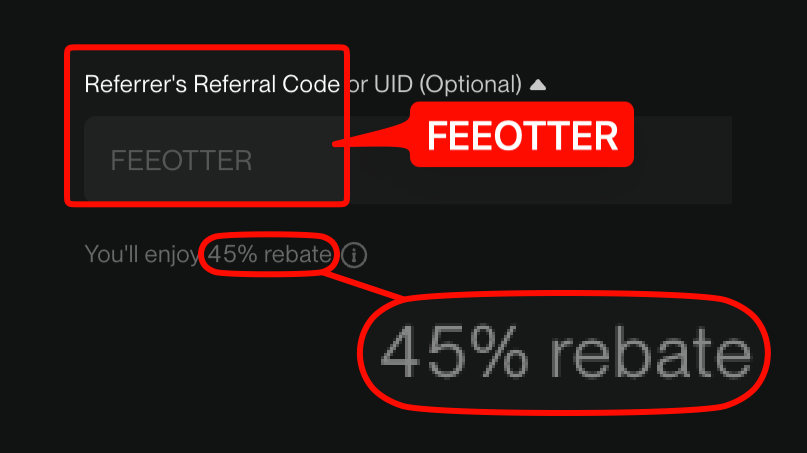
This guide is based on BingX's fee schedule, its comparison page for the two products and its margin-mode articles. It covers how the two differ, how the fee and the spread are charged, funding and liquidation rules, what the same trade costs on each, and how the 45% rebate fits in. Sign up for BingX with our referral code FEEOTTER and 45% of your trading fees come back, all paid automatically by BingX, with no UID binding. A 0.10% market-in, market-out perpetual trade drops to 0.055% after the rebate.
Quick answer
- Fees only: Standard Futures cost 0.045% per trade, less than the 0.10% of a perpetual market-in, market-out trade and more than the 0.04% of a perpetual trade with maker orders on both sides.
- With the spread: Standard Futures fill at a price that includes a spread. With BingX's 0.04% BTC/USDT reference that is about 0.085%, between a perpetual maker-in, taker-out trade (0.07%) and a market-in, market-out trade (0.10%).
- After the rebate: the rebate only covers trading fees, not the spread. A perpetual market-in, market-out trade nets 0.055%; Standard Futures net about 0.025% plus the spread. Once the spread is above roughly 0.03%, the perpetual market trade is cheaper.
- Features: limit orders, maker fees, VIP discounts, API, grid bots, signal trading and demo trading exist only on Perpetual Futures.
- Standard Futures suit: beginners who want every order managed separately, use market orders anyway and don't want to count two fees.
Side-by-side comparison
| Item | Perpetual Futures | Standard Futures |
|---|---|---|
| BingX's positioning | Industry standard; beginners and advanced users | BingX's own product; beginners |
| Trading fee | Maker 0.02%, taker 0.05%, charged on open and close | 0.045%, charged only on close |
| VIP discount | Yes, down to maker 0% and taker 0.028% | Not stated on official pages |
| Spread | No separate spread (market orders can still slip) | Yes, adjusted in real time by the long/short ratio |
| Order types | Limit, market, trigger, trailing stop, Post Only, TWAP | Market, trigger |
| TP/SL | Limit or market TP/SL, Guaranteed Price, trailing TP/SL | Market TP/SL only, trailing stop; no Guaranteed Price |
| Position handling | Orders merge into one position; one-way or hedge mode | Each order managed on its own; one position mode |
| Liquidation trigger | Both mark price and last price must hit the level (dual-price mechanism) | Mark price hitting the level |
| Coin-margined contracts | Yes | Yes |
| API, grid, signal trading, demo | All supported | None supported |
| Leverage | 1x to 150x | 1x to 150x |
Sources: BingX Comparison of Perpetual Futures & Standard Futures (2024-11-15) and How to Get Started With Futures Trading (leverage range), checked 2026-10-22. The comparison page also says Standard Futures offer commodities, forex, index and other non-crypto pairs in some regions. The actual maximum leverage depends on the pair; the order page is what counts.
How the fee is charged: once vs twice
Standard Futures: per the BingX Fee Schedule and Standard Futures FAQs on Fee Schedule, the list rate is 0.075%, currently discounted to 0.045%, for both your own trades and copy trades. The fee is trade volume × fee rate, charged once: recorded when you open and deducted when you close.
Perpetual Futures: per the Perpetual Futures Fee Schedule, taker 0.05% and maker 0.02%, charged on the open and again on the close. VIP users pay less; see BingX VIP fee tiers.
The 0.045% on Standard Futures covers the whole round trip, while the 0.05% on Perpetual Futures is per side, so a market-in, market-out trade pays it twice. Compare on the same basis: a perpetual round trip costs 0.04% (maker both sides), 0.07% (maker in, taker out) or 0.10% (taker both sides). Standard Futures have no limit orders, so the maker rate is not available there.
BingX: for Standard Futures, the trading fee is 0.045%; these fees are unilaterally applied and will only be incurred when closing positions. For Perpetual Futures, trading fees are applied when opening or closing positions. (A Quick Comparison Between Perpetual Futures and Standard Futures)
That 2021 comparison page also gives 0.0375% for Standard Futures copy trading. The current fee schedule says 0.045%, and we go with the fee schedule.
The Standard Futures spread: a cost on top of the fee
Standard Futures don't fill at the last traded price; they fill at a price with a spread added. From the BingX Fee Schedule:
- Formula: long price = current price × (1 + spread ratio); short price = current price × (1 − spread ratio).
- Which side pays more: the spread follows the long/short ratio. When longs outnumber shorts, the buying spread is larger, and vice versa.
- Reference values: daily average 0.04% for BTC/USDT and ETH/USDT, 0.1% for most other major coins. BingX says these are for reference and the actual spread applies; the table still lists old pairs such as LUNA, so it has not been updated in a long time.
- Large orders: for users with large positions, high-frequency trading or several accounts, the spread is adjusted accordingly. Closes fill at the actual market price, and BingX does not guarantee execution at the index price.
- Copy trading: when a lead trader places an order, the spread is calculated on the combined volume of the trader and all copiers.
Before you open, the order page shows an "Est. Filled Price". Its gap to the last price is the spread on that order. The official pages don't say whether a separate spread is added on the close; they only say closes fill at the actual market price.
Funding: both products have it
- Timing: every 8 hours on both, at 00:00, 08:00 and 16:00 (UTC+8), and only if you hold a position at that moment.
- Standard Futures: on isolated orders, funding accumulates and is settled when you close; on cross orders it is deducted at each funding time (Standard Futures isolated and cross margin). On commodity, forex and index pairs, the long and short funding rates can differ.
- Perpetual Futures: taken from position margin in isolated mode and from the balance in cross mode; the rate formula is capped at ±0.3% (Perpetual Futures Fee Schedule).
Funding passes between longs and shorts, not to the exchange. It isn't a trading fee, so the rebate doesn't cover it.
How liquidation differs
- Perpetual Futures: BingX's dual-price mechanism liquidates only when both the mark price and the last price reach the level, which is meant to stop liquidations caused by price anomalies. Formulas and the insurance fund are in the BingX futures guide.
- Standard Futures, isolated: each order stands alone, and a loss to the liquidation point closes only that order. BingX's estimated liquidation price formula includes trading fees, funding and an "adjustment factor".
- Standard Futures, cross: margin rate = equity ÷ Σ(order margin × adjustment factor) − 1. At 0% liquidation is triggered, all positions are closed together and you can lose the whole account balance. BingX's example: with a 10% adjustment factor and 15 USDT of order margin, liquidation comes when equity falls to 1.5 USDT.
Sources: Standard Futures isolated and cross margin and the comparison page, checked 2026-10-22.
Worked example: one BTC trade on each
Our own example: 1,000 USDT margin at 10x, a 10,000 USDT BTC/USDT long, opened and then closed, VIP 0, account registered with code FEEOTTER (BingX refunds 45% of fees). The spread uses BingX's 0.04% reference and will vary in practice; BingX gives no figure for slippage on perpetual market orders, so it is left out.
| Approach | Fee | BingX refunds 45% | Net fee | Spread (reference) | Total cost |
|---|---|---|---|---|---|
| Standard Futures | 10,000 × 0.045% = 4.5 | 2.025 | 2.475 | about 4 | about 6.48 |
| Perpetual: market both sides | 5 + 5 = 10 | 4.5 | 5.5 | none | 5.5 |
| Perpetual: maker in, market out | 2 + 5 = 7 | 3.15 | 3.85 | none | 3.85 |
| Perpetual: maker both sides | 2 + 2 = 4 | 1.8 | 2.2 | none | 2.2 |
Figures in USDT. Without a rebate, Standard Futures cost 4.5 + 4 = 8.5 against 10 for a perpetual market round trip, so Standard is slightly cheaper. With the rebate the order flips, because the rebate only refunds fees and never touches the Standard Futures spread. The break-even: before the rebate, Standard Futures beat a perpetual market round trip while the spread is under 0.055%; after it, the spread has to be under about 0.03% (0.055% − 0.045% × 55%). Check the gap between the Est. Filled Price and the last price before you trade and you'll know which one is cheaper for that order.
Holding time doesn't change the trading fee, but it does change funding, and both products pay funding. The fee comparison is the same for short and long holds.
How the 45% rebate applies to each
BingX's referral program tutorial says the referrer receives a portion of the referee's "trading fees (including spot and futures trading)", and the referee receives a trading fee rebate. The page doesn't separate Standard Futures from Perpetual Futures; the detailed rules are in the in-app terms. Register with our code FEEOTTER and 45% is refunded automatically by BingX to your BingX account. You don't bind a UID at Fee Otter.
- Perpetual Futures: fees on both the open and the close count. Taker 0.05% becomes 0.0275% after the rebate, maker 0.02% becomes 0.011%.
- Standard Futures: 0.045% becomes 0.02475%. The official pages don't name Standard Futures separately as rebate-eligible, so check your rebate records after your first trade.
- Not covered: the spread, funding and any margin left after liquidation are not trading fees.
- VIP: per the BingX VIP Club page, Standard Futures volume counts toward the futures volume for VIP levels; the VIP fee table only lists Perpetual Futures. VIP discounts and the rebate stack.


%2C2026-10-05%20%E5%8F%96%E6%A8%A3%3A%0A%20%20%20%20%20%20%20%E5%BA%95%E8%89%B2%20%230E3452%2C%E5%AD%97%E7%AC%A6%20%2303CA9B)%E3%80%82%0A%20%20%20%20%20%20%20%E7%94%A8%20potrace%20%E6%8F%8F%E5%AD%97%E7%AC%A6%E8%BC%AA%E5%BB%93%2C%E6%95%B4%E5%BC%B5%E7%95%AB%E5%B8%83%E7%9B%B4%E6%8E%A5%E6%98%A0%E5%B0%84%E5%88%B0%E9%80%99%E8%A3%A1%E7%9A%84%2032%20%E5%96%AE%E4%BD%8D%20%E2%80%94%E2%80%94%20%E4%B8%8D%E9%87%8D%E6%96%B0%E7%BD%AE%E4%B8%AD%2C%E4%BF%9D%E7%95%99%E5%AE%98%E6%96%B9%E7%9A%84%E7%95%99%E7%99%BD%E6%AF%94%E4%BE%8B%E3%80%82%0A%20%20%20%20%20%20%20%E8%A6%81%E6%94%B9%E8%AB%8B%E9%87%8D%E8%B7%91%E6%8F%8F%E5%9C%96%2C%E4%B8%8D%E8%A6%81%E6%86%91%E5%8D%B0%E8%B1%A1%E8%AA%BF%E3%80%82%20--%3E%0A%20%20%3Crect%20x%3D%221.5%22%20y%3D%221.5%22%20width%3D%2229%22%20height%3D%2229%22%20rx%3D%228%22%20fill%3D%22%230E3452%22%2F%3E%0A%20%20%3Cpath%20fill%3D%22%2303CA9B%22%20d%3D%22M23.02%205.97C22.14%206.02%2021.54%206.07%2021.22%206.1C20.72%206.15%2019.6%206.28%2019.41%206.31C19.31%206.33%2019.1%206.37%2018.94%206.39C18.29%206.5%2017.94%206.57%2017.2%206.73C16.92%206.79%2016%207.03%2015.8%207.09C15.36%207.23%2014.42%207.54%2014.39%207.56C14.38%207.57%2014.3%207.6%2014.23%207.62C13.82%207.76%2012.7%208.28%2012.13%208.6C11.95%208.7%2011.8%208.78%2011.79%208.78C11.7%208.78%2010.42%209.71%209.98%2010.08C9.16%2010.79%208.07%2012.09%207.6%2012.91C7.28%2013.46%207.18%2013.65%207.06%2013.91C6.87%2014.3%206.76%2014.53%206.68%2014.74C6.56%2015.08%206.37%2015.64%206.34%2015.73C6.33%2015.78%206.3%2015.91%206.27%2016C6.06%2016.79%205.93%2017.87%205.94%2018.62L5.95%2019.05L6.69%2019.04C7.78%2019.03%208.57%2018.94%209.73%2018.68C10.18%2018.58%2011.05%2018.33%2011.45%2018.18C11.52%2018.15%2011.7%2018.08%2011.84%2018.03C13.58%2017.38%2015.67%2016.19%2017.55%2014.77C17.8%2014.58%2018.67%2013.89%2018.74%2013.83C18.76%2013.81%2018.94%2013.66%2019.14%2013.48C19.34%2013.31%2019.54%2013.14%2019.58%2013.11C19.61%2013.07%2019.78%2012.92%2019.95%2012.77C20.94%2011.88%2022.24%2010.57%2023.2%209.48C23.68%208.94%2023.69%208.93%2023.86%208.73C23.94%208.63%2024.02%208.54%2024.03%208.53C24.17%208.4%2025.09%207.25%2025.52%206.67C25.67%206.47%2025.81%206.28%2025.83%206.26C25.86%206.23%2025.89%206.19%2025.9%206.16C25.92%206.13%2025.94%206.12%2025.95%206.13C25.98%206.15%2025.3%207.5%2024.99%208.07C24.88%208.28%2024.78%208.45%2024.78%208.46C24.78%208.46%2024.66%208.67%2024.51%208.93C24.24%209.4%2024.17%209.52%2024.07%209.69C24%209.81%2023.72%2010.27%2023.39%2010.8C22.69%2011.91%2021.44%2013.66%2020.74%2014.52C20.25%2015.12%2020.09%2015.31%2019.72%2015.73C19.01%2016.55%2018.19%2017.38%2017.42%2018.08C17.07%2018.39%2016.92%2018.52%2016.5%2018.87C16.37%2018.98%2016.24%2019.09%2016.2%2019.12C15.83%2019.43%2014.7%2020.21%2014.16%2020.54C13.69%2020.82%2012.69%2021.34%2012.41%2021.45C12.33%2021.48%2012.23%2021.52%2012.17%2021.55C12.01%2021.62%2011.45%2021.84%2011.11%2021.95C10.97%2022%2010.05%2022.26%209.84%2022.31C9.23%2022.45%208.97%2022.5%208.56%2022.56C8.43%2022.58%208.25%2022.61%208.16%2022.62C8.06%2022.64%207.79%2022.67%207.56%2022.69C7.32%2022.71%207.12%2022.74%207.12%2022.76C7.12%2022.85%207.58%2023.42%207.97%2023.82C9.2%2025.09%2010.67%2025.8%2012.52%2026.02C16.51%2026.48%2020.99%2024.06%2023.2%2020.25C23.32%2020.05%2023.43%2019.86%2023.46%2019.81C23.51%2019.73%2023.96%2018.81%2024.04%2018.62C24.67%2017.21%2025.19%2015.43%2025.52%2013.67C25.66%2012.9%2025.73%2012.45%2025.81%2011.77C25.99%2010.32%2026.05%209.33%2026.05%207.64C26.05%206.06%2026.04%206.01%2025.97%205.98C25.9%205.95%2023.53%205.94%2023.02%205.97Z%22%2F%3E%0A%3C%2Fsvg%3E%0A)


%2C2026-10-05%20%E5%8F%96%E6%A8%A3%3A%0A%20%20%20%20%20%20%20%E5%BA%95%E8%89%B2%20%23FFFFFF%2C%E5%AD%97%E7%AC%A6%20%235227FF)%E3%80%82%0A%20%20%20%20%20%20%20%E7%94%A8%20potrace%20%E6%8F%8F%E5%AD%97%E7%AC%A6%E8%BC%AA%E5%BB%93%2C%E6%95%B4%E5%BC%B5%E7%95%AB%E5%B8%83%E7%9B%B4%E6%8E%A5%E6%98%A0%E5%B0%84%E5%88%B0%E9%80%99%E8%A3%A1%E7%9A%84%2032%20%E5%96%AE%E4%BD%8D%20%E2%80%94%E2%80%94%20%E4%B8%8D%E9%87%8D%E6%96%B0%E7%BD%AE%E4%B8%AD%2C%E4%BF%9D%E7%95%99%E5%AE%98%E6%96%B9%E7%9A%84%E7%95%99%E7%99%BD%E6%AF%94%E4%BE%8B%E3%80%82%0A%20%20%20%20%20%20%20%E5%AE%98%E6%96%B9%E6%98%AF%E7%99%BD%E5%BA%95%E7%B4%AB%E8%89%B2%E5%AD%97%E7%AC%A6%3B%E7%99%BD%E5%BA%95%E5%8A%A0%E6%B7%A1%E9%82%8A%2C%E5%85%8D%E5%BE%97%E5%9C%A8%E7%99%BD%E8%89%B2%E8%83%8C%E6%99%AF%E4%B8%8A%E6%B6%88%E5%A4%B1%E3%80%82%0A%20%20%20%20%20%20%20%E8%A6%81%E6%94%B9%E8%AB%8B%E9%87%8D%E8%B7%91%E6%8F%8F%E5%9C%96%2C%E4%B8%8D%E8%A6%81%E6%86%91%E5%8D%B0%E8%B1%A1%E8%AA%BF%E3%80%82%20--%3E%0A%20%20%3Crect%20x%3D%221.5%22%20y%3D%221.5%22%20width%3D%2229%22%20height%3D%2229%22%20rx%3D%228%22%20fill%3D%22%23FFFFFF%22%20stroke%3D%22%23E4E4E7%22%2F%3E%0A%20%20%3Cpath%20fill%3D%22%235227FF%22%20d%3D%22M13.31%208.92L13.31%2012.28L9.94%2012.28L6.56%2012.28L6.57%2015.71C6.58%2019.51%206.57%2019.29%206.79%2020.2C7.56%2023.33%2010.21%2025.78%2013.38%2026.31C14.1%2026.43%2014.44%2026.44%2019.24%2026.44L23.91%2026.44L23.91%2023.05L23.91%2019.66L19.2%2019.65L14.48%2019.64L14.28%2019.56C13.89%2019.41%2013.63%2019.16%2013.44%2018.76L13.36%2018.58L13.35%2015.46L13.34%2012.34L18.56%2012.34L23.78%2012.34L23.78%208.95L23.78%205.56L18.55%205.56L13.31%205.56L13.31%208.92Z%22%2F%3E%0A%3C%2Fsvg%3E%0A)