Gate copy trading automatically mirrors a lead trader's opens and closes on USDT perpetual futures. Your copy funds move from your spot account into a sub-account used only for that copy, the copy multiplier can be set from 0.01x to 100x, and copiers are capped at 20x leverage. The lead trader sets the profit share; Gate's top level, Expert Lead Trader, is announced at 30% plus a 1% bonus for premium traders. Profit share is calculated every 7 days and paid daily at 01:45 UTC (verified 17 October 2026).
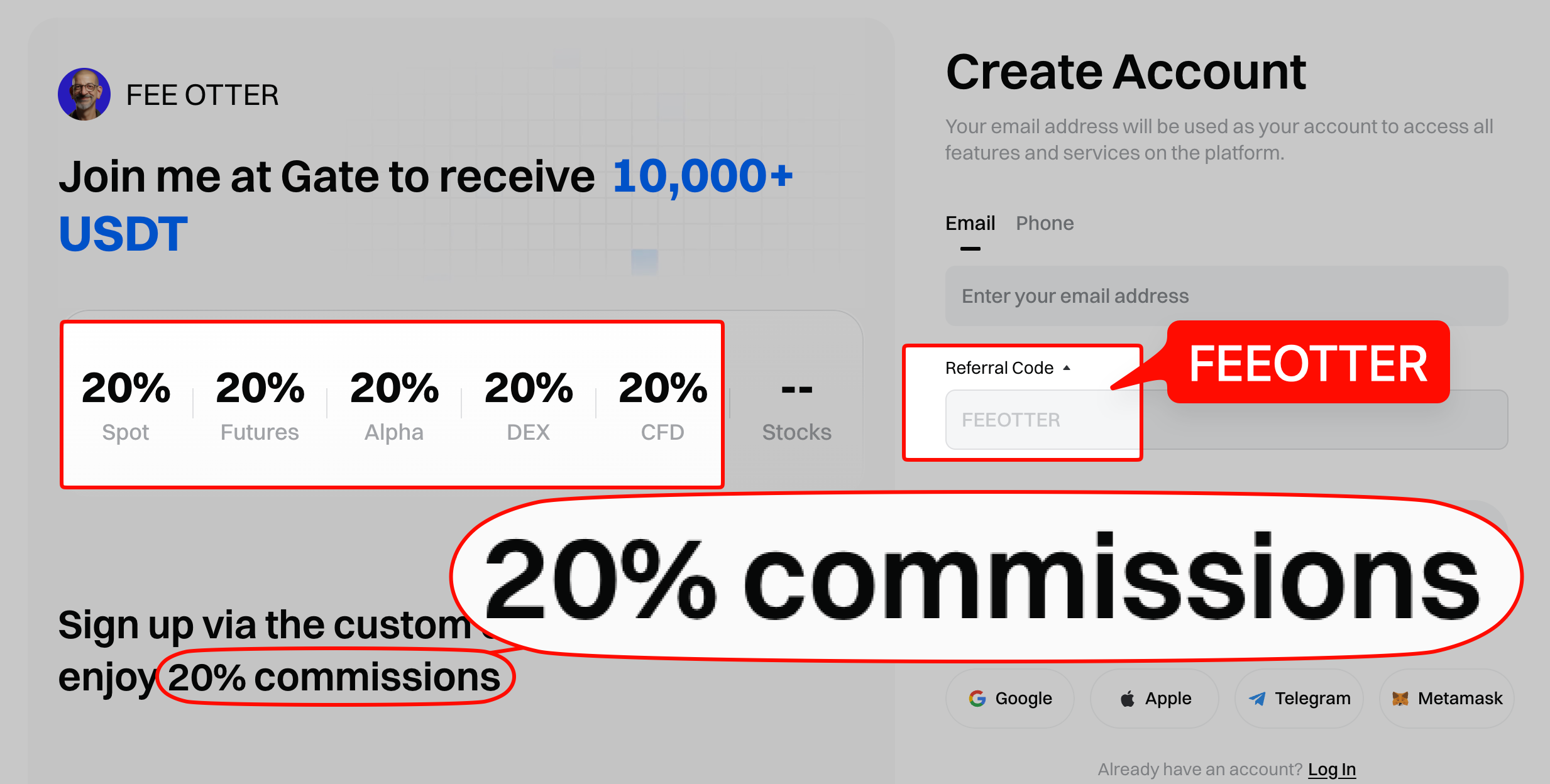
This guide uses Gate's help center articles on copy trading: where your money goes, the two copy modes and how the multiplier works, why copies fail, how profit share is calculated and settled, what it takes to become a lead trader, and a worked example of fees, profit share and rebate on one copied trade. Every copied open and close pays a futures fee. Sign up for Gate with our referral code FEEOTTER and get 70% of your futures fees back (20% exchange automatic rebate + 50% extra rebate), 3.5 times the usual 20% code.
Quick answers
- It's futures: the lead traders on Gate's copy trading page trade futures. TradFi CFD copy trading and stock copy trading are separate products with their own rules and aren't covered here.
- Ring-fenced funds: copy funds move from spot into a virtual sub-account. When the copy ends, profit share and fees are deducted and the rest goes back to spot.
- Multiplier and leverage: a fixed multiplier of 0.01x to 100x, or copying by total-asset ratio. Copiers are capped at 20x; some lead traders can use up to 100x.
- Limit orders only, stop-losses not copied: copies are placed as limit orders and fail if they don't fill. The lead trader's stop-loss orders aren't copied, so set your own take-profit and stop-loss.
- Profit share: set by the lead trader and not adjustable by you. Expert Lead Traders get up to 30% plus a 1% bonus. Copiers pay no separate fee to copy.
Where your copy funds go
According to Gate's [Copy Trading] FAQ (2024-03-11, checked 2026-10-17), copy funds move from your spot account into a virtual sub-account used only for that copy. When copying ends, the system settles the sub-account, deducts profit share and trading fees, and returns the remainder to spot.
The basic rule is "contracts filled by the lead trader × copy multiplier", rounded down. If the result is below the contract's minimum copy size, nothing is copied. How big a position you can open depends on the sub-account's available funds and the leverage you set; anything beyond that fails.
The FAQ on Gate's copy trading page says the minimum copy amount is set by the lead trader, starting at 10 USDT, with some traders setting 50, 100 or 300 USDT (Gate copy trading page, checked 2026-10-17).
Two modes and the copy multiplier
Gate's copiers guide (published 2022-06-17, checked 2026-10-17) describes two modes:
| Mode | What you set | Everything else |
|---|---|---|
| Quick Copy | Copy amount | Follows the lead trader's leverage and margin mode, and copies every contract the trader leads |
| Advanced Copy | Copy amount, which contracts to copy, and per-contract leverage, multiplier, single-copy limit, maximum copy amount, take-profit and stop-loss | Contracts without custom settings use the basic parameters |
Gate's copying methods guide (2024-06-14) gives two ways to size copies:
- By total-asset ratio (dynamic): total assets = available funds + position value. Gate's example: a lead trader with 100 USDT places a 10 USDT order (10%), so a copier with 200 USDT would ideally copy 20 USDT.
- Fixed multiplier (static): 0.01x to 100x. If the lead trader places 1,000 contracts, a 0.2 multiplier copies 200 and a 2 multiplier copies 2,000. Gate recommends the fixed multiplier for users with large capital.
The FAQ suggests setting the multiplier in proportion to capital: with 100 USDT copying a trader with 1,000 USDT of equity, use 0.1. Keep your leverage and margin mode the same as the lead trader's, and leave enough margin for the trader's add-ons, or the first time they add to a position your copy will fail.
Why copies fail or returns differ
From the FAQ and Gate's note on why trader and copier ROI differ (2024-11-27):
- Limit orders only: copies are limit orders. If the market moves too far they don't fill, and an unfilled copy simply fails; there's no validity period.
- Not enough margin: in Gate's case study a copier with 700 USDT and a 0.01 multiplier copied a 1 BTC position. When the lead trader added 10 BTC, the required margin reached 770 USDT, more than the copier had, so the add-on failed.
- Different leverage caps: on some contracts lead traders can use up to 100x while copiers are capped at 20x (Gate says this applies in Advanced mode). Risk-limit tiers also reduce the leverage available to large positions.
- Positions opened before you started: if the trader already held a position and adds to it later, your entry cost differs from theirs.
- Slippage: lead traders open with limit orders and close with market orders, so prices can differ. Maximum opening slippage can be set from 0.1% to 3.0% under Futures Copy Trading → Copy Settings → More Settings, default 0.5%; beyond that the trade isn't copied (slippage protection notice, 2023-12-12). The tighter the setting, the lower the success rate.
Gate's FAQ states that the lead trader's stop-loss orders are not copied, so copiers must set their own take-profit and stop-loss. Copying can only be stopped manually, and stopping ends the whole copy relationship, not just one order.
How profit share is calculated and settled
Rate: per the copiers guide, the lead trader sets the profit-share percentage and copiers can't change it. Traders can adjust it within their level's limits; increases apply only to new copiers, decreases apply to everyone. Lead traders have five levels: beginner, elementary, intermediate, advanced and expert (lead trader level-up guide, 2024-03-19). The caps for each level are in an image table, not in the text. The text does give the top level:
- A 2024-06-28 notice added Expert Lead Trader: 20% profit share, plus 1% for premium lead traders, and up to 1,000 copiers (Gate notice).
- A 2024-09-20 notice raised the Expert Lead Trader share to 30%, with a 1% premium bonus and 1,000 copiers (Gate notice).
The rate you actually pay is shown on the lead trader's page; check it before you copy.
Settlement: per Gate's trader profit sharing rules (2026-04-13):
- Profit share is calculated in three cases: a scheduled run every 7 days for each copier, when a copier stops copying, and when the lead trader requests a withdrawal of profit share.
- If the copier still has open orders, open positions, unrealized PnL or a negative available balance, the calculation is deferred and retried every 10 minutes.
- Profit share is paid automatically every day at 01:45 UTC, based on statistics collected before 00:00 UTC.
The copiers guide says profit share is based on total profit minus total loss, and is paid only when that's positive. Copy earnings are displayed as historical earnings minus trading fees on current positions minus profit share, excluding unrealized PnL. Gate's current text doesn't spell out whether trading fees are deducted before profit share is calculated. Gate's note on the updated PnL calculation (2025-02-20) adds that copiers pay no extra fee to copy; the lead trader earns a share of the profit the copy generates.
Worked example: fees, profit share and rebate
Say the copy sub-account uses 500 USDT of margin at 10x, so the position is worth 5,000 USDT. Gate's VIP 0 USDT perpetual fees are maker 0.02% and taker 0.05% (Gate fee announcement; the official fee page after login prevails). Copies are limit orders, and whether they fill as maker or taker depends on the order book at the time, so both are shown. The trade closes with 200 USDT profit; profit share is shown at 10% and 30%, assuming it's calculated on profit after fees:
| Item | All taker | All maker |
|---|---|---|
| Open + close fees | 5,000 × 0.05% × 2 = 5 | 5,000 × 0.02% × 2 = 2 |
| Profit after fees | 195 | 198 |
| Profit share 10% / 30% | 19.5 / 58.5 | 19.8 / 59.4 |
| Fee Otter 70% rebate | 3.5 | 1.4 |
Losing trades pay no profit share, but they still pay fees. The more often the lead trader opens and closes, the more fees the copier pays. Gate's referral rules don't say separately whether futures fees from copy trading count toward commission (see "Copy trading and the rebate" below), so your rebate statement is the record. If you're already a VIP at an exchange and want to rebind or sign up elsewhere, contact our support: we can help apply for special trading benefits or a higher rebate rate.
How to pick a lead trader
- Look at copier PnL, not just trader PnL: the cards on the copy trading page show 30-day ROI, trader PnL, assets under management, 30-day copier PnL and 7-day ROI. Be careful when the two PnL figures are far apart.
- Check the profit share and minimum copy amount: with the same results, a 30% share costs three times a 10% share.
- Check the trader's leverage: you're capped at 20x. If the trader uses 100x, your returns and risk won't match theirs.
- Short-term numbers aren't long-term results: 7-day and 30-day ROI swing widely, and lead traders' own profiles on the page say returns are "not guaranteed".
Becoming a lead trader: requirements and limits
From the lead trader FAQ (2024-03-11) and the level-up guide:
- The entry requirement is assets of at least 300 USDT. If total assets fall below 200 USDT, open and add-position signals are blocked until assets are back at 300 USDT or more.
- Traders are hidden from search if they haven't set parameters after approval, haven't completed a first live copy trade, or have had no positions or trades for 3 weeks.
- Advanced and expert traders must join the lead trader risk control system and keep maximum trading leverage below 25x.
- External contact details on profiles are banned: a first offence means blocking and a possible downgrade, a repeat means disqualification.
Gate also has a "posteriority mechanism": a lead trader can post a deposit and promise to cover copiers' losses during a campaign. To offer up to 100 USDT each to 20 users, the trader deposits 2,000 USDT, and anything unused is returned after the campaign (Gate notice, 2024-07-12). It's an individual trader's promotion, not a platform guarantee.
Restricted regions
Gate's restricted locations page (checked 2026-10-17) lists regions it doesn't serve, including the United States, Mainland China, Singapore, Canada, France, Germany, Hong Kong, Malaysia, the United Kingdom, the Netherlands, Spain, Austria, Japan, South Korea, Indonesia, Thailand, India, the UAE and Argentina. It says the list is "not limited to" these and may change without notice. Residents of these regions can't use Gate, copy trading included. For licensing by country, see the exchange licenses comparison.
Copy trading and the rebate
Rebates apply only to trading fees. Profit share is a cut of profits paid to the lead trader, not a fee, so it isn't rebated; nor is funding. Gate's referral program rules say commission is a percentage of the trading fees a referee generates on spot, Alpha, futures or margin trades, and the affiliate program page lists spot, futures, Alpha, Web3, CFD and options. Neither page mentions copy trading separately, so whether futures fees from copied trades count isn't stated; your rebate statement is the record.
Sign up for Gate with our referral code FEEOTTER and submit your UID to Fee Otter for a 70% futures fee rebate. The 20% part is paid by Gate straight to your exchange account, and the other 50% is settled daily by Fee Otter; see the screenshots on our rebate rates page. Fee Otter works from your UID only. We never ask for an API key and never place or copy trades for you. For sign-up steps see how to register on Gate; if you signed up with someone else's code, see the Gate rebind guide; for futures rules see the Gate futures guide.
 Telegram · @feeotter