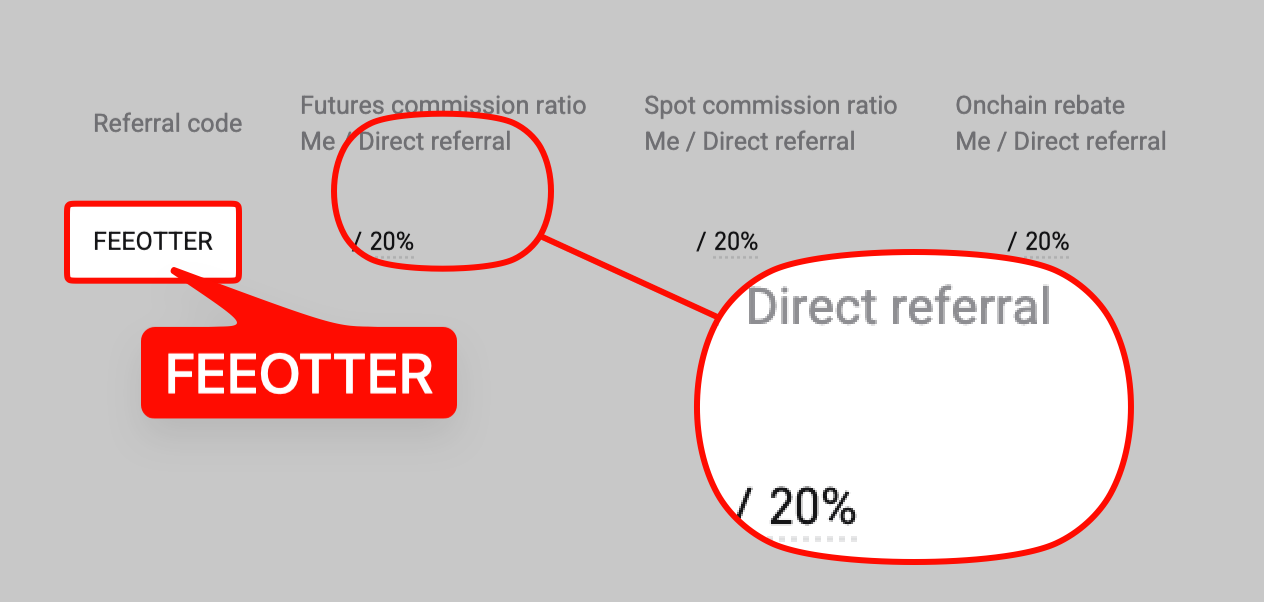
If you want to redeem any time, use Bitget's flexible Simple Earn, which stops accruing as soon as you redeem. Dual Investment locks until settlement and may pay you back in a different coin, and fast redemption on On-chain Earn costs 10% of the yield. Earn itself earns no trading rebate; if you trade on Bitget, binding Fee Otter's code FEEOTTER gets you a 50% futures fee rebate (checked October 2026).
Bitget Earn covers a lot of products: Simple Earn (flexible and fixed), Shark Fin, Dual Investment, On-chain Earn, DeFi Earn, Launchpool, PoolX, plus products tagged VIP. They all sound like "park it and earn interest", but when interest starts, whether you can redeem early and which coin you get back at settlement differ a lot. This guide pulls together the subscription, redemption, yield calculation and payout rules for each one from Bitget's official Earn pages and product FAQs, using the rates shown when we checked on 2026-09-28 as examples. APRs float and can change at any time; the figures here are snapshots from that day, not a forecast and not a guarantee.
If you trade on Bitget, binding our code FEEOTTER through Fee Otter gives you a 50% futures fee rebate, 2.5 times the common 20% code. Earn itself generates no trading fees; how it relates to rebates is covered further down.
Start with the map: does your principal change?
Bitget's Earn hub filters products into "Structured", "Protected", "High-yield" and "VIP". For most people the more useful split is whether the coin and amount you get back at settlement can change:
| Product | Redemption | Payout | Can the settlement coin change? |
|---|---|---|---|
| Simple Earn Flexible | Anytime; interest stops once you submit | Hourly or daily, to Spot account | No, same coin |
| Simple Earn Fixed | Moves to Flexible at maturity; some allow early redemption, interest may be forfeited | Per product page | No, same coin |
| Shark Fin | Fixed term (e.g. 7 days) | At maturity, by formula | No, same coin; APR floats within a range |
| Dual Investment | Locked until settlement | Principal plus interest at settlement | Yes, may convert to the other coin |
| On-chain Earn (PoS) | Standard follows the on-chain unbonding period; express costs 10% of returns | Subscribe D, accrue D+1, paid D+2 | No, same coin |
| DeFi Earn | Per product | Principal auto-compounds; token incentives claimed manually | Principal value can fluctuate |
| Launchpool / PoolX | Unlock anytime | Airdrops hourly | No, locked tokens come back; the airdrop is a new token |
One inconsistency on Bitget's own pages: the Earn hub FAQ lists Dual Investment next to Shark Fin and Smart Trend as structured products, while the Dual Investment page itself says it is a non-principal-guaranteed product. Go by the product page and treat Dual Investment as a product whose principal can change.
Simple Earn: tiered flexible APR and two payout modes
How flexible interest accrues and pays
According to the FAQ on Bitget's Simple Earn page, subscribed funds are deducted from your Spot account and estimated daily interest = subscription amount × APR ÷ 365. There are two payout modes, depending on the product:
- Daily payout: interest starts accruing at 00:00 (UTC+8) the day after you subscribe and is credited to your Spot account one day after the value date.
- Hourly payout: principal starts accruing in the next hour, and that interest is credited the hour after.
Bitget notes that some APRs move with the market, so the daily estimate is for reference only.
Tiered APR: the first 300 USDT earns a different rate
Flexible products often use tiers: the same product applies different APRs to different amount brackets. From the Simple Earn page data on 2026-09-28:
| Coin (flexible) | Amount bracket | APR at check |
|---|---|---|
| USDT | 0 to 300 USDT | 7.79% |
| USDT | Above 300 USDT | 3.13% |
| USDC | 0 to 300 USDC | 6.66% |
| USDC | Above 300 USDC | 2.02% |
| BTC | By bracket | 0.12% to 1.88% |
In money terms: put 1,000 USDT into flexible and assume each bracket is calculated separately. The first 300 USDT earns about 300 × 7.79% ÷ 365 ≈ 0.064 USDT a day and the other 700 USDT about 700 × 3.13% ÷ 365 ≈ 0.060 USDT, around 0.124 USDT a day in total. That works out to roughly 4.5% on the whole amount, not the headline 7.79%. When you read a flexible APR, open the product and check the brackets; the top rate usually only covers a small first slice.
Auto-subscribe and redemption
- Auto-subscribe: when enabled, the available balance in your Spot account is subscribed to Simple Earn Flexible automatically. Bitget's FAQ says this runs daily at 15:00 (UTC+8), while the tip on the subscription page says 03:00 and 15:00 (UTC+8); go by what the page shows. You can turn it off on the subscription page. If you trade spot often, keep in mind that this moves idle spot balance away.
- Redemption: the English FAQ path is Assets > Orders > Earn Orders, then Redeem on the product. Interest stops from the moment you submit.
Fixed term
Fixed products run for a set term and are described as paying more than flexible, with profits paid in the same coin. At maturity your principal moves automatically into Simple Earn Flexible, not straight back to Spot. Some fixed products allow early redemption, but Bitget says early redemption may result in the loss of interest; the product page rules apply. On 2026-09-28 the USDT 7-day fixed product showed 1.30%, lower than the flexible first tier at the same time, so fixed is not always higher. Compare product by product.
Shark Fin: in range, settlement price decides; out of range, base APR
Shark Fin is a structured product combining fixed income and derivatives. You put in one coin, get the same coin back at maturity plus a return that floats within a range. The formula on Bitget's Shark Fin page:
- Price stays inside the range for the whole observation period: APR = min APR + (settlement price − lower limit) ÷ (upper limit − lower limit) × (max APR − min APR); returns = amount × APR ÷ 365 × term. The closer settlement is to the upper limit, the higher the APR.
- Price ever falls below the lower limit or above the upper limit: settles at the base APR.
The APR range updates hourly before accrual starts and is fixed once it does. On 2026-09-28 the listed series ran from 2026-09-28 to 2026-10-05 (7 days): 2.20% to 7.00% for USDT, 0.60% to 7.00% for BTC, plus Bullish BTC and Bullish ETH versions.
Using that series, 1,000 USDT for 7 days:
- Stayed in range, settled at the lower limit: minimum 2.20%, 1,000 × 2.20% ÷ 365 × 7 ≈ 0.42 USDT.
- Stayed in range, settled exactly mid-range: APR = 2.20% + 0.5 × (7.00% − 2.20%) = 4.60%, about 0.88 USDT.
- Stayed in range, settled near the upper limit: close to 7.00%, about 1.34 USDT.
- Price left the range at any point: settles at the base APR shown on the product page, so check that figure before subscribing.
Bitget also warns that extreme volatility can cause slippage that lowers the final return. With auto-renewal on, principal rolls into the same product at maturity; with it off, principal and interest go to Spot when the current term ends.
Dual Investment: you may be paid in the other coin
This is the product most worth understanding before you click. Per Bitget's Dual Investment page:
- Buy Low: you invest USDT. If the settlement price is at or below the strike, your USDT buys BTC at the strike and you are paid in BTC; if above, you keep USDT and earn USDT interest.
- Sell High: you invest BTC. If settlement is at or above the strike, your BTC is sold for USDT and you are paid in USDT; if below, you keep BTC and earn BTC interest.
- Settlement price: the average market price over the 30 minutes before 16:00 (UTC+8) on the settlement date.
- Lock-up: assets stay locked for the whole term and cannot be unlocked before settlement.
- APR may differ from the display: in volatile markets the displayed APR can differ from the actual order APR; if the gap is beyond a reasonable range, the order is blocked and you are asked to refresh.
A hypothetical to show where the risk sits: 1,000 USDT into a 7-day Buy Low BTC product with an 80,000 USDT strike at an assumed 20% APR earns about 1,000 × 20% ÷ 365 × 7 ≈ 3.84 USDT. If BTC settles at 79,000, you receive about (1,000 + 3.84) ÷ 80,000 ≈ 0.01255 BTC, which means you bought BTC at 80,000 when the market was 79,000. If BTC keeps falling, the paper loss can be far larger than the 3.84 USDT of interest. Bitget's own risk note says price moves can lead to losses from asset devaluation.
In Dual Investment, interest accrues at the subscribed rate whether or not the target is hit. That says nothing about the value of your principal. The product suits people who are already happy to buy or sell at the strike, and it is a poor place to simply park funds.
On-chain Earn and DeFi Earn: unbonding periods and the express fee
From the FAQ on Bitget's On-chain Earn page:
- Timing: subscribe on day D, interest accrues from D+1, paid on D+2.
- APR source: based on on-chain rewards; Bitget charges no extra fees for subscription and redemption. With multiple orders, your share of total on-chain earnings follows your cumulative subscription as a share of the project total.
- Simple vs compound: simple-interest mode credits interest every day and principal returns to Spot after redemption; compound interest must be redeemed to reach Spot, and you can switch compounding on or off anytime.
- Standard redemption: available from D+1; the period matches the on-chain nodes and earns nothing while pending.
- Express redemption: funds reach Spot within 10 minutes, but the platform deducts 10% of the returns as a service fee; there is a daily limit, and anything above it can only be redeemed the next day.
On 2026-09-28 ETH showed 2.23% to 2.90% and SOL 4.36% to 5.66% (tagged as including VIP products).
DeFi Earn allocates assets to on-chain DeFi strategies Bitget has vetted. Principal auto-compounds, and some token incentives must be claimed manually. Bitget states plainly that it is not principal-protected; the main risks are protocol hacks and being unable to redeem during extreme markets because of thin liquidity. At our check, the USDT and USDC DeFi products showed as sold out.
Launchpool and PoolX: lock tokens for new-token airdrops
Launchpool lets you lock BGB or a designated token to receive airdrops of newly listed tokens:
- Identity verification is required; users in Singapore, the United States, Cuba, Iran, Syria, Sudan, Crimea, Donetsk, Luhansk and North Korea are not eligible.
- Bitget runs a newcomer pool and a regular pool based on your participation history, with different staking thresholds; check each event's rules.
- Airdrops are distributed hourly and calculated on a T+1 basis; est. pool APR = total airdrops in the previous hour ÷ total locked tokens in the previous hour × 365 × 24, updated hourly and for reference only.
- You can unlock anytime; at the end of the locking period tokens unlock automatically and reach Spot in about five minutes (or your Earn account if Auto-savings is on).
- Maximum individual lock amounts are set per event; using bots or repeated or automated participation voids the rewards on all related accounts.
PoolX works the same way with different timing and a boost: lock in hour H, the amount is counted at H+1 and rewards are paid at H+2; tokens per hour = (your hourly locked amount ÷ total eligible locked amount) × hourly pool. The long-term holdings boost uses your lowest daily holding of that asset over the past 15 days as the base: boost = min(current staking amount, boost base) × boost multiplier; trading bonuses, loan assets, risk-frozen assets and deposits not yet credited are excluded. On 2026-09-28 neither had an ongoing project.
VIP-only Earn products
The Simple Earn page has a "VIP only" filter, and the Dual Investment page lists a VIP-exclusive daily-settlement product that settles within 24 hours. On 2026-09-28 the VIP USDT flexible product paid 4.00% on 0 to 300,000 USDT and 2.88% above, with 7-day fixed at 3.00% and 14-day at 3.20%. The first-tier rate is lower than the regular flexible product, but it covers a much larger amount, which suits larger balances.
The Earn pages do not state the subscription thresholds for VIP products; Bitget's VIP criteria are in Bitget VIP tiers and fees. If you are already VIP on another exchange or trade in size, contact Fee Otter support: we work directly with the exchange's official team to seek benefits such as a VIP tier trial for you. Actual benefits are decided by the exchange.
 Telegram · @feeotter