Ourbit's latest proof of reserves is the snapshot taken at 00:00 UTC+8 on 1 October 2026: BTC reserve ratio 110.31%, ETH 108.76%, USDT 102.56%, all above 100% (checked 7 October 2026). Ourbit publishes the PoR itself using a Merkle tree, and users can check that their balance is included with an open-source tool; the official page lists no third-party accountant's audit report.
The figures here come from the official data behind the Ourbit proof of reserves page, and the Merkle tree rules come from Ourbit's official GitHub. Each snapshot replaces the last, so the official page has the current numbers.
Key points
- Latest snapshot: 1 October 2026, 00:00 UTC+8. BTC 110.31%, ETH 108.76%, USDT 102.56%.
- Each coin stands alone: Ourbit states that one asset cannot offset a shortfall in another.
- Spot, futures and wallet accounts are covered; assets in earn products are excluded.
- Self-published and user-verifiable: a Merkle tree and an open-source verifier, with no third-party audit report listed.
- Regulation: PoR is a transparency measure the platform publishes itself. It is not regulatory oversight.
The latest snapshot: 1 October 2026
Reserve ratio = the amount of a coin held in Ourbit's wallets ÷ users' balances of that coin on Ourbit. Official data, checked 2026-10-07:
| Coin | User assets | Ourbit wallet assets | Reserve ratio |
|---|---|---|---|
| BTC | about 679.54 BTC | about 749.63 BTC | 110.31% |
| ETH | about 5,362.29 ETH | about 5,832.55 ETH | 108.76% |
| USDT | about 22.70 million | about 23.28 million | 102.56% |
Two things to keep in mind when reading it:
- No USDC figure this time: the official page says PoR supports USDT, USDC, BTC and ETH, but this snapshot's reserve ratio data only covers BTC, ETH and USDT.
- It is a small book: about 680 BTC and 22.7 million USDT in user assets, far below the tens of thousands of BTC at the largest exchanges. A ratio above 100% tells you whether reserves cover balances, not how big the platform is.
A PoR shows that, at the moment of the snapshot, the platform held at least as much as its users' balances. It does not reflect anything that happens after the snapshot.
Coverage: which accounts and which chains
The official page lists spot accounts, futures accounts and wallet holdings as included, and states that the 1:1 reserve excludes assets reserved in financial products. Where the reserve wallets sit, from the official data:
| Coin | Chains holding reserves |
|---|---|
| BTC | Bitcoin, BNB Smart Chain (BEP20) |
| ETH | Ethereum, BNB Smart Chain, Arbitrum One, Optimism, Base, Linea, Robinhood |
| USDT | Tron, Ethereum, BNB Smart Chain, Solana, Arbitrum One, Optimism, Polygon, Avalanche C-Chain, Plasma, opBNB, TON, Aptos |
The "Ourbit wallet details" view lists every address with its chain, amount and block height; on 2026-10-07 there were 28 addresses, which you can look up on a block explorer. Those amounts update live, so they will not match the snapshot exactly (when we checked, the BTC wallets held about 733.6 BTC against 749.63 BTC at the snapshot).
How Ourbit builds its Merkle tree
From the official GitHub README:
- Leaf nodes: one per user. Hash = SHA-256 of (ProofId, UID, balance string), first 32 characters. ProofId is "PR-" plus the snapshot date (for example PR-2025-03-15); the balance string lists the user's amount of each coin, with spot and futures amounts of the same coin added together.
- Parent nodes: SHA-256 of the two child hashes plus their summed balances, repeated level by level.
- Padding nodes: if a node has no sibling, the system adds one with the same hash and zero balances so the tree is a complete binary tree.
- Root: the result is a single Merkle root. Changing any user's UID or balance changes the root.
So if you hash your way up from your own leaf and get the same root Ourbit published, your balance was included in that snapshot.
How to verify it yourself
Option 1: "View My Proof of Assets" on the official page
Log in, open the proof of reserves page and click View My Proof of Assets to see your entry in the snapshot; the page also has a Hash ID lookup. It is the easiest route, but the result is still displayed by the platform.
Option 2: run the official verifier offline
From the OurbitOfficial/merkle_validate README:
- Download the verifier for your operating system from the Ourbit platform (Linux amd64 or arm64, macOS, Windows; the README lists v1.0.2).
- Unzip it to a folder, for example
~/Downloads/proof-of-reserves-*. - Download your Merkle path file for the snapshot,
merkel_tree_ourbit.json, and replace the file of the same name in that folder. - Run
sh start.sh(on Windows, openstart.bat). - "Consistent with the Merkle tree root hash. The verification succeeds" means it passed; "Inconsistent" means it failed.
To build from source, the README asks for Java 11 and Maven 3.8.4 or later: run mvn clean install, then start it with java -jar proof-of-reserves.jar. You can also write your own check from the hashing rules above.
Verification only tells you that your balance is in this snapshot's tree. Whether the reserves really sit on-chain is a separate check: look up the published wallet addresses on a block explorer.
Security audits and bug bounty
From Ourbit's blog post Is Ourbit Safe?:
- Hacken: carried out a penetration test and security audit of Ourbit. The post gives no completion date or scope.
- SlowMist: described as a partnership on threat intelligence and incident response, not a one-off audit.
- Bug bounty: runs on BugEx, with rewards of up to 20,000 USD per vulnerability.
- Other measures: most assets in cold storage, two-factor authentication and anti-phishing codes.
Hacken and SlowMist are security engagements, not third-party audits of the PoR. As of 2026-10-07, neither the reserves page nor the GitHub README lists an accountant's or auditor's review of the PoR, and the liabilities side (user assets) is counted by the platform itself.
What PoR can and cannot show
These limits apply to any exchange that uses a Merkle tree PoR.
It can show
- How much the platform's on-chain addresses held at the snapshot time.
- That your balance was counted in total user assets.
- Whether reserves of each coin were at least equal to users' balances of that coin.
It cannot show
- What happened after the snapshot: flows between snapshots are invisible.
- All liabilities: other platform debts, such as loans, are outside the PoR.
- Whether assets are pledged or lent out: holdings are visible on-chain; commitments against them are not.
- Coins not listed: anything beyond BTC, ETH and USDT has no reserve ratio in this snapshot.
PoR and regulation
Ourbit is operated by Ourbit Holdings Ltd., incorporated in the British Virgin Islands (user agreement), and holds no licence from a major financial regulator. PoR and regulation are separate questions; for licences by country, see our exchange licences compared page. Ourbit suits funds you are actively trading; move long-term or large holdings to a cold wallet you control.
What this means for your rebate
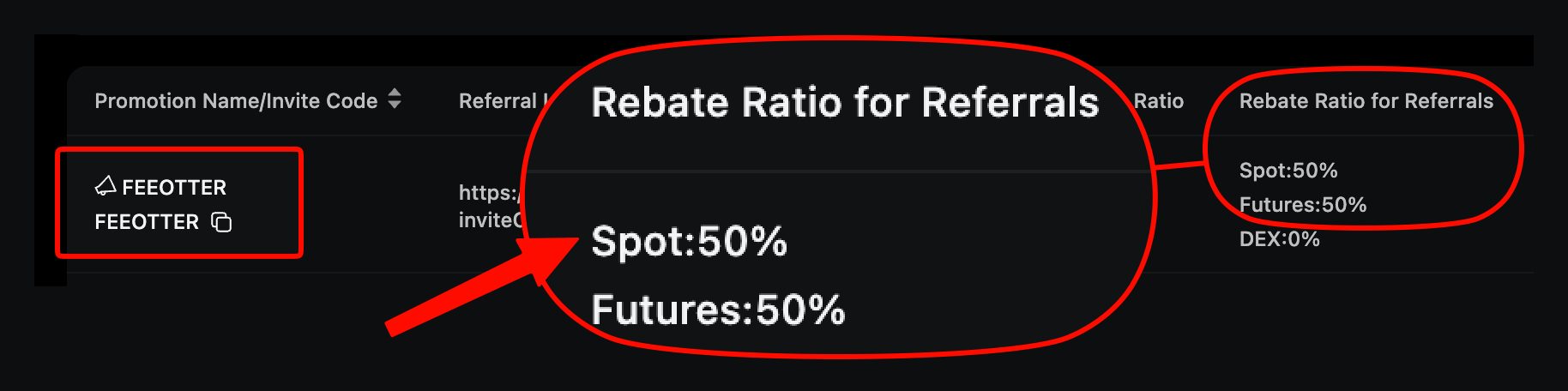
Binding a rebate only needs your UID, so the rebate platform never touches your account or assets, and the reserve and security risks are the same either way. See is a crypto fee rebate safe. Sign up on Ourbit with referral code FEEOTTER and Ourbit returns 50% of your fees automatically; bind your UID and Fee Otter adds 20%, a 70% futures rebate in total, 3.5 times the common 20% code. On 200 USDT of futures fees a month, a common 20% code returns 40 USDT; ours returns 140 USDT. If you are already a VIP on an exchange and want to rebind or sign up elsewhere, contact our support; we can help apply for special trading benefits or a higher rebate rate. The numbers are in the Ourbit fee rebate guide.
FAQ
What is Ourbit's latest reserve ratio?
As of 2026-10-07, the latest snapshot is 00:00 UTC+8 on 1 October 2026: BTC 110.31%, ETH 108.76%, USDT 102.56%.
Is Ourbit's PoR audited by a third party?
The reserves page and the GitHub README list no third-party auditor. Ourbit publishes the Merkle tree and reserve figures, and users verify them with the open-source tool. Hacken and SlowMist work on security, not on PoR attestation.
Are coins in earn products included?
No. Ourbit states the 1:1 reserve excludes assets in financial products; spot, futures and wallet accounts are covered.
How do I confirm my balance is included?
Log in and use View My Proof of Assets on the reserves page, or download your Merkle path file and run the official open-source verifier to compare the root hash.
Does a ratio above 100% mean the exchange is safe?
It only means that at the snapshot, reserves of those coins covered user balances. Later changes, other liabilities, and operational or security risk are outside what PoR can show.
Further reading
Reserve figures are taken from the official data on Ourbit's proof of reserves page and the Merkle tree rules from Ourbit's official GitHub, checked 2026-10-07. Figures change with each snapshot; the official pages prevail. This is information only, not an assessment of any exchange's safety or investment advice. Rebate rates are set by the exchanges and may change; see Fee Otter rebate rate data.
Data verified: 2026-10-07