MEXC's latest proof of reserves, published on October 16, 2026, gives reserve ratios of BTC 294%, USDT 122%, USDC 115% and ETH 111%. All four are above 100%, and the auditor is the blockchain security firm Hacken. In the previous report (snapshot of 2026-09-10), MEXC's wallets held 12,202.13 BTC against 4,106.57 BTC owed to users. Logged-in users can check on the proof of reserves page that their own balance was counted (checked 2026-10-17).
Proof of reserves (PoR) answers one question: does the exchange hold enough coins in its wallets to cover what it owes users on its books? Using MEXC's proof of reserves page, help center, official blog and press releases, this article sets out the last two reports, works out the surplus in coins, explains how the Merkle tree lets you verify your own balance, adds the size of the insurance fund and the Guardian Fund, and lists what PoR can't prove.
Key points
- October 2026 report: BTC 294%, USDT 122%, USDC 115%, ETH 111%, audited by Hacken. The press release gives no snapshot date and no coin amounts.
- September 2026 report (snapshot 2026-09-10): BTC 297%, USDT 119%, USDC 111%, ETH 111%, with wallet and user amounts for each coin.
- Coins covered: the help center says the audit covers the USDT, USDC, BTC and ETH wallets.
- Monthly: MEXC's blog says the report is updated every month, and Hacken audits each one.
- Self-verification: check the published wallet addresses on a block explorer, and use the Merkle tree to confirm your balance is in the user total.
Reserve ratios in the last two reports
| Coin | September 2026 report (09-10 snapshot) | October 2026 report |
|---|---|---|
| BTC | 297% | 294% |
| USDT | 119% | 122% |
| USDC | 111% | 115% |
| ETH | 111% | 111% |
Sources: MEXC October 2026 PoR press release (2026-10-16) and MEXC September 2026 PoR press release (2026-09-15), checked 2026-10-17. The September release also says the BTC ratio rose from 288% in August to 297%.
The official proof of reserves page states that "MEXC maintains a 1:1 reserve of all user assets". The per-coin figures and the audit report sit behind the "My Proof of Reserves" and "Audit Report" buttons, which need a login and load in the browser. We couldn't read them directly this time, so the table uses MEXC's own press releases.
The September snapshot in coins: how big is the surplus?
| Coin | MEXC wallet assets | User assets | Reserve ratio | Wallet − user (our calculation) |
|---|---|---|---|---|
| BTC | 12,202.13 | 4,106.57 | 297% | About 8,095.56 BTC |
| USDT | 1,818,202,910.24 | 1,526,526,878.38 | 119% | About 291.7 million USDT |
| USDC | 299,925,929.77 | 269,894,125.25 | 111% | About 30.0 million USDC |
| ETH | 58,917.60 | 53,243.98 | 111% | About 5,673.62 ETH |
Wallet and user amounts come from MEXC's September release (2026-09-10 snapshot; full text of the release). The last column is our subtraction. Reserve ratio = wallet assets ÷ user assets, and all four ratios match what MEXC published. A ratio above 100% means that at the moment of the snapshot, MEXC's wallets held more of that coin than users had on its books.
BTC at 297% stands well above the other three: users had about 4,107 BTC on the books, while the wallets held about 12,202 BTC. Neither the release nor the official page says who owns the extra BTC or where it came from, so it shouldn't be read as "the exchange has lots of its own money". The stablecoins are the more useful figure: users held about 1.527 billion USDT and the wallets held about 291.7 million more. That was the buffer at the snapshot, not every day afterwards.
From one user's side: say you held 1,000 USDT on MEXC on the snapshot day. The Merkle check confirms those 1,000 USDT were counted in the 1.527 billion USDT of user assets. On the wallet side, the public addresses let you confirm that MEXC really held 1.818 billion USDT. You've read a PoR properly only when both sides check out.
What Hacken audited
Both the September and October releases say Hacken's review covered proof of liabilities, proof of ownership, the reserve calculation and an overall PoR assessment, and found reserves above 1:1 for every asset in scope. The Hacken report page linked in the release (October) blocked our reader with a browser check, so for the snapshot time and method details inside the report, rely on Hacken's page.
Keep in mind that Hacken is a blockchain security firm. Its audit covers the proof of reserves itself; it isn't an accounting firm's opinion on the company's financial statements.
How to verify it yourself
Method 1: check the wallet balances on-chain
- Open the MEXC proof of reserves page and find the published wallet addresses for each coin.
- Check the balances on a block explorer, for example Etherscan for ETH and ERC20 tokens and a BTC explorer for Bitcoin.
- Add up the balances and compare them with the user total MEXC reports.
Method 2: confirm your balance with the Merkle tree
- Log in to MEXC and open "My Proof of Reserves" on the proof of reserves page.
- Find the latest Merkle root and the verification tool, pick the snapshot, click "Details", then "Verify Now", and follow the on-screen steps.
- The tool builds a verification path showing how your hashed balance leads up to the published root. If it matches, your assets were counted in total user assets.
Steps are compiled from MEXC's official blog on PoR (2025-12-05) and the help center article What is Proof of Reserves?. Button names after login may change between versions. You are verifying your balance at the snapshot; anything deposited afterwards shows up only in the next report.
MEXC's own materials give different start dates for PoR: the blog says December 2022, the press releases say it launched in February 2023. Both are listed here.
The insurance fund and the Guardian Fund
- Futures insurance fund: covers losses beyond a user's margin after liquidation. The September release put it at about 798 million USDT at the time of writing; the October release gives no new figure.
- Guardian Fund: meant to protect users hit by serious security incidents such as large-scale exploits. The October release says MEXC added 1,000 BTC in September, the fund now holds over 100 million USDT and 2,000 BTC, and the target is 500 million US dollars within two years. Official page: Proof of Trust.
These funds are separate from the reserve ratio. The ratio compares wallets with user assets; the funds are extra money set aside for liquidation shortfalls and security incidents.
What PoR proves and what it doesn't
What it proves
- At the snapshot, MEXC's wallets held more BTC, ETH, USDT and USDC than users had on its books.
- Your own balance was included in total user assets (once you check it with the Merkle data).
What it doesn't
- Anything after the snapshot: balances change daily, and PoR is a picture of one moment.
- Assets beyond the four coins: other tokens you hold on MEXC aren't in these ratios.
- Off-chain liabilities: the help center notes that PoR generally can't account for off-chain liabilities such as fiat deposits, loans or other financial commitments.
- The exchange's overall finances: PoR isn't a financial statement and leaves out MEXC's own operations and other debts.
Service regions
The "Prohibited Jurisdiction" clause in MEXC's User Agreement (updated 2026-10-13) lists North Korea, Cuba, Sudan, Iran, Mainland China, Singapore, Malaysia, the United States, the United Kingdom, Hong Kong, Kazakhstan, the Russian-controlled regions of Ukraine (currently Crimea, Donetsk, Luhansk, Zaporizhzhia, Kherson and Sevastopol), Canada, and countries under comprehensive EU or US OFAC sanctions or on FATF's "call for action" list. The list is "non-exclusive and is subject to change". If you live in one of these places you can't use MEXC, however good the PoR looks. For licence status by country, see exchange licences compared.
Risks
Proof of reserves is a transparency tool the exchange publishes and users verify. It isn't a licence, regulatory oversight or deposit insurance. Whatever happens between snapshots, such as a wallet hack or misused funds, PoR can't show in advance. Assets you aren't trading are safer in your own wallet; keep only working funds on the exchange and turn on Google Authenticator and a withdrawal whitelist.
For PoR frequency, coins and auditors across exchanges, see proof of reserves compared. For MEXC's deposit and withdrawal rules, see MEXC deposits and withdrawals.
PoR and your rebate
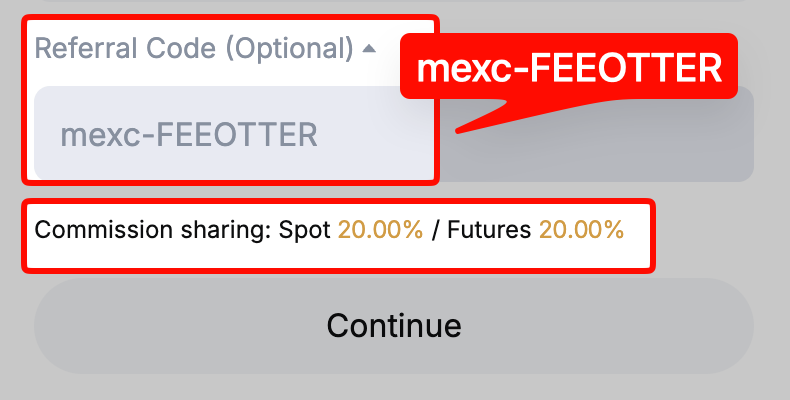
Proof of reserves has nothing to do with rebates; the rebate depends on the referral code you sign up with. Register on MEXC with our code mexc-FEEOTTER (keep the mexc- prefix) and the fee rebate is 60% (20% automatic exchange rebate + 40% extra rebate), spot and futures alike, 3× a common 20% code. MEXC pays the 20% straight into your account. Fee Otter settles the other 40% daily and pays it out on request as USDT on BEP20, minimum 1 USDT per request, with the 0.015 USDT network fee paid by you. The rebate covers trading fees only, not funding or liquidations, and MEXC's affiliate terms say trades placed through the API don't count toward commission, so API trades earn no rebate. On 500 USDT of monthly fees from manual trading, a common 20% code returns 100 USDT and ours returns 300 USDT. See MEXC referral code and MEXC fee rebate guide.
 Telegram · @feeotter